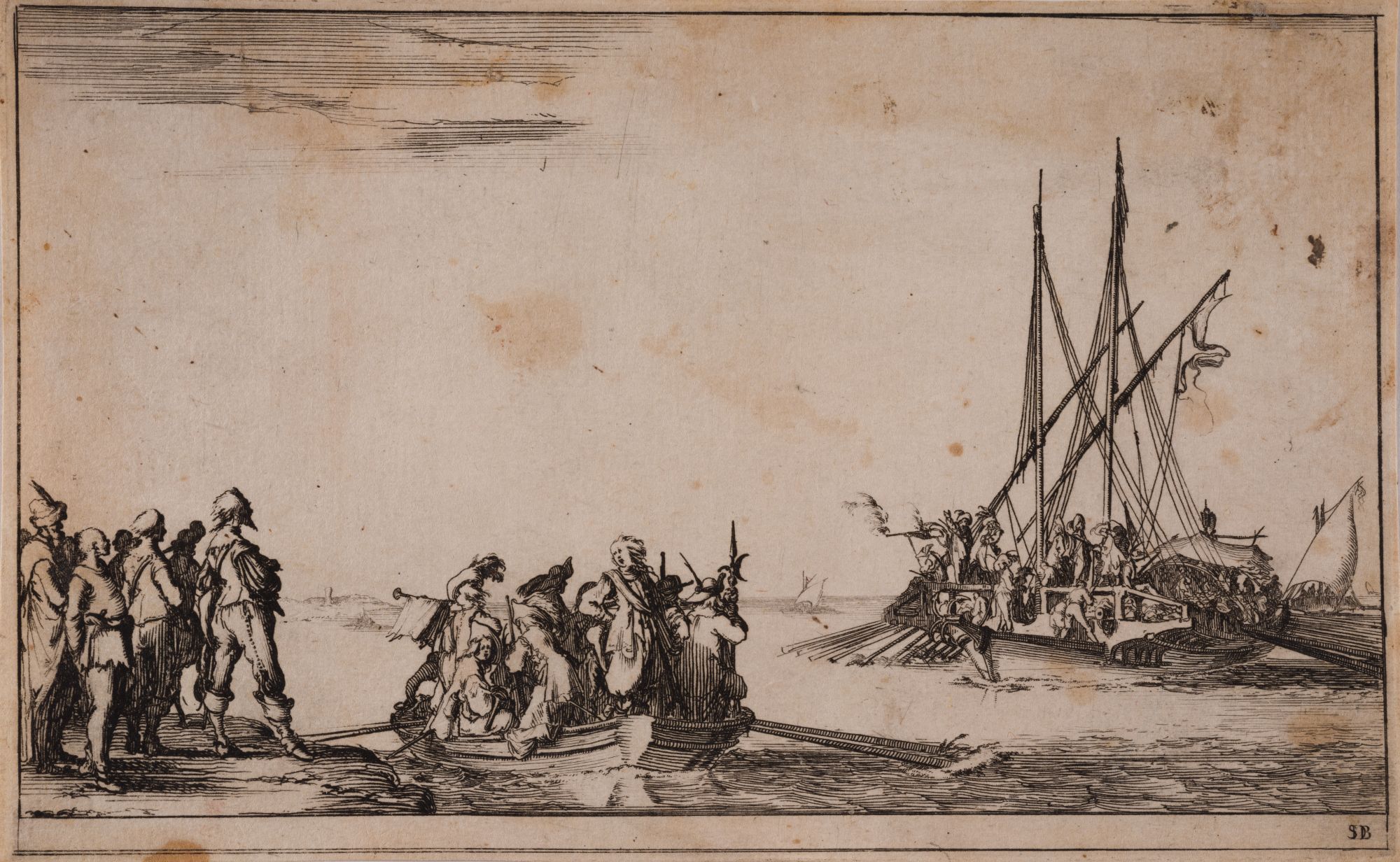
Passengers Embarking on Boat Heading Towards Galley. From the "Various Landscapes" Series or the "Set of Eight Nautical Landscapes" (Suite de huit Marines) Series
Stefano della Bella
Basic information
- ID
- Г-IV-940
- Author
- Stefano della Bella
- Name
- Passengers Embarking on Boat Heading Towards Galley. From the "Various Landscapes" Series or the "Set of Eight Nautical Landscapes" (Suite de huit Marines) Series
- Country
- Italy
- Technique
- etching
- Material
- paper
- Dimensions
- 12.7 x 20.5 cm (height x width)
Additionally
- Type
- graphic art
- Genre
- marine painting
- Provenance
- Received from the Lviv Historical Museum, 1954
Information about author
Object description
The work, inspired by views of the port of Livorno, is dedicated to maritime voyages and the daily life of a port city. The composition consists of three scenes arranged as the planes recede from left to right. In the foreground on the left, figures stand seeing off a longboat carrying passengers – soldiers and sailors. They are heading towards the sailing vessel on the right. Among the people on the shore, a man in the costume of a European aristocrat with a pointed beard stands out. He positions himself in front, looking towards the boats. On the right, a two-masted vessel with furled sails, yards with flags, and oars is depicted, already filled with people. In the background on the right and in the centre, vessels with hoisted sails are visible.
Despite the small size of the print, the artist masterfully renders the minute figures of people, elements of ship rigging, and waves. The clear division into planes creates a sense of space and depth within the seascape.
Despite the small size of the print, the artist masterfully renders the minute figures of people, elements of ship rigging, and waves. The clear division into planes creates a sense of space and depth within the seascape.
Inscriptions
At the bottom right, between the image and the border, the artist's monogram is engraved: "SDB". On the backing cardboard on the left beneath the sheet, a sticker with the stamp of the Lviv Historical Museum and the former print inventory number in ink: "Г-4691/42", and above it in pencil, the current gallery collection inventory number: "№ Г-IV-940/ ЛДКГ". Pencil marks on the backing cardboard on the left near the corner of the print sheet at the bottom: "73", "2657", on the right: "149".
Legal regulation
Borys Voznytskyi Lviv National Art Gallery