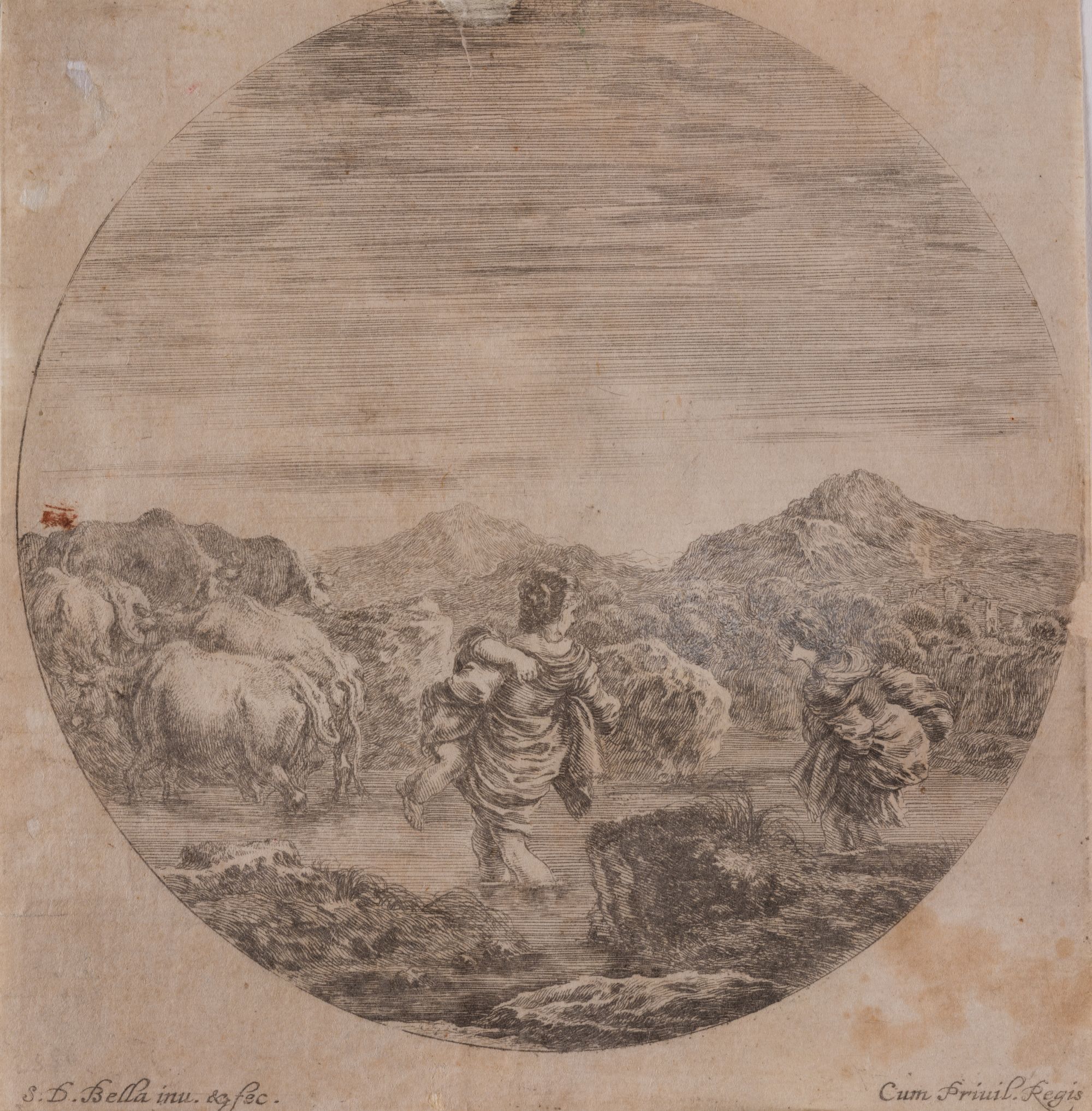
Two Peasant Women and a Herd of Cattle Crossing a River. From the "Six Animal Subjects" Series
Stefano della Bella
Basic information
- ID
- Г-IV-945
- Author
- Stefano della Bella
- Name
- Two Peasant Women and a Herd of Cattle Crossing a River. From the "Six Animal Subjects" Series
- Country
- France
- Technique
- etching
- Material
- paper
- Dimensions
- 14.2 x 14 cm (height x width)
Additionally
- Type
- graphic art
- Genre
- genre art
- Provenance
- Received from the Lviv Historical Museum, 1954
Information about author
Object description
The composition of the work is inscribed within a tondo on a rectangular sheet. It presents a pastoral scene typical of the seventeenth century – the crossing of livestock through a shallow mountain stream. In the foreground, amidst the current, two peasant women in traditional attire are depicted wading across the river. One of the women, turned with her back to the viewer, firmly holds a child in her arms. To her right walks a second peasant woman with a load upon her shoulders. To the left and ahead of them, a small herd moves. The artist highlights two cows standing in the water in close-up with anatomical precision, while other animals of the herd are visible slightly further in the background. The action unfolds against the backdrop of a wild, rugged landscape. Behind them rise hills and rocky mountains covered with sparse vegetation and shrubs. The open sky occupies the upper half of the circle, creating a sense of space.
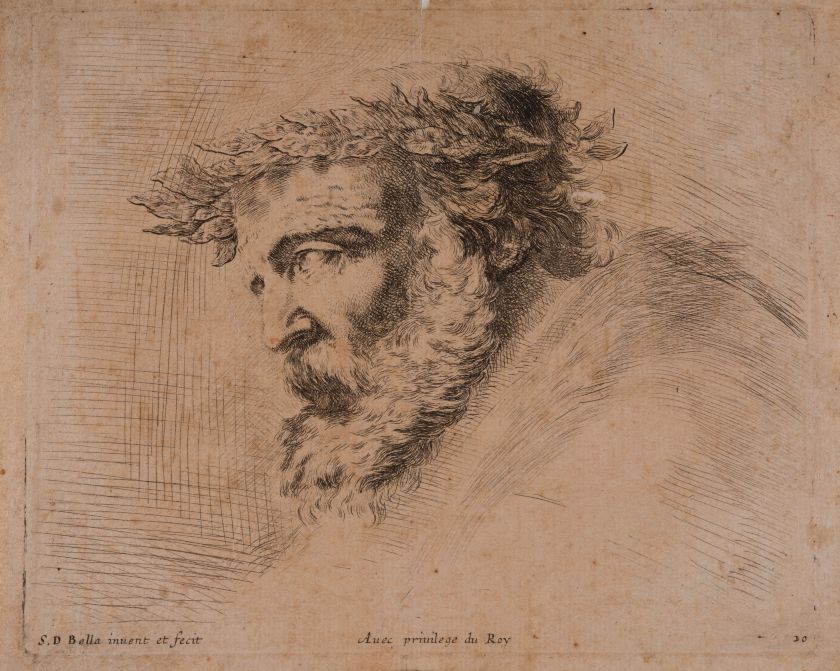
Through fine hatching of varying density, the master virtuously conveys the shimmering and fluidity of the river water, the texture of the animals' bodies, the heavy folds of the peasants' garments, and the aerial perspective where distant mountains gently dissolve into the horizon. The engraving was created during the artist's stay in Paris, as evidenced by the mark of the Royal Privilege at the bottom.
Through fine hatching of varying density, the master virtuously conveys the shimmering and fluidity of the river water, the texture of the animals' bodies, the heavy folds of the peasants' garments, and the aerial perspective where distant mountains gently dissolve into the horizon. The engraving was created during the artist's stay in Paris, as evidenced by the mark of the Royal Privilege at the bottom.
Inscriptions
At the bottom left on the sheet, the artist's inscription is engraved: "S. D. Bella іn. et feс.", on the right: "Cum Priuil. Reg." (by Royal Privilege). On the backing cardboard at the bottom left in pencil: "104", in the centre, the gallery inventory number: "№ Г-IV-945", on the right: "39", "61".
Legal regulation
Borys Voznytskyi Lviv National Art Gallery