Polish Cavalier. From the "Moorish, Polish, and Hungarian Riders" Series
Stefano della Bella
Basic information
- ID
- Г-IV-974
- Author
- Stefano della Bella
- Name
- Polish Cavalier. From the "Moorish, Polish, and Hungarian Riders" Series
- Country
- France
- Technique
- etching
- Material
- paper
- Dimensions
- 18.7 x 18.3 cm (height x width)
Additionally
- Type
- graphic art
- Genre
- battle painting
- Provenance
- Received from the Lviv Historical Museum, 1954
Information about author
Object description
The artist's interest in depicting exotic warriors arose as early as 1633, when he witnessed and recorded the magnificent procession of the Polish ambassador. Later, while in France, the master recreated these cavalrymen across eleven tondi of a military series. These prints are highly valued by historians for their extraordinary precision in rendering the details of military attire, harness, equine anatomy, and weaponry – including karabela sabres, bows, and shields.
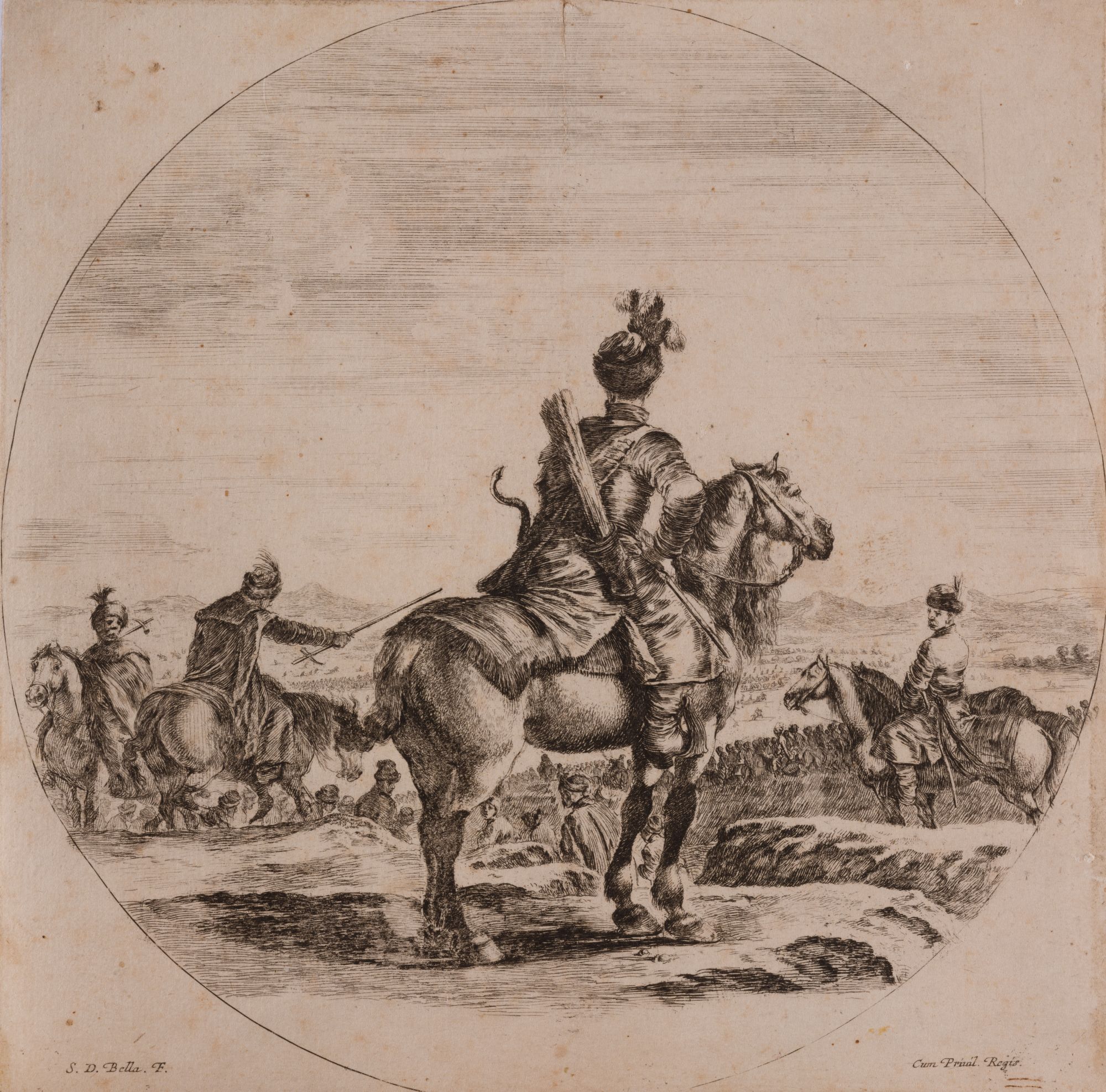
The artwork is rendered in the form of a tondo inscribed within a rectangular sheet. In the very centre, upon a small rocky elevation, a Polish rider stands with his back to the viewer. This is likely a Lisowczyk – a representative of the seventeenth-century light cavalry. His horse, turned to the right, displays a muscular torso and a flowing, windblown mane. Suspended behind the rider's back are a bow and a quiver with arrows. The warrior's head is adorned with a traditional fur hat with a feather. Around the central figure, a dynamic panorama of a military camp unfolds. On the left, a cavalryman is depicted pointing forward with a whip. Another horseman beside him is facing the viewer. To the right, in the middle ground, yet another warrior is presented on horseback in profile. On the horizon, the silhouettes of hills and a cloudy sky are indicated with delicate strokes.
The work is executed using the pure etching technique. The master employs fine cross-hatching to reproduce volumes, the horse's musculature, the texture of fabrics and fur, and the rugged surface of the rocky ground.
Inscriptions
Beneath the image on the bottom left of the sheet, the artist's signature is engraved: "S.D. Bella. F.", on the right: "Cum Priuil. Regis" – [With the King's privilege]. Pencil marks on the backing cardboard indicate the gallery inventory number "Г-IV-974/ЛДКГ" and the number "50".
Legal regulation
Borys Voznytskyi Lviv National Art Gallery