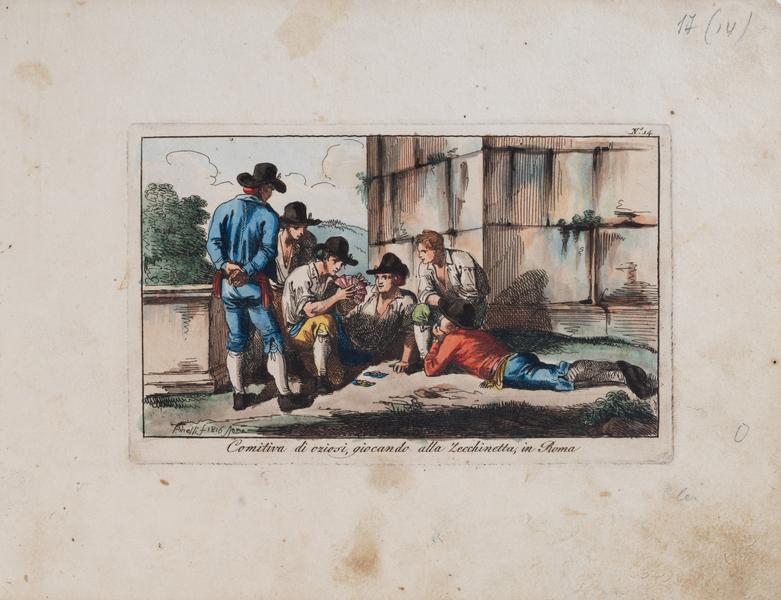
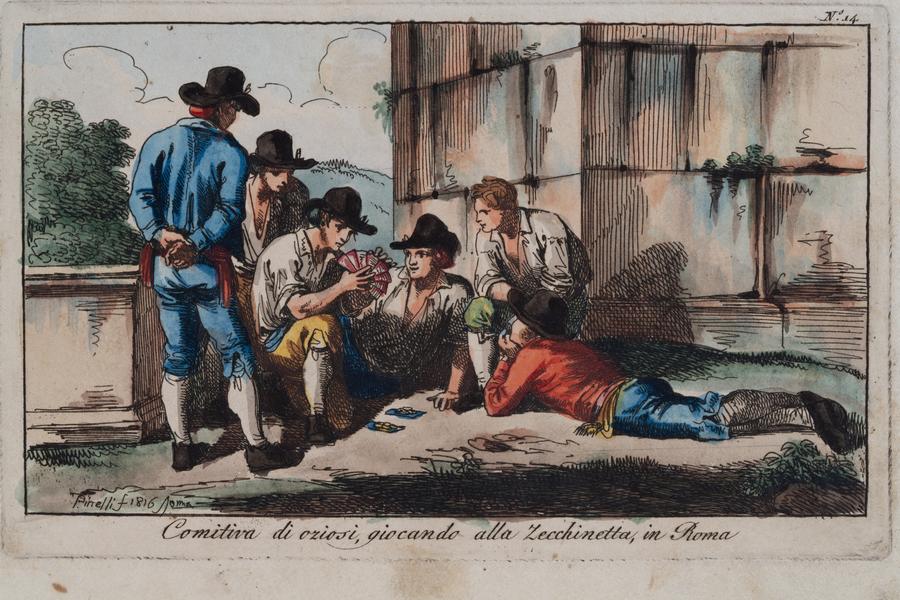
Group of Idlers Playing Zecchinetta in Rome
Bartolomeo Pinelli


Basic information
- ID
- Г-IV-1713
- Author
- Bartolomeo Pinelli
- Name
- Group of Idlers Playing Zecchinetta in Rome
- Date of creation
- 1816
- Technique
- etching watercolour
- Material
- paper
- Dimensions (height x width, cm)
- 9.9 x 16
Additionally
- Type
- graphic art
- Genre
- genre art
- Provenance
- Collection of Faina Tarashchanska (Lviv), 1966
Information about author
Object description
In the first version of the composition Comitiva di oziosi, giocando alla Zecchinetta, in Roma, which Bartolomeo Pinelli performed for the album Raccolta di Cinquanta Costumi Pittoreschi (Collection of Fifty Picturesque Costumes) published in 1809, the author paid special attention to the architectural background (the main thing for the artist was that the event took place in Rome). The players and spectators were depicted sitting and standing with their backs or sides turned to the viewers; without a caption text, it was unclear what they were doing. In the simplified version (without the Roman architectural background) presented in the Lviv collection, the main attention is paid to the players and the deck of cards. This etching painted with watercolours has been known since 1816. It was issued in the album Nuova Raccolta di Cinquanta Costumi Pittoreschi incisi di acqua forte (New Collection of Fifty Picturesque Costumes), published in Rome in 1817. This composition is from a series of Roman entertainments. In front of the brick wall are six young men captured by playing zecchinetta. The central character opened the deck of cards in a semicircle. The other characters sit, stand, and lie beside each other, looking intently at the deck of cards accentuated by pink stripes on a grey background. The composition is dynamic; the drawing is light and relaxed. The engraving is painted with watercolours, with prevailing dimmed grey, ocher, black, and accents of bright red, blue, green, and yellow.
Zecchinetta (Italian: zecchinetta, French: lansquenet, German: landsknecht) is a card game played in Italy since the 16th century. The name comes from the Italianized form of "landsknechts", the military mercenaries who popularized gambling in the 17th century during the Thirty Years' War.
Zecchinetta (Italian: zecchinetta, French: lansquenet, German: landsknecht) is a card game played in Italy since the 16th century. The name comes from the Italianized form of "landsknechts", the military mercenaries who popularized gambling in the 17th century during the Thirty Years' War.
Inscriptions
In the lower left corner, there is the painter's signature Pinelli f. [fecit], the date 1816, and the place of painting – Rome. In the centre of the engraving, under the image, is the work's title Comitiva di oziosi, giocando alla Zecchinetta, in Roma. The number "14" is in the upper right corner of the engraving above the plate.
Legal regulation
Borys Voznytskyi Lviv National Art Gallery