Руїни римської святині
невідомий


Основна інформація
- ID
- Ж-3423
- Автор
- невідомий
- Назва
- Руїни римської святині
- Дата створення
- XVIII ст.
- Техніка
- олійний живопис
- Матеріал
- полотно олія
- Розміри (висота x ширина, см)
- 30.8 x 24
Додатково
- Вид
- живопис
- Жанр
- архітектурний пейзаж
- Сюжет
- Архітектура
- Провенанс
- Львівський історичний музей
- Експозиція
- Палац Потоцьких
Інформація про автора
Опис роботи
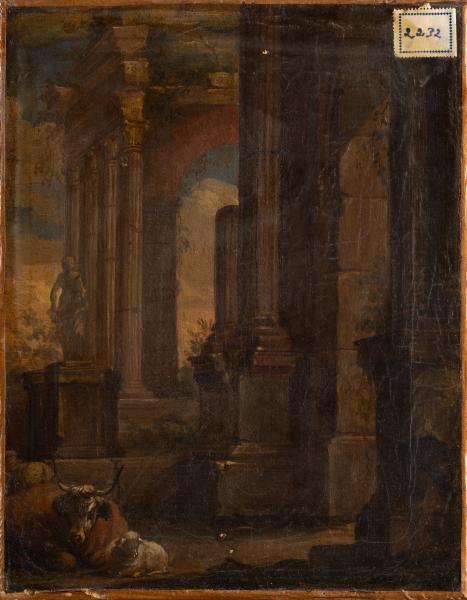
Архітектурний пейзаж невідомого майстра репрезентує надзвичайно популярний у XVII–XVIII століттях живописний жанр капріччо. Це вишукана архітектурна фантазія, у якій величні античні руїни поетизуються й гармонійно поєднуються з пасторальними мотивами.
Розквіт капріччо (італ. capriccio – примха, каприз) припав на XVIII століття. У цьому напрямі працювала ціла плеяда видатних європейських художників, серед яких Франческо Цуккареллі, Джованні Паоло Паніні, Каналетто, Антоніо Джолі, Жан Лемер, Паоло Анезі, Вівіано Кодацці, Дженнаро Греко, Хендрік Франс ван Лінт, Гюбер Робер та Франческо Гварді.
Композицію твору побудовано на грі масштабів і глибокій перспективі. Колорит картини витримано в теплій, майже монохромній гамі із переважанням відтінків вохри, теракоти та коричневого.
Більшу частину полотна займають монументальні залишки давньоримської споруди – масивні колони та фрагменти зруйнованих стін. Подекуди вони поросли травою й чагарниками, символізуючи невблаганність часу та байдужість природи до колишньої людської величі. Ліворуч, у глибині простору, на високому постаменті постає антична статуя – жіноча постать із глечиком. Тлом для композиції слугує вечірнє небо з легкими білими хмарами.
У лівому нижньому кутку зображено стафаж – фігури свійських тварин. На землі мирно відпочивають віл та вівця. Їхня присутність серед руїн колишнього величного храму створює характерний для капріччо контраст між величним минулим і буденним теперішнім.
Розквіт капріччо (італ. capriccio – примха, каприз) припав на XVIII століття. У цьому напрямі працювала ціла плеяда видатних європейських художників, серед яких Франческо Цуккареллі, Джованні Паоло Паніні, Каналетто, Антоніо Джолі, Жан Лемер, Паоло Анезі, Вівіано Кодацці, Дженнаро Греко, Хендрік Франс ван Лінт, Гюбер Робер та Франческо Гварді.
Композицію твору побудовано на грі масштабів і глибокій перспективі. Колорит картини витримано в теплій, майже монохромній гамі із переважанням відтінків вохри, теракоти та коричневого.
Більшу частину полотна займають монументальні залишки давньоримської споруди – масивні колони та фрагменти зруйнованих стін. Подекуди вони поросли травою й чагарниками, символізуючи невблаганність часу та байдужість природи до колишньої людської величі. Ліворуч, у глибині простору, на високому постаменті постає антична статуя – жіноча постать із глечиком. Тлом для композиції слугує вечірнє небо з легкими білими хмарами.
У лівому нижньому кутку зображено стафаж – фігури свійських тварин. На землі мирно відпочивають віл та вівця. Їхня присутність серед руїн колишнього величного храму створює характерний для капріччо контраст між величним минулим і буденним теперішнім.
Правове регулювання
Львівська національна галерея мистецтв імені Б.Г. Возницького