Cupid and Psyche
unknown


Basic information
Additionally
- Type
- sculpture
- Genre
- mythological painting
- Provenance
- Collection of Leon Pininski
Information about author
Object description
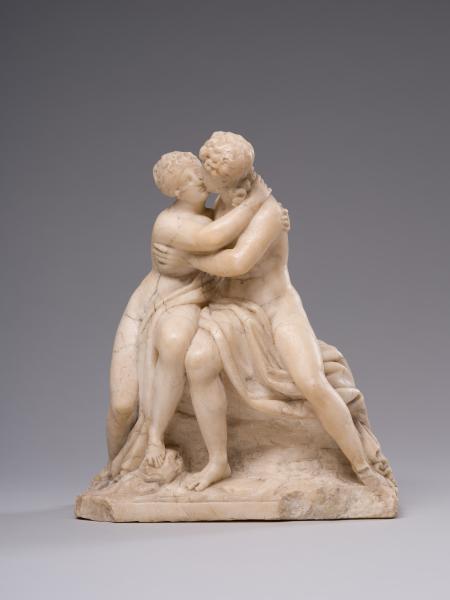
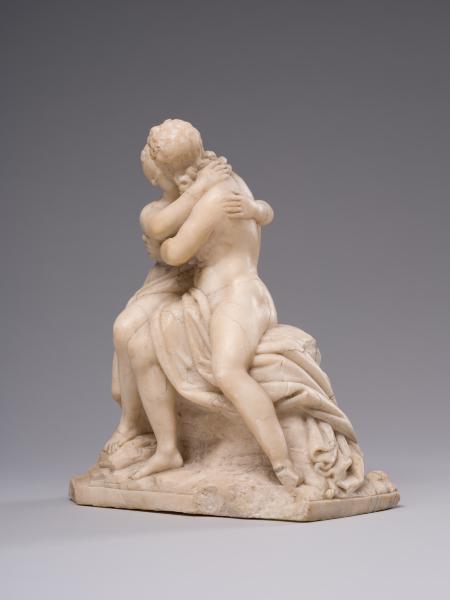
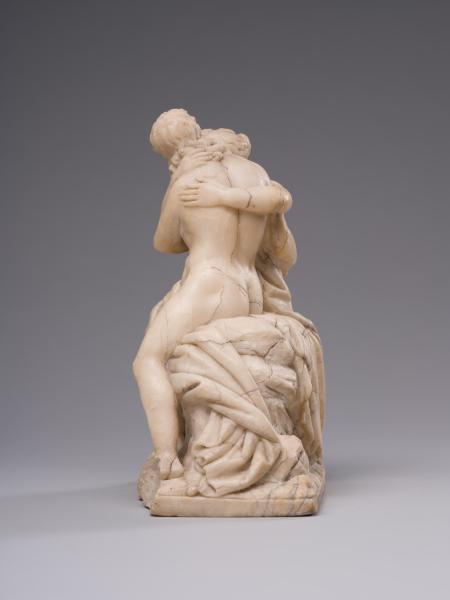
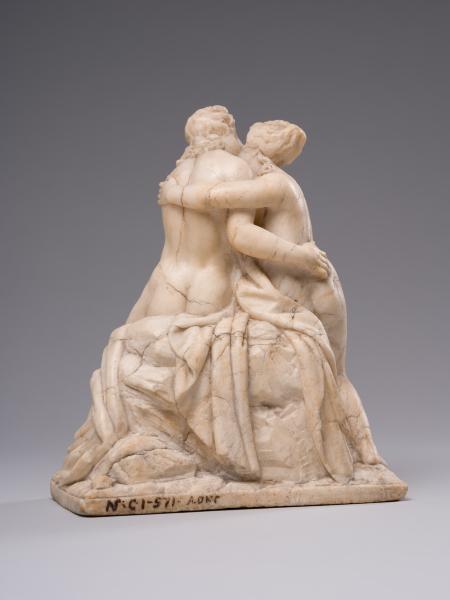
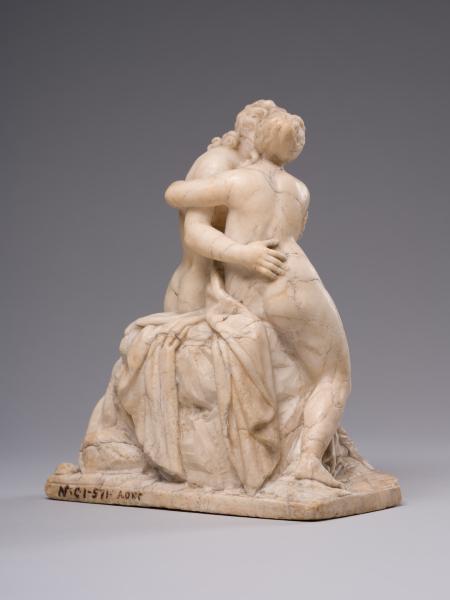
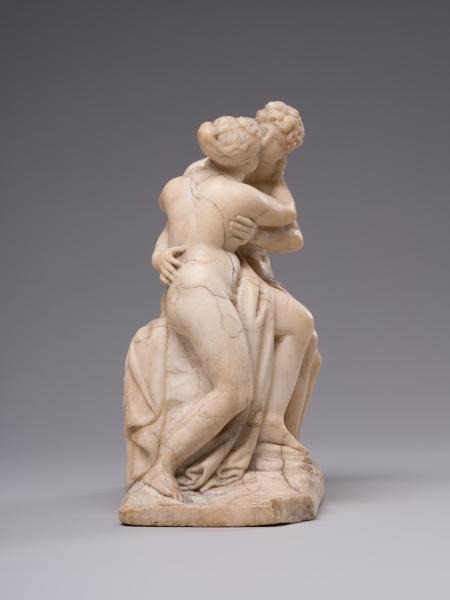
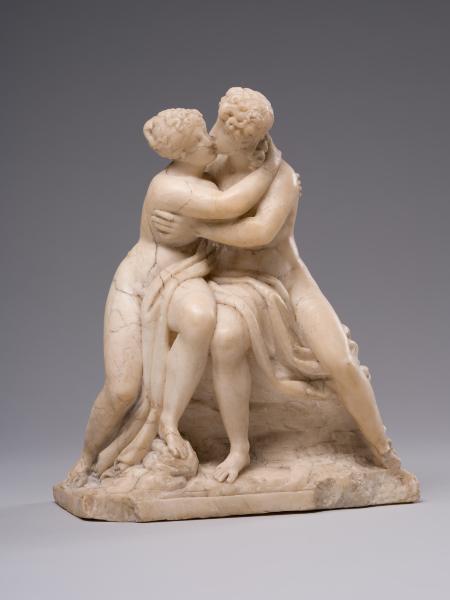
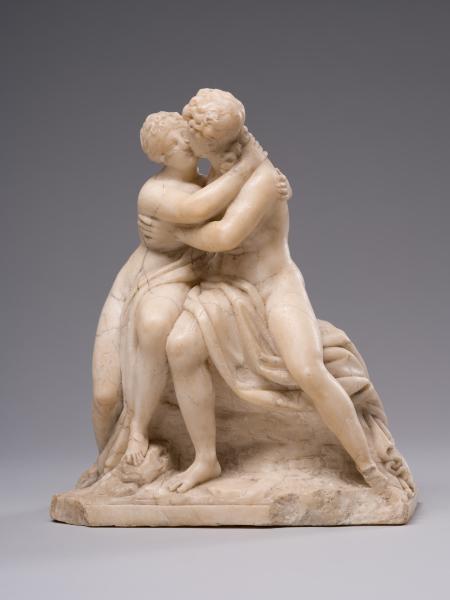
The work is based on the myth of Cupid (Erotus) and Psyche, one of the most widely interpreted in literature and art history. According to one version of the myth, Psyche is the daughter of the king of Crete; according to other versions, the sun god Helios. She is equated with the soul in its eternal desire for the sublime and beauty. The love story of Cupid and Psyche first appears in the epigrams of Posidippus (third century BC) and Meleager (first century BC). The most complete literary account of the love story of Cupid and Psyche is the work of the Roman writer Lucius Apuleius (c. 124 – c. 180 AD), "Metamorphoses, or The Golden Donkey". According to Apuleius, Psyche was so beautiful that she was called the second Aphrodite. In a rage, the goddess of beauty and love ordered her son Cupid to force her to fall in love with the ugliest man in the world. But when Cupid saw her beauty, he fell in love with her and took her to his palace, where he visited her every night in complete darkness at the god's request. One day, Psyche, encouraged by her sisters, lit a torch and saw Cupid's surprisingly handsome face. Her hand trembled, and a few drops of boiling oil burned the young man's body. Cupid then left Psyche, unable to tolerate her disobedience. In her search for her beloved, Psyche underwent many hardships. Moved by remorse, Cupid persuaded Jupiter to grant Psyche immortality, and she became his wife. The love story between Cupid and Psyche was popular in the Hellenistic period – in frescoes, mosaics, small sculptures and cameo compositions – and was forgotten in the Middle Ages. Interest in them was revived in the Renaissance. G. Boccaccio, for example, found the text of Apuleius in one of the codices of the eleventh century and created his own interpretation of the story in his work "On the Genealogy of the Gods of the Gentiles" (c. 1373). Among Renaissance artists, Raphael depicted the love story of Cupid and Psyche on the ceiling of the loggia of the Villa Farnesina in Rome (early 16th century). The story of the "marriage of Cupid and Psyche" was also used by the Mannerist artists Giulio Romano, Perino del Vaga, Francesco da Volterra, and Francesco Salviati. Jacopo Zucchi and the prominent Baroque masters Orazio Gentileschi and Peter Paul Rubens depicted the night-time meeting of Cupid and Psyche. Jacob Jordaens and Anthony van Dyck creatively interpreted the story. Among the sculptural representations of the story is the famous composition by Lorenzo Bernini's student Giulio Cartari, depicting Psyche with a torch in her hand over a sleeping, wingless Cupid. The love story of Cupid and Psyche played a prominent role in the works of representatives of the sensual, erotic and capricious Rococo: Charles-Joseph Natoire, in the murals of the Salon "Ovale" of the Hotel de Soubise and in the paintings by François Boucher. Numerous representations of Cupid and Psyche can be found in the products of the Sèvres Manufactory. The terra cotta Cupid and Psyche were created by Claude-Augustin Caillot and Claude Michel (Clodion). Jean-Baptiste Greuze, a famous moralist painter of the 18th century, created the "Psyche crowning Cupid" work. Pompeo Girolamo Batoni made the "Wedding of Amor and Psyche" composition, combining elements of Neoclassicism and Rococo. Jacques-Louis David rewrote the story in the Neoclassical style. Joshua Reynolds painted Cupid and Psyche at the end of the 18th century. Augustin Pajou, a representative of French Classicism, depicted the suffering of the abandoned Psyche in sculpture. Sculptures of the lovers Cupid and Psyche were created by the representative of European Neoclassicism Antonio Canova (1798, 1808). During the Empire, François Gerard turned to the subject in painting. In the 19th century, artistic interpretations of Psyche's awakening from the Stygian dream and her reunion with Cupid became widespread. In nineteenth-century sculpture, the flight of Psyche with the Zephyr (H. Bates, J. Gibson, H-J. Rigel) and the scene with the torch (C. Baruzzi, R. Begas, A. Carrier-Belleuse, A. Rodin, W. von Hoyer) became widespread. A plot innovation was the depiction of Psyche looking at Cupid's arrow (B. Thorvaldsen). In the 19th century, bas-reliefs depicting the story of Cupid and Psyche (B. Thorvaldsen "Cupid and Psyche") and the reproduction of the story in commemorative sculptures (B. Thorvaldsen, J. Flaxman) became popular. Auguste Rodin, the founder of Impressionism in sculpture, repeatedly referred to the love story of Cupid and Psyche. A new stage in the development of images of Psyche and Cupid were the works of the Symbolists, which revealed the allegorical meaning of the heroine's trials. In the work from the collection of Borys Voznytskyi Lviv National Art Gallery, a carving by an unknown master depicts the gallant, erotic aspect of the plot – kisses and embraces between the characters. The physical and spiritual intimacy of Cupid and Psyche is reflected in the compactness of the sculptural group forming a stable triangle, the movements of the hands, and the sensual curves of the naked bodies. The plastic unity of the image is given by the drapery that wraps around the lovers' hips and falls in heavy folds. The eroticism of the scene and the high wig-like hairstyles suggest the influence of 18th-century "gallant scenes" in sculpture and painting and the whimsical Rococo style on the plastic solution of the work. At the same time, the somewhat heavy proportions of the figures and the less successful modelling of the heads, hands and bannocks suggest that the sculpture is a copy.
Legal regulation
Borys Voznytskyi Lviv National Art Gallery