Religious Figures
Myroslav Yahoda


Basic information
- ID
- Ж-7816
- Author
- Myroslav Yahoda
- Name
- Religious Figures
- Date of creation
- 1998
- Technique
- oil painting
- Material
- canvas oil
- Dimensions (height x width, cm)
- 120 x 100
Additionally
Information about author
Object description
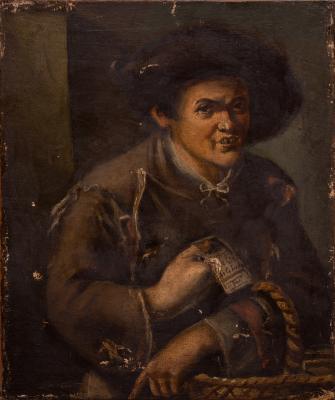
"Religious Figures" was created during the mature period of Myroslav Yahoda's work – an artist whose creative path was shaped by the intersection of pressure and a persistent striving for inner freedom. The canvas should be viewed not as an illustration of a specific religious theme, but as the artist's attempt to build his own space of spiritual experience, parallel to the official one – an "ivory tower" to which access was permitted only to a chosen few. Myroslav Yahoda belonged to a circle of artists who, like Fedir Tetianych, Oleh Mitasov and Hennadii Podvoyskyi, operated outside institutional frameworks, and he himself transformed his studio into an ecological niche of personal space.
In "Religious Figures", this is felt in the interpretation of sacred images not as canonical symbols of faith, but as a descriptive definition of the human liminal state, a point where the boundary between mystical illumination and an extreme, almost delusional experience of reality is blurred. The figures on the canvas appear as witnesses to depersonalisation, and the artist transfers religious iconography into the plane of the existential experience of loneliness and the search for support. It is precisely in this that Myroslav Yahoda's affinity lies with the tradition of the Romantics (Eugène Delacroix, Théodore Géricault and Francisco Goya), who also explored states of mental and social marginalisation, seeking to express that layer of human experience which official culture tends to suppress. At the same time, unlike a purely clinical interpretation, Myroslav Yahoda's paintings are not reduced to a symptom, but are a form of sincerity, a correspondence between word and deed, which can be defined as an attempt to "build a world in which a person is happy", as the artist himself puts it.
Compositionally, the figures in the work are devoid of illusory depth and academic anatomical precision, and the emphasised language of deformed, generalised silhouettes, characteristic of the artist, serves to dispel the generally accepted, logical perception of the image. The religious motif here functions rather as an archetypal matrix from which the author's individual mythology emerges. This is a catastrophic but bearable space – an "environment of exiles from paradise", in which the return to the sacred image is simultaneously a path to self-knowledge and the destruction of habitual, comfortable forms of existence.
Importantly, this work does not lend itself to clear interpretation, but balances between affirming humanity's closeness to transcendence and stating a complete separation, a distance between people, which Myroslav Yahoda himself considered a rather conventional category. "Religious Figures" also visualises the two poles that defined the artist's entire oeuvre: Nietzschean loneliness and a constant search for a state that can be defined as freedom, and at the same time a gift and a burden – a form of existence rather than a mere artistic gesture.
The canvas became part of the Gallery's collection as a gift from the Lviv City Council on the occasion of the museum's 95th anniversary, which is a testament to the public and institutional recognition of the work of an artist who, throughout his life, consciously distanced himself from the conformist local cultural environment.
In "Religious Figures", this is felt in the interpretation of sacred images not as canonical symbols of faith, but as a descriptive definition of the human liminal state, a point where the boundary between mystical illumination and an extreme, almost delusional experience of reality is blurred. The figures on the canvas appear as witnesses to depersonalisation, and the artist transfers religious iconography into the plane of the existential experience of loneliness and the search for support. It is precisely in this that Myroslav Yahoda's affinity lies with the tradition of the Romantics (Eugène Delacroix, Théodore Géricault and Francisco Goya), who also explored states of mental and social marginalisation, seeking to express that layer of human experience which official culture tends to suppress. At the same time, unlike a purely clinical interpretation, Myroslav Yahoda's paintings are not reduced to a symptom, but are a form of sincerity, a correspondence between word and deed, which can be defined as an attempt to "build a world in which a person is happy", as the artist himself puts it.
Compositionally, the figures in the work are devoid of illusory depth and academic anatomical precision, and the emphasised language of deformed, generalised silhouettes, characteristic of the artist, serves to dispel the generally accepted, logical perception of the image. The religious motif here functions rather as an archetypal matrix from which the author's individual mythology emerges. This is a catastrophic but bearable space – an "environment of exiles from paradise", in which the return to the sacred image is simultaneously a path to self-knowledge and the destruction of habitual, comfortable forms of existence.
Importantly, this work does not lend itself to clear interpretation, but balances between affirming humanity's closeness to transcendence and stating a complete separation, a distance between people, which Myroslav Yahoda himself considered a rather conventional category. "Religious Figures" also visualises the two poles that defined the artist's entire oeuvre: Nietzschean loneliness and a constant search for a state that can be defined as freedom, and at the same time a gift and a burden – a form of existence rather than a mere artistic gesture.
The canvas became part of the Gallery's collection as a gift from the Lviv City Council on the occasion of the museum's 95th anniversary, which is a testament to the public and institutional recognition of the work of an artist who, throughout his life, consciously distanced himself from the conformist local cultural environment.
Legal regulation
Borys Voznytskyi Lviv National Art Gallery