Victory Over Time (Sheet 10 from the Graphic Cycle "Jonathan Swift's Kingdom of Absurdity")
Alexander Aksinin


Basic information
- ID
- Г-IV-3645
- Author
- Alexander Aksinin
- Name
- Victory Over Time (Sheet 10 from the Graphic Cycle "Jonathan Swift's Kingdom of Absurdity")
- Date of creation
- 1978
- Technique
- etching
- Material
- imprint on paper
- Dimensions (height x width, cm)
- 29.3 x 29.7
Additionally
- Type
- printmaking
- Provenance
- Purchased and kept in permanent storage,1983
Information about author
Object description
Alexander Aksinin's legacy of graphic works contains a series of etchings based on some literary works, one of which is Jonathan Swift's "Gulliver's Travels" (1977–1978). In this series (as in others, such as Lewis Carroll's "Alice in Wonderland"), Aksinin often turned the texts into part of an image. The artist's creative world is characterised by a condensed intellectual atmosphere full of "codes of aesthetic information". The art critic Mykhailo Sokolov noted that the artist introduced into his works a subject line, which was to symbolically reproduce not a separate part of the text but to give the image of the text as a whole, as well as to serve as a sign and matrix of an illustrated verbal work.
The work is the second-to-last sheet from the "Jonathan Swift's Kingdom of Absurdity" graphic cycle. The author wrote "Victory over Time" on one of its prints. In the last two etchings based on Jonathan Swift's "Gulliver's Travels" and "A Tale of a Tub", Alexander Aksinin touches on general philosophical issues such as the creation of the universe and the birth of Space and Time.
The philosophical issues are evidenced by the author's sketches for the future completed composition and comments that lead to the disclosure of the meaning of the author's symbolism. The whirligig is one of the author's central graphic image metaphors, which he associates with the flow of time and rhythm ("whirligig" meaning "rhythm"). In the first square of the table's sketch of "The Origin of the Universe", Alexander Aksinin depicts a nimbus over a circle of whirligigs. Thus, "Aksinin's whirligig" is similar to the eternal engine, and the Creator configures a group of such whirligigs to form the historical Time.
There is also the author's name "billions of years ago". In another sketch, in which the circle is crossed diagonally by an orbicular spiral resembling a serpentine caterpillar or a snake, Alexander Aksinin explains the metaphor's meaning as follows: "Approaching through metaphor. Beyond the metaphor, everything remains alienated." In another sketch, Alexander Aksinin emphasises his philosophical priorities with the following phrase: "Phenomenology of space / not explication, but eloquence – like Merleau-Ponty".
Maurice Merleau-Ponty was a twentieth-century French philosopher and prominent representative of existential phenomenology. He considered intention to be a man's subjective reference to the world, that is, seeing the essence with his own eyes. The thinker continued to develop Edmund Husserl's theory, searching for a phenomenon "on the other side of the world of objects".
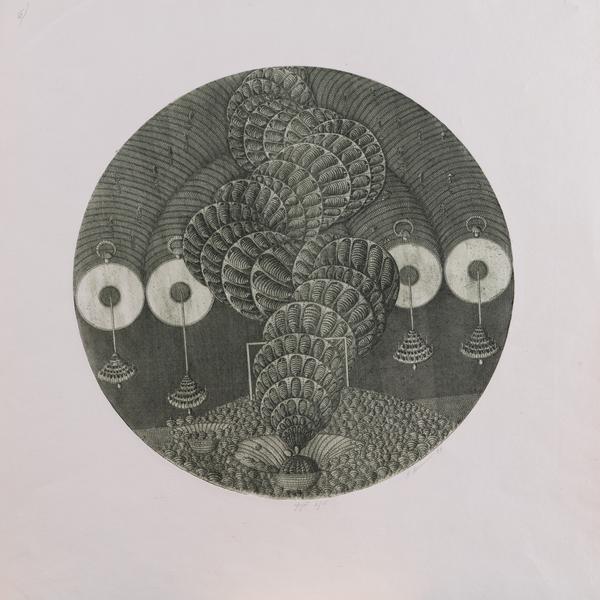
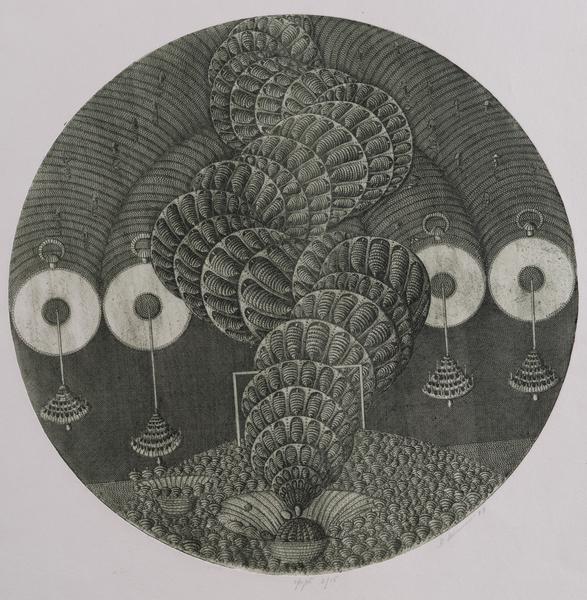
The author resorts to using the composition scheme of the previous etchings of the series. He depicts a circle with a curly rough ribbon crossing it vertically. This zoomorphic S-shaped spiral meta-whirligig, in this case, adds dynamism to the static composition as a whole. The spiral resembles an eyeless snake with its mouth stuck into the segment's crater formed by a swarm of whirligigs. Actually, it is the birth of a tornado in the crater. The crater looks like an inverted hat, containing a sphere with a faceted coating of diamond rust.
This sphere, the Turtle's shell, is a model of the universe, according to the artist's plan. Thanks to it, the meta-whirligig tornado maintains its balance. The zoomorphic spiral's body is made up of wide discs, the sections of which are filled with whirligigs turned into spindles, prompting us to see another symbol of Time and an attribute of Destiny. At the top, the vertical creature transforms into two arched pipes. Their horizontal throats are tightly closed with white lids fixed by rings at the top. The lids have black circles in the centre to emphasise the overall composition.
"A. AKSININ–78" is engraved on the far-right lid. The pipes' scaly coating is divided into stripes. Birdhouses, as another ironic symbol of Time, chaotically jump up from the pipes' spirals, while whirligigs are jammed between the stripes in some places. Four chandeliers with candles hang down from the black circles of the lids. They are the same transformed whirligigs that highlight the process of Time formation. Later, the artist used the whirligigs repeatedly, transforming them into Christmas trees in New Year's greeting cards. A second smaller crater resembling the hat can be found under one of the chandeliers on the left, in the segment of the whirligigs cluster. Individual whirligigs have already occupied it to form a new meta-whirligig.
The work can be defined as showing how to order chaos despite such structuring generating monsters.
Regarding composition and general concept, Alexander Aksinin's work can be compared to Sandro Botticelli's "Circles of Hell" (1480).
The work is the second-to-last sheet from the "Jonathan Swift's Kingdom of Absurdity" graphic cycle. The author wrote "Victory over Time" on one of its prints. In the last two etchings based on Jonathan Swift's "Gulliver's Travels" and "A Tale of a Tub", Alexander Aksinin touches on general philosophical issues such as the creation of the universe and the birth of Space and Time.
The philosophical issues are evidenced by the author's sketches for the future completed composition and comments that lead to the disclosure of the meaning of the author's symbolism. The whirligig is one of the author's central graphic image metaphors, which he associates with the flow of time and rhythm ("whirligig" meaning "rhythm"). In the first square of the table's sketch of "The Origin of the Universe", Alexander Aksinin depicts a nimbus over a circle of whirligigs. Thus, "Aksinin's whirligig" is similar to the eternal engine, and the Creator configures a group of such whirligigs to form the historical Time.
There is also the author's name "billions of years ago". In another sketch, in which the circle is crossed diagonally by an orbicular spiral resembling a serpentine caterpillar or a snake, Alexander Aksinin explains the metaphor's meaning as follows: "Approaching through metaphor. Beyond the metaphor, everything remains alienated." In another sketch, Alexander Aksinin emphasises his philosophical priorities with the following phrase: "Phenomenology of space / not explication, but eloquence – like Merleau-Ponty".
Maurice Merleau-Ponty was a twentieth-century French philosopher and prominent representative of existential phenomenology. He considered intention to be a man's subjective reference to the world, that is, seeing the essence with his own eyes. The thinker continued to develop Edmund Husserl's theory, searching for a phenomenon "on the other side of the world of objects".
The author resorts to using the composition scheme of the previous etchings of the series. He depicts a circle with a curly rough ribbon crossing it vertically. This zoomorphic S-shaped spiral meta-whirligig, in this case, adds dynamism to the static composition as a whole. The spiral resembles an eyeless snake with its mouth stuck into the segment's crater formed by a swarm of whirligigs. Actually, it is the birth of a tornado in the crater. The crater looks like an inverted hat, containing a sphere with a faceted coating of diamond rust.
This sphere, the Turtle's shell, is a model of the universe, according to the artist's plan. Thanks to it, the meta-whirligig tornado maintains its balance. The zoomorphic spiral's body is made up of wide discs, the sections of which are filled with whirligigs turned into spindles, prompting us to see another symbol of Time and an attribute of Destiny. At the top, the vertical creature transforms into two arched pipes. Their horizontal throats are tightly closed with white lids fixed by rings at the top. The lids have black circles in the centre to emphasise the overall composition.
"A. AKSININ–78" is engraved on the far-right lid. The pipes' scaly coating is divided into stripes. Birdhouses, as another ironic symbol of Time, chaotically jump up from the pipes' spirals, while whirligigs are jammed between the stripes in some places. Four chandeliers with candles hang down from the black circles of the lids. They are the same transformed whirligigs that highlight the process of Time formation. Later, the artist used the whirligigs repeatedly, transforming them into Christmas trees in New Year's greeting cards. A second smaller crater resembling the hat can be found under one of the chandeliers on the left, in the segment of the whirligigs cluster. Individual whirligigs have already occupied it to form a new meta-whirligig.
The work can be defined as showing how to order chaos despite such structuring generating monsters.
Regarding composition and general concept, Alexander Aksinin's work can be compared to Sandro Botticelli's "Circles of Hell" (1480).
Inscriptions
At the bottom right under the imprint, there is an author's inscription "A. Aksinin – 78"
Legal regulation
Borys Voznytskyi Lviv National Art Gallery