Market
Vasyl Poliovyi


Basic information
- ID
- Ж-6993
- Author
- Vasyl Poliovyi
- Name
- Market
- Date of creation
- 1968
- Country
- the USSR
- Culture
- Ukrainian art of the Soviet period
- Technique
- original technique
- Material
- fibreboard mixed media
- Dimensions (height x width, cm)
- 110 x 120
Additionally
- Type
- painting
- Genre
- symbolic art
- Plot
- Allegory
- Provenance
- Handed over to the museum from Vasyl Poliovyi
Information about author
Object description
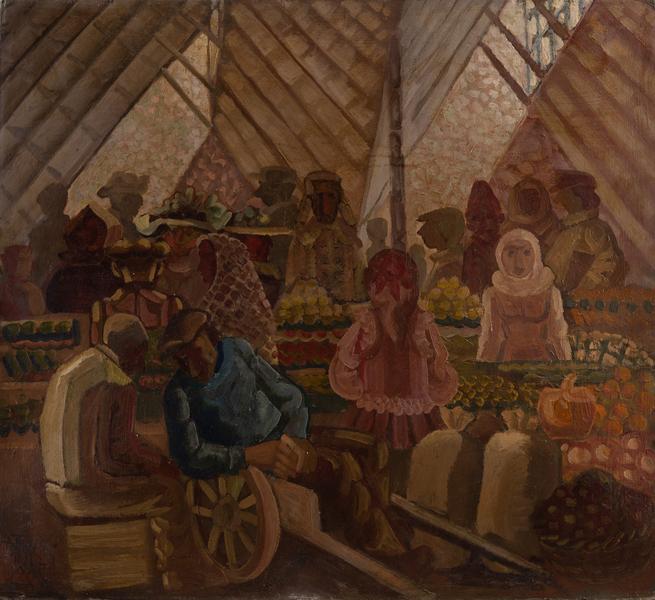
In this artwork, the author depicts what appears to be a genre scene in a covered market where people could sell their agricultural produce during the Soviet time. The variety and specificity of the displayed goods indicate that it is an autumn season when the harvest has already been gathered; hence there are practically no spring or summer crops. The right side of the composition depicts a pumpkin, typical baskets with beets and onions, apples of various kinds, and sacks, probably with potatoes. Sellers and buyers are dressed according to the season. The artist captures the contrast between what the townspeople wear (coats, jackets, fur hats, and caps indicative of the era's fashion) and the villagers' clothes (traditional corsets – kersetkas, pleated skirts, and uniquely tied headscarves). By capturing the specific scattered lighting, the scene's space vibrates with colour and tone, becoming almost mosaic-like. A complex, warm range of almost golden hues provides the backdrop for micro-stories unfolding in the pavilion. The foreground depicts something the buyer does not see, as the viewer is positioned on the other side of the counter. Here, a woman stands with her back to the viewer, wearing a rather unusual rose madder and purple outfit with whitewashed segments. Next to her on the left are many goods waiting to be picked up – in bags, baskets, or stacked in a large pile. To her left, there are two men. An elderly man, likely a war veteran, sits in a wooden two-wheeled cart, wearing a warm blue sweater and a cap, leaning towards his conversation partner. The other man sits on a wooden crate, almost facing away from the viewer, dressed in light ochre-coloured attire. Behind the counter is a woman wearing a large light-coloured down headscarf and a man with a distinctive headdress (resembling a tasselled kresania – a traditional Hutsul felt hat). To the right of the woman stands a girl of Eastern appearance in light clothing, wearing her namitka (?) – a traditional white headdress – in a unique way. The characters in the background, walking between the rows or standing behind the counters, illustrate the diversity of society, bringing together genre anthropological scenarios of behaviour and everyday practices. Among them is a woman in elegant, antique headwear and ordinary workers. This approach refers to the philosophical understanding of what this world is: diverse, varied, yet tightly interconnected. The artist partially revisited this theme in one of his works of the American period, but in a completely different colour scheme, with the active use of ultramarine.
Inscriptions
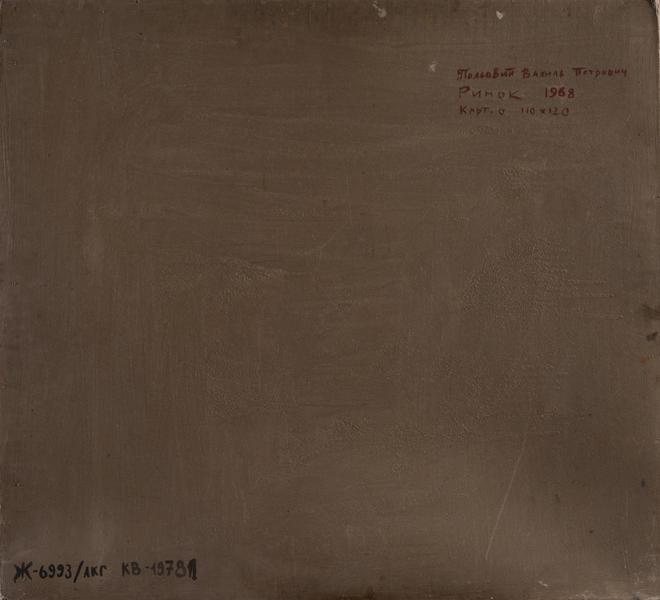
In the bottom left corner: ВПоЛеВоЙ 68 г
Legal regulation
Borys Voznytskyi Lviv National Art Gallery