Composition
Vasyl Poliovyi



Basic information
- ID
- Ж-7006
- Author
- Vasyl Poliovyi
- Name
- Composition
- Date of creation
- 1965
- Country
- the USSR
- Culture
- Ukrainian art of the Soviet period
- Technique
- original technique
- Material
- cardboard mixed media
- Dimensions (height x width, cm)
- 65 x 122
Additionally
- Type
- painting
- Genre
- symbolic art
- Plot
- Allegory
- Provenance
- Handed over to the museum from Vasyl Poliovyi
Information about author
Object description
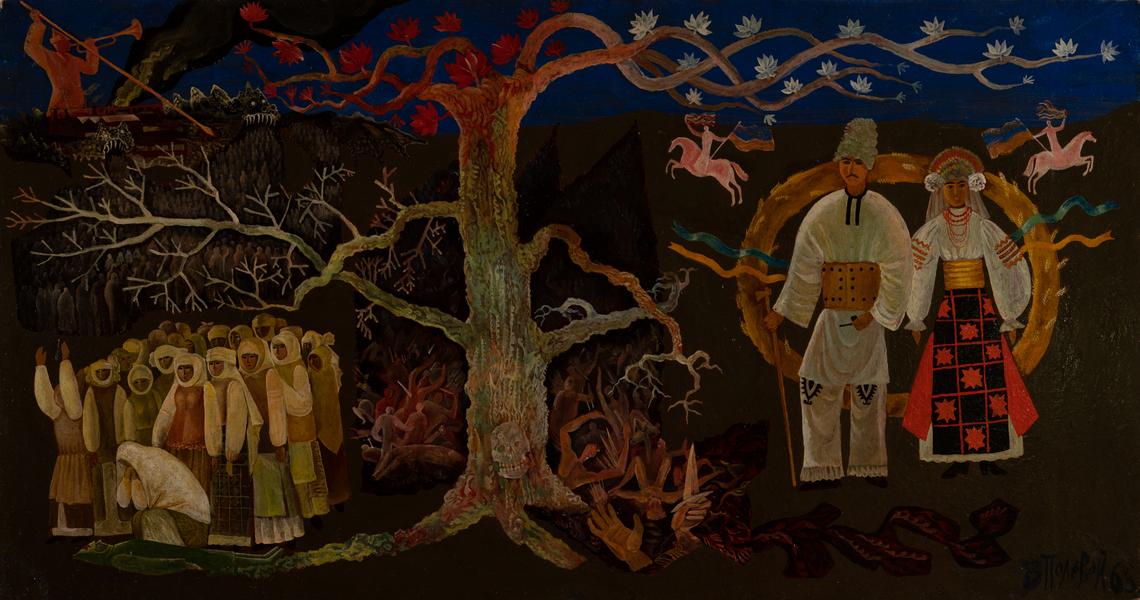
The symbolic composition is dedicated to simultaneously depicting Ukrainian history in the 20th century, from the events of the Civil War to an idealistic allusion to the liberation struggle. Additionally, one of the potential sources of inspiration is Taras Shevchenko's poem-mystery "The Big Cellar" (1845), which portrays epic and detailed scenes of the consequences of military actions and punitive measures. Confirmation of this can be found in the concluding statement of the text, which is likely illustrated in the right part of the painting: "Ukraine will rise / Banish captivity darkness, (...)". The overall solution to the composition and stylisation used by the artist refers to the practices of folk painting and iconography: against the background of a conventionally plane greenish ground and blue sky, there is a partially withered tree covered with leaves on the right side, and on the left side there is something resembling bloody blossoms, from which blood streams flow down the trunk. At the base of the tree, a stylised skull is depicted, reminiscent of Adam's head in the depiction of the Crucifixion at Golgotha. Beneath the tree is a vast abyss, in which macabre battles of all against all unfold, similar to Pieter Brueghel the Elder's works "The Fall of the Rebel Angels" (1562) or "The Triumph of Death" (1563) or the hellish visions of Hieronymus Bosch (1500–1510). To the left is a large group of elderly women in folk clothing, mourning a fallen Red Army soldier in a Civil War uniform. Behind them is a vision of thousands of people, marching into what resembles a Boschian infernal city, where alongside fantastical monsters (Leviathan?), there is a fiery and titanic half-figure of a Red Army soldier in a budenovka hat, holding a trumpet and a spear in his right hand. It is an apparent reference to the iconography of the Archangel Michael on a fiery winged horse, where, according to one version, he acts as a harbinger of the Apocalypse (common primarily among Old Believers). Meanwhile, the plot unfolds to the right of the tree: against the background of a wreath made of ripe ears (somewhat reminiscent of Ouroboros), complemented by yellow and blue ribbons, a young man and a woman stand facing the viewer. Their clothing exhibits distinct ethnic and regional features. The man wears a grey fur hat and a knee-length shirt with a subtle dark decoration around the neckline, complemented by a wide leather belt – cheres. He wears pants embroidered with a black geometrical pattern on the knees and leather boots, possibly postoly (traditional Hutsul footwear). He holds a small axe in his right hand and a pipe in his left hand. The young woman wears a richly decorated wreath with numerous ornaments and ribbons. Around her neck are red (coral?) beads with three thick and four thin rows. The girl's shirt is embroidered on the sleeves, completed with ruffled cuffs. She wears a red plahta (a big rectangular cloth used as a skirt) complemented by a woven black and red zapaska (rectangular apron), likely secured with a wide kraika (traditional female belt), and dark boots with a small heel. Behind them are two outlined figures of horsemen with blue and yellow flags and wreaths with multicoloured ribbons (red, yellow, green and blue). The interpretation of these riders, particularly the profiled figures of the horses, also has iconographic allusions to the figures of holy horsemen, including Saint George and Saint Theodore Stratelates. Overall, the artwork deserves special attention, considering the ideological context of its creation and its unquestionable uniqueness as an openly politicised and oppositional narrative that has no parallels in the practices of artists of the Ukrainian SSR.
Inscriptions
In the bottom right corner, there is an inscription: "В. ПолеВоЙ 65"
Legal regulation
Borys Voznytskyi Lviv National Art Gallery