Sea Battle
Johannes Lingelbach


Basic information
- ID
- Ж-4125
- Author
- Johannes Lingelbach
- Name
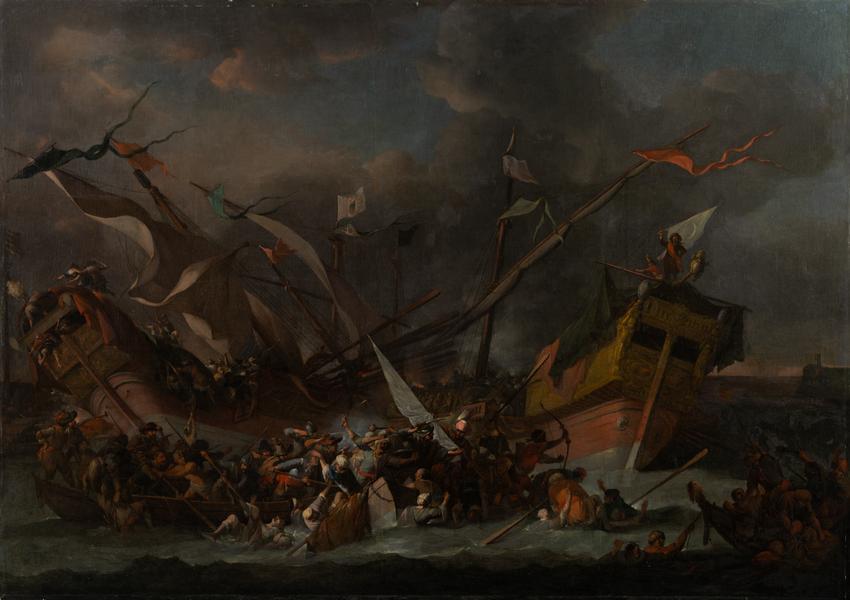
- Sea Battle
- Date of creation
- 1st half of the 16th c.
- Technique
- oil painting
- Material
- canvas oil
- Dimensions (height x width, cm)
- 74 x 100
Additionally
- Type
- painting
- Genre
- battle painting
- Plot
- Battle
- Exposition
- Potocki Palace
Information about author
Object description
The collection of Borys Voznytskyi Lviv National Art Gallery includes "A Sea Battle" painting by Johannes Lingelbach. The work depicts an event that occurred on October 7, 1571, during a raid on the Greek city of Lepanto in the Ionian Sea. The battle between the fleets of the Holy League and the Ottoman Empire was one of the most extensive naval engagements of the 16th century. Ottoman expansion into Europe continued during the reign of Selim II (1524–1574). Holy Roman Emperor Maximilian II Habsburg was forced to agree to the annual tribute and to accept Turkish sovereignty over Wallachia and Moldavia. In 1570, Ottoman troops landed on the Venetian island of Cyprus, the last Christian outpost in the Eastern Mediterranean. On May 25, 1571, to counteract the Ottoman threat, Pope Pius V established the Holy League, consisting of the Spanish Empire, the Republics of Venice and Genoa, the Duchies of Parma, Savoy and Tuscany, and the Papal State. On September 16, the coalition fleet sailed from Messina. It headed to the island of Corfu, where the expedition's commander, Spanish general Juan of Austria, received news of the Ottoman capture of Famagusta, the critical port of Cyprus. Due to those circumstances, the Holy League armada changed its route and headed to Lepanto (now Nafpaktos, Greece), where most of the Ottoman fleet was transferred from Cyprus. Muezzinzade Ali Pasha, inexperienced in naval affairs, had about 210 galleys, 750 cannons, and 90,000 troops under his command. He was opposed by the allied fleet of more than 200 galleys, 1815 cannons, and more than 100,000 troops. Both forces simultaneously moved against each other. The Ottoman fleet was destroyed in the five-hour battle, and Ali Pasha was killed during the fighting. Despite the convincing victory glorified in numerous works by European artists, it did not affect the overall course of the war between the Holy League and the Ottoman Empire. The Ottomans captured Tunisia in 1574, gained a foothold on the coasts of Morocco in two years, and with French support, quickly expanded their influence all the way to the Strait of Gibraltar. "A Sea Battle" by Johannes Lingelbach vividly depicts the struggle between Muslim and Christian worldviews.
Legal regulation
Borys Voznytskyi Lviv National Art Gallery