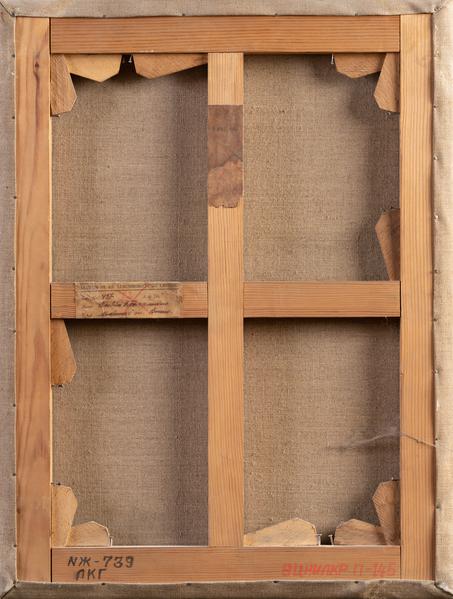
Back

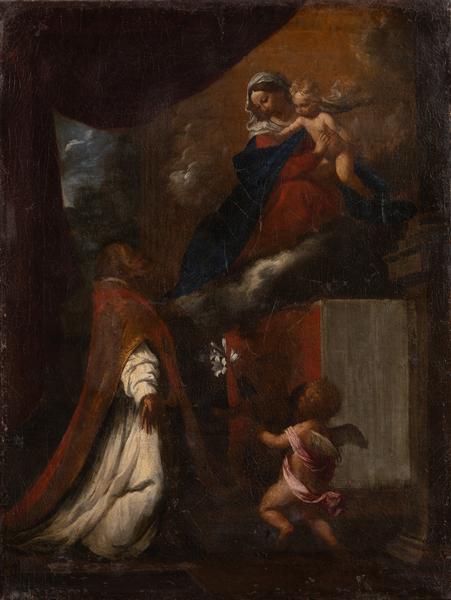
Madonna and Saint Bruno

Giovanni Francesco Barbieri (Guercino)

  • Madonna and Saint Bruno 2
  • Madonna and Saint Bruno 3
Basic information
ID
Ж-739
Author
Giovanni Francesco Barbieri (Guercino)
Name
Madonna and Saint Bruno
Technique
oil painting
Material
canvas oil
Dimensions (height x width, cm)
50.5 x 37.6
Additionally
Type
painting
Genre
religious
Provenance
the Lubomirski collection
Exposition
Potocki Palace
Information about author
Author
Giovanni Francesco Barbieri (Guercino)
Artist's lifetime
1591–1666
Country
Italy
Biography
Guercino (Giovanni Francesco Barbieri) was an Italian Baroque artist. The painter was born in Cento, near Bologna (Ferrara Province, Italy). He was baptised on February 8, 1591. The Bologna School tradition greatly influenced the author's work. As an artist, Guercino drew inspiration from Ludovico Carracci, even though he did not directly study at the Carracci brothers' Academy. From 1617 to 1621, the painter lived in Bologna, where he created some of his most outstanding works. In grand altar paintings, such as "The Return of the Prodigal Son" (Turin), "The Ecstasy of Saint Francis" (Paris), and "Saint William Receiving the Monastic Habit" (Bologna), the author developed his signature Baroque style. His early works, such as "The Martyrdom of Saint Peter" (1618–1619, Modena, Galleria Estense) and "Tancred and Erminia" (1618–1619, Rome, Doria Pamphil Gallery), were executed with an increased dramatisation of light and shadow. This technique, only outwardly resembling Caravaggio's manner, was adopted from the Artistic Schools of Northern Italy – Ferrara and Venice. Guercino's talent was noticed by Cardinal Serra, the papal legate in Ferrara, for whom the artist created several works. Experts believe that the artist created his best paintings at a young age, so the works from his early period were called "il vero Guercino" ("the real Guercino"). In 1618, the author visited Venice, where he was strongly impressed by the works of Tintoretto and Jacopo Bassano. In 1621, Pope Gregory XV invited Guercino to Rome. Upon arriving, the author painted the famous "Aurora" fresco for the Casino di Villa Ludovisi ceiling, executed in brilliant Venetian colourism and Bolognese academism tradition. However, Roman classics restrained Guercino's baroque manner. Consequently, the artist drastically changed his style, shifting away from the relief volumes construction with chiaroscuro but using bold compositional structures, unusual angles, and less dramatic gestures. This transition is characterised by such works of the artist as the painting "Apparition of Christ to the Virgin" (1629, Cento, Municipal Pinacotheca) and the altar image "The Burial of Saint Petronilla" (1623, Rome, Capitoline Museum). In the Gospel episode depiction, the author still utilised emotionally expressive possibilities of chiaroscuro, but the figures' gestures were considerably more restrained. In 1623, Guercino returned to Cento. His palette began to lighten, and his energetic Baroque style underwent a sharp shift towards Classicism, especially under the influence of the Bolognese painter Guido Reni. After Reni's death, Guercino moved to Bologna, where he took one of the leading positions among the Reni Artistic School masters. His later works became more conventional in style. One of the most classically executed works by the artist is "Saint Romuald" (1640–1641, Ravenna, Pinacoteca). In the centre of the painting, Saint Romuald is depicted, protected by an angel from a demon approaching. The contrast of light and shadow appears more subdued, but the luminosity of colours reveals the hand of a Bolognese School master. The fabric of Saint Romuald's bright robe, illuminated by a stream of light, seems to radiate. This painting was one of the last works completed by the master in Rome. Guercino passed away in Bologna on December 22, 1666. Many European artists of the following generations studied Guercino's paintings. His early works directly influenced Neapolitan painters, particularly Pier Francesco Mola, Mattia Preti, and the Bolognese artist Giuseppe Crespi.
Object description
Guercino's paintings resembled Caravaggio's works: irrational lighting, dark and gloomy backgrounds, large figures, and commoners' character types. The author was a follower of Ludovico Carracci, actively using romantic chiaroscuro, which softens the sculptural clarity of the form. The structure of the form dissolves in streams of light, emphasising the prominent parts and leaving everything else submerged in impenetrable shadow; the movements are directed diagonally into the depths of the painting's boundless space; the asymmetrical composition and rich Venetian colouring intensify the overall dramatic effect. The painting illustrates the apparition of the Madonna sitting on a cloud in a sanctuary in front of the altar. She is dressed in deep shades of red and blue. In her arms, Mary holds Jesus, who blesses Saint Bruno with his right hand. The painting's left side depicts the kneeling figure of Saint Bruno with his arms outstretched, receiving the blessing. In the lower right part is a small angel holding a white lily, a symbol of the Madonna. According to tradition, the archangel Gabriel came to Mary on Annunciation Day with a white lily, which has since become a symbol of the Madonna. The flower symbolises the unfading blossom of her purity, innocence, and devotion to God.
Inscriptions
At the bottom right, there is an inscription: "G.Franc. Barbieri"
Legal regulation
Borys Voznytskyi Lviv National Art Gallery