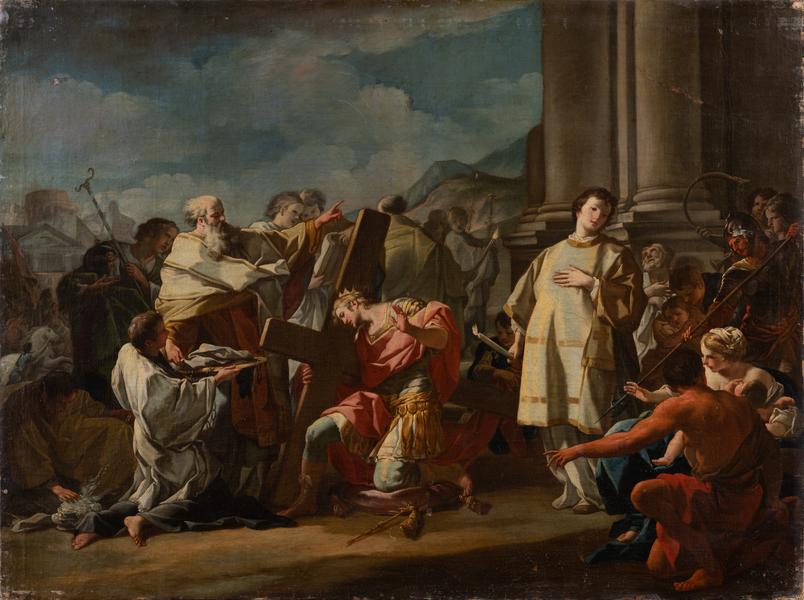
Heraclius Carries the Cross
unknown (School of Francesco Solimena)


Basic information
- ID
- Ж-832
- Author
- unknown (School of Francesco Solimena)
- Name
- Heraclius Carries the Cross
- Technique
- oil painting
- Material
- duplicated canvas oil
- Dimensions (height x width, cm)
- 73.5 x 97.5
Additionally
- Type
- painting
- Genre
- religious
- Provenance
- Collection of Lviv City Gallery
- Exposition
- Potocki Palace
Information about author
Object description
It can be assumed that the author of this canvas belonged to the School of Francesco Solimena, an Italian artist of the Baroque era and a representative of the Neapolitan Art School. Solimena's works were characterised by a lavish artistic style, featuring bright and almost festive colours. The church demanded elaborate decorations and the glorification of Catholic saints, portraying their struggles for faith. For years, Francesco Solimena created altar images, painted numerous visions and scenes of the Catholic saints' martyrdom. In many biblical narratives, the master employed exaggeration, theatricality, and abundant secondary characters in the compositions. The artist depicted his interpretation of a historical event on the canvas. In the year 614, Jerusalem was plundered by the Persians. The Cross on which Jesus was crucified ended up in the hands of pagans. Byzantine emperors organised a punitive expedition, and after fourteen years, the Holy Cross was recaptured. Emperor Heraclius personally carried the relic back to Jerusalem on his shoulders. Set against a mountainous landscape, there is a multifigure scene. In the centre stands a young man dressed in Roman attire with a crown on his head. He holds a wooden cross. The artist portrays Heraclius somewhat satirically – the emperor stands with one knee resting on an elaborate cushion and holds the Cross pushed into the ground. In front of him, a figure of an older man stands, holding a cloth in his right hand, which is presented on a tray by a servant. Another servant is censing the ground. Behind the elder is a young man with a headdress and a staff in his hands. On the right, near the columns, a young deacon holds a candle. Next to the deacon is a group of people, including a warrior with a long spear, which he uses to keep the crowd away from the emperor.
Legal regulation
Borys Voznytskyi Lviv National Art Gallery