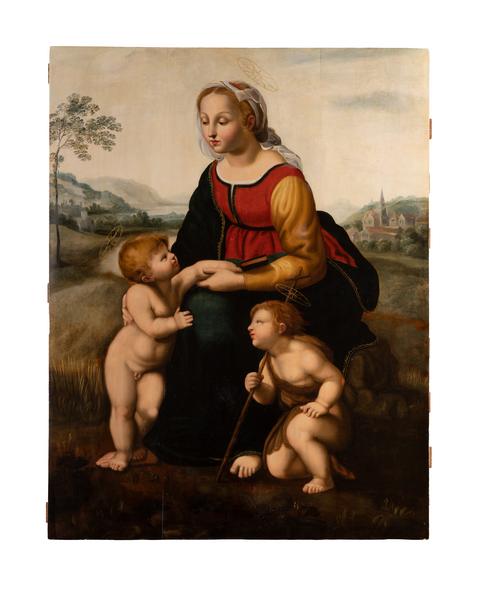
Madonna with the Infant Christ and Child John the Baptist (or La Belle Jardinière)
unknown (Copy after Rafael Santi)


Basic information
- ID
- Ж-1633
- Author
- unknown (Copy after Rafael Santi)
- Name
- Madonna with the Infant Christ and Child John the Baptist (or La Belle Jardinière)
- Technique
- oil painting
- Material
- wood oil
- Dimensions (height x width, cm)
- 92 x 71.5
Additionally
- Type
- painting
- Genre
- religious
- Plot
- Madonna and Infant Christ with Saint John the Baptist
- Provenance
- the Lubomirski collection
- Exposition
- Potocki Palace
Information about author
Object description
By the year 1300, a form of spirituality emerged in Western Europe that emphasised the emotional involvement of believers – they were encouraged to contemplate events from the lives of Christ, the Virgin Mary or the saints. Images of Madonna with Child were among the most popular depictions for private devotional use. These were typically small religious paintings intended for private worship instead of larger altarpieces intended for public display. Such images often emphasised the tender relationship between mother and child. The author of the work created a replica of the painting "La Belle Jardiniere", considered one of the most famous depictions of Madonna by the Italian Renaissance artist Raphael. He used the popular pyramidal composition typical of High Renaissance art and the sfumato technique. Another feature that can be seen in "La Belle Jardiniere" is the highly idealised beauty and grace of Madonna, which was admired by Raphael's followers. There is no definitive information regarding the authorship of the painting. The painting depicts the Virgin Mary, Christ, and the young John the Baptist. The Virgin Mary is at the centre of the composition. Her face is positioned at the top of the pyramidal composition, and her body covers most of the canvas. She holds the infant Christ, who stands next to her right leg. John the Baptist stands on the ground to the left of Madonna, holding a reed cross in his right hand. A book rests on the Virgin Mary's knees. Faint halos are around their heads, a feature that disappeared in the High Renaissance period. In this replica, the author has slightly complicated the halo pattern. The landscape in the painting is a beautiful rural garden. The painter has used a unified naturalistic composition with rich, vibrant colours and blended light and shadow to create a realistic atmosphere. The outlines of the landscape on the canvas are somewhat simplified. In the collection of the Lviv National Gallery, there is another copy of Raphael's work "Madonna with Child and Saint John the Baptist" ("La Belle Jardiniere"), which was created by Albrecht Kraft (1816–1847).
Legal regulation
Borys Voznytskyi Lviv National Art Gallery