Crucifixion
unknown


Basic information
- ID
- С-I-1651
- Author
- unknown
- Name
- Crucifixion
- Date of creation
- 18th c.
- Country
- Ukraine
- Technique
- carving polychrome
- Material
- wood
- Dimensions (height x width x depth, cm)
- 67.2 x 23 x 10.3
Additionally
- Type
- sculpture
- Genre
- religious
- Plot
- Crucifixion
- Provenance
- Pidhirtsi village, Brody district, Lviv region
Information about author
Object description
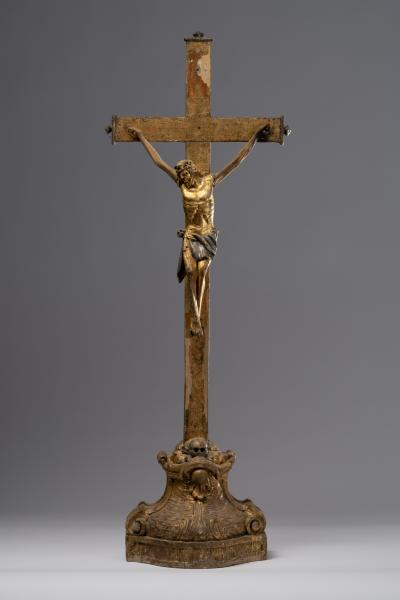
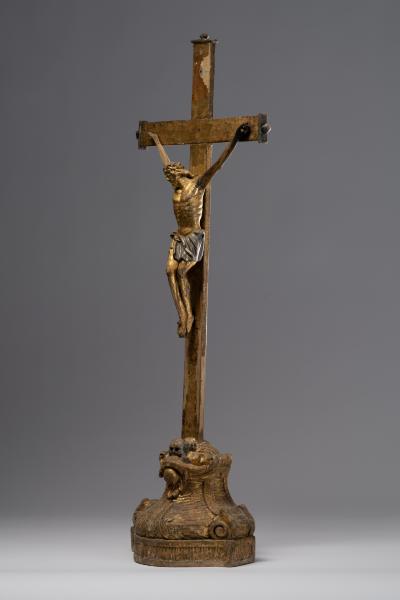
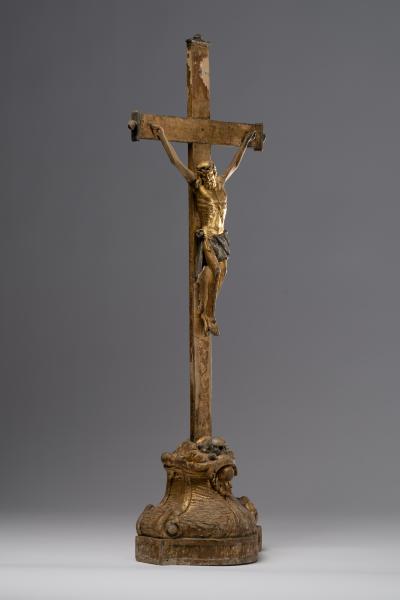
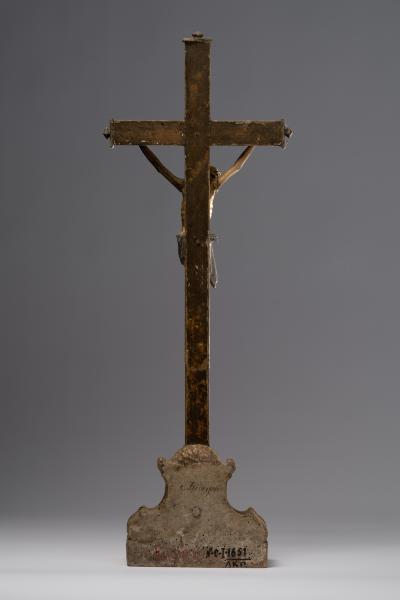
The compositional centre of the altar cross on a base decorated with curls and floral motifs is the Crucifixion, a subject common among professional and folk artists. Despite the established scheme, all sculptural representations differ in their imaginative interpretation. The Crucifixion from the Pidhirtsi village is executed in imitation of Western iconography, where Jesus is nailed to the cross with three nails, and his feet are placed one on top of the other. The sculpture is imbued with realism. The master depicted the Saviour as deceased – eyes closed, head tilted to the right, arms outstretched upward. The saint's face is recreated with a straight, prominent nose, closed lips, and closely set eyes beneath low brows. On the head of Christ, the author depicted a crown of thorns made of two intertwined rolls. The expressiveness of the image is enhanced by the meticulously rendered chest and tense muscles of the arms and legs. The decorative nature of the composition is complemented by draperies on the fabric that wraps around the thighs, as well as the ornamentation of the pedestal. At the bottom of the cross is Adam's skull.
Legal regulation
Borys Voznytskyi Lviv National Art Gallery