"The Passion of Christ" Iconostasis: The Last Supper, The Bargain of Judas, The Kiss of Judas, Christ Before Annas
unknown


Basic information
- ID
- Ж-4132
- Author
- unknown
- Name
- "The Passion of Christ" Iconostasis: The Last Supper, The Bargain of Judas, The Kiss of Judas, Christ Before Annas
- Date of creation
- early 18th c.
- Country
- Ukraine
- Culture
- Rybotytska School
- Technique
- tempera painting
- Material
- wood tempera
- Dimensions (height x width, cm)
- 112 x 220
Additionally
- Type
- icon
- Genre
- religious
- Plot
- The Passion of Christ
- Provenance
- Semenivka village, Lviv region
Information about author
Object description
"The Passion of Christ" is an iconostasis of the 17th – early 18th century consisting of a series of monumental multi-plot icons that should be viewed from top to bottom, in rows from left to right. The work's composition is distinguished by a large number of iconographic images with multi-figure scenes: 25 horizontally elongated Gospel scenes that tell us about the last days of Christ's earthly life. The work was painted by an artist of the Rybotytska School of icon painting, whose Passion Cycle icons became a distinctive key element.
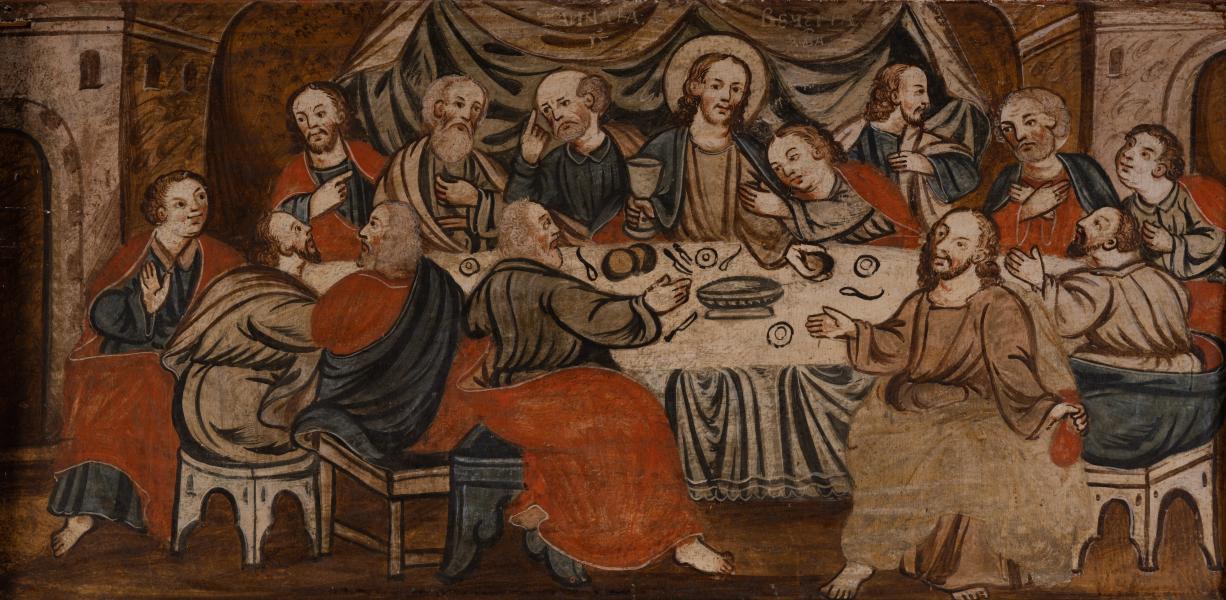
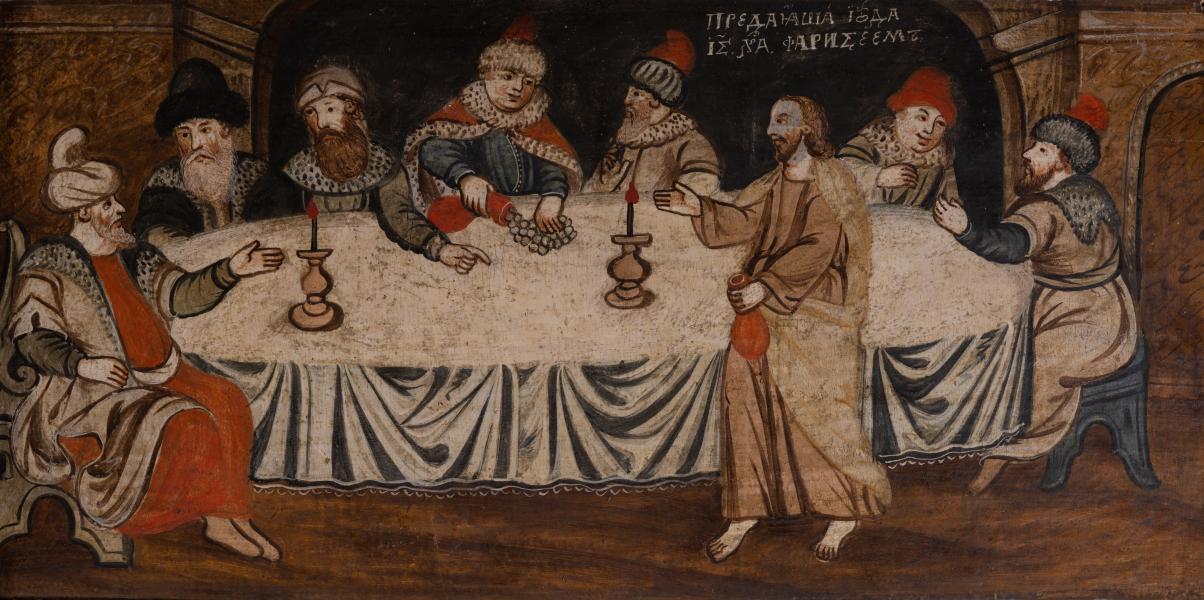
Part of the "Passion of the Christ" iconostasis is the Last Supper scene, an iconographic plot illustrating the events of Holy Thursday, the last meal of Christ before his crucifixion. The action occurs in the interior of a room where Christ and his disciples sit at a large oval table. A lively multi-figure scene shows a moment of heated discussion: the Saviour informs them that there is a traitor among them. The artists of the Rybotytska School showed the dishes in detail, using the time's characteristic decor, and depicted each character's individual features and emotional state. The work is marked by expressiveness and bright colours.
The following fragment of the work – the Bargain of Judas – is a scene in which Judas takes money from the chief priests. A multi-figure scene depicts the chief priests in expensive clothes sitting at a large oval table with a white tablecloth. One of the priests gives Judas silver coins.
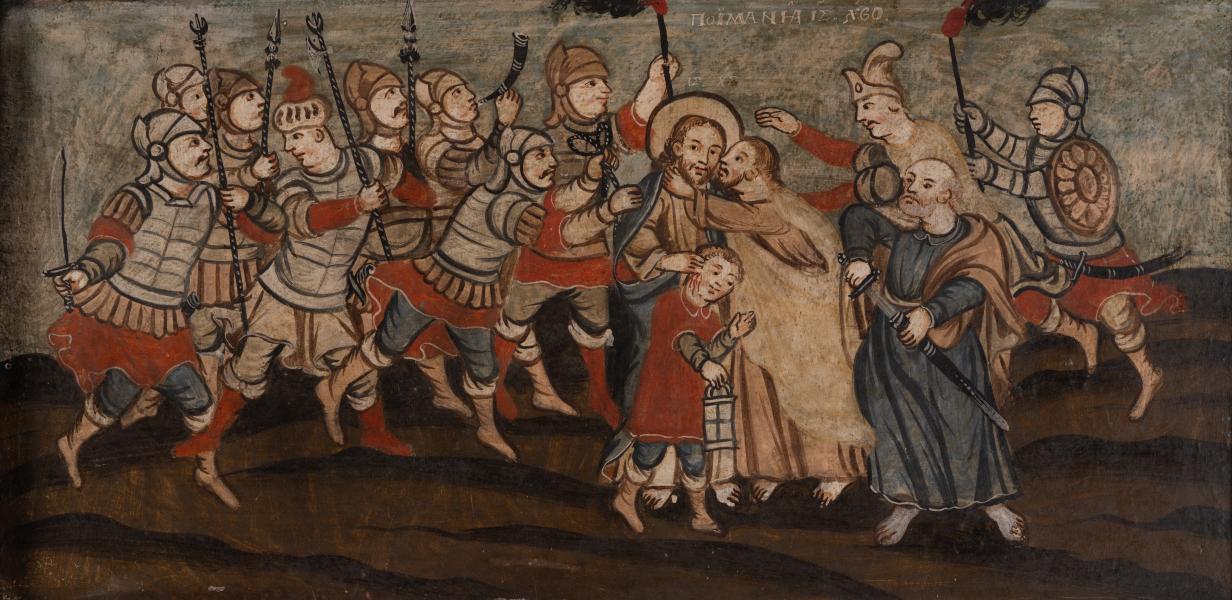
"The Kiss of Judas" is a scene that depicts the moment when the guards came to take away Christ, who his disciple had betrayed with a kiss. It shows the moment when Judas reached out with his lips to the Master, and the guards realised who they were to take. The group of guards is depicted in armour outlined by a graphic black line. The cheeks of the white faces are flushed – a characteristic feature of the Rybotytska School masters. Olive, red-ochre, and blue colours dominate in the colour scheme.
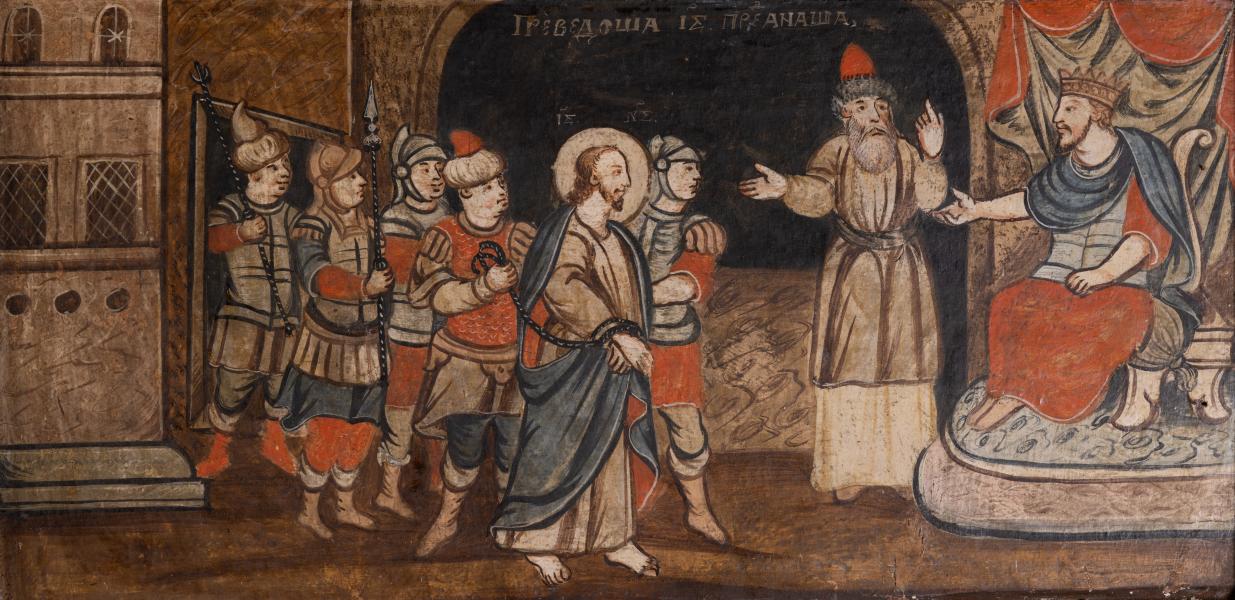
"Christ Before Annas" is a story about one of the Saviour's trials. The soldiers brought the Saviour to the old high priest Annas, Caiaphas' father-in-law, who was no longer serving in the temple and was living in peace. He interrogated Christ, trying to find some fault.
The works by the Rybotytska School artists were narrative: minor scenes and individual characters had inscriptions, which made it easy to identify images and plots.
Part of the "Passion of the Christ" iconostasis is the Last Supper scene, an iconographic plot illustrating the events of Holy Thursday, the last meal of Christ before his crucifixion. The action occurs in the interior of a room where Christ and his disciples sit at a large oval table. A lively multi-figure scene shows a moment of heated discussion: the Saviour informs them that there is a traitor among them. The artists of the Rybotytska School showed the dishes in detail, using the time's characteristic decor, and depicted each character's individual features and emotional state. The work is marked by expressiveness and bright colours.
The following fragment of the work – the Bargain of Judas – is a scene in which Judas takes money from the chief priests. A multi-figure scene depicts the chief priests in expensive clothes sitting at a large oval table with a white tablecloth. One of the priests gives Judas silver coins.
"The Kiss of Judas" is a scene that depicts the moment when the guards came to take away Christ, who his disciple had betrayed with a kiss. It shows the moment when Judas reached out with his lips to the Master, and the guards realised who they were to take. The group of guards is depicted in armour outlined by a graphic black line. The cheeks of the white faces are flushed – a characteristic feature of the Rybotytska School masters. Olive, red-ochre, and blue colours dominate in the colour scheme.
"Christ Before Annas" is a story about one of the Saviour's trials. The soldiers brought the Saviour to the old high priest Annas, Caiaphas' father-in-law, who was no longer serving in the temple and was living in peace. He interrogated Christ, trying to find some fault.
The works by the Rybotytska School artists were narrative: minor scenes and individual characters had inscriptions, which made it easy to identify images and plots.
Legal regulation
Borys Voznytskyi Lviv National Art Gallery