"The Passion of Christ" Iconostasis: The Way of the Cross, Crucifixion, Descent into Hell, Resurrection
unknown


Basic information
- ID
- Ж-4134
- Author
- unknown
- Name
- "The Passion of Christ" Iconostasis: The Way of the Cross, Crucifixion, Descent into Hell, Resurrection
- Date of creation
- early 18th c.
- Country
- Ukraine
- Culture
- Rybotytska School
- Technique
- tempera painting
- Material
- wood tempera
- Dimensions (height x width, cm)
- 114 x 221
Additionally
- Type
- icon
- Genre
- religious
- Plot
- The Passion of Christ
- Provenance
- Semenivka village, Lviv region
Information about author
Object description
"The Passion of Christ" is an iconostasis of the 17th – early 18th century consisting of a series of monumental multi-plot icons that should be viewed from top to bottom, in rows from left to right. The work's composition is distinguished by a large number of iconographic images with multi-figure scenes: 25 horizontally elongated Gospel scenes that tell us about the last days of Christ's earthly life. The four canonical scenes are part of a monumental painting composition belonging to the brush of the Rybotytska School painter. The multi-figure scenes are based on Western European models incorporated into Ukrainian art, mainly through engraving.
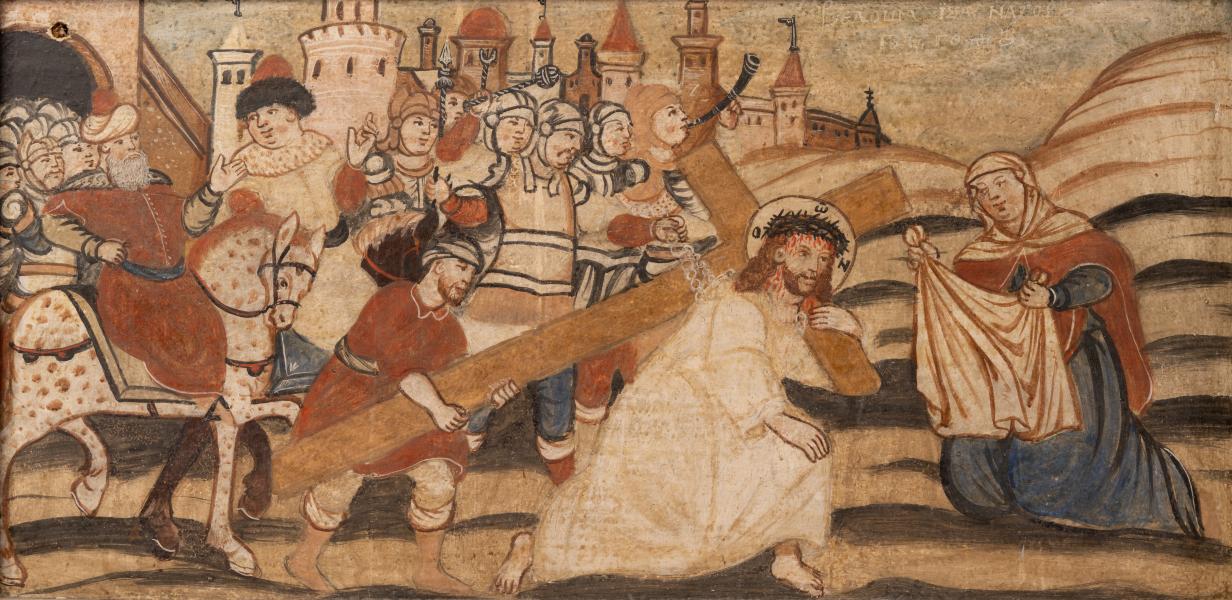
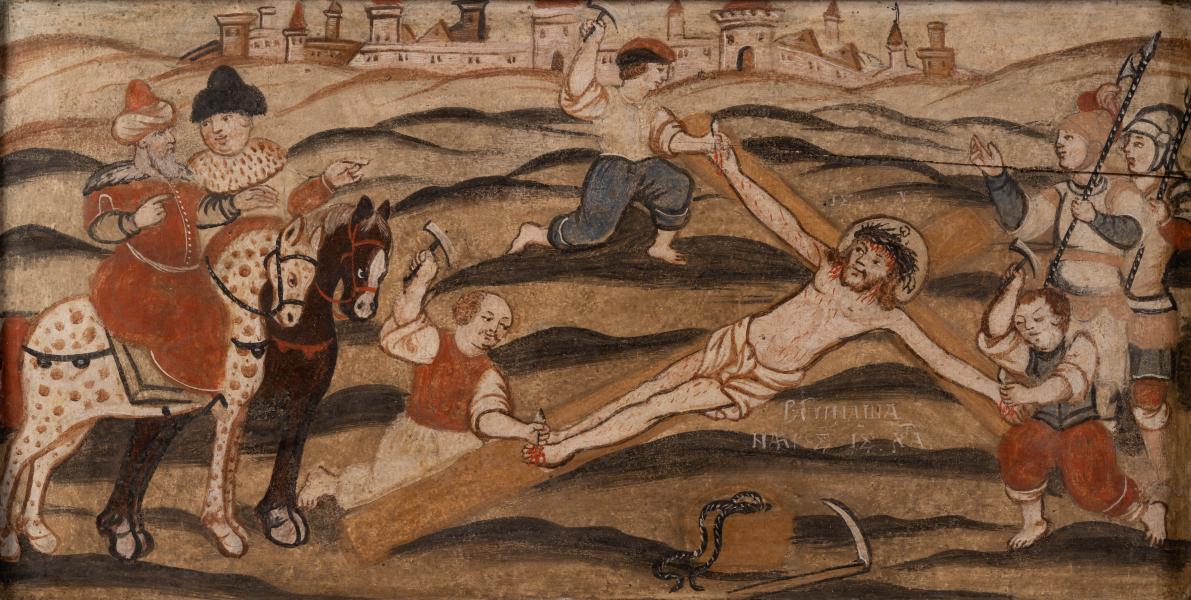
The depicted scenes – "The Way of the Cross", "Crucifixion", "Descent into Hell", and "Resurrection" – are located in the two lower rows. In the seventeenth century, the scenes of Veronica with a Handkerchief (the Way of the Cross) and the Crucifixion became popular in Ukrainian iconography. They are reproduced in the cycle from the village of Semenivka.
The "Way of the Cross" fragment depicts Jesus carrying the cross with Simon of Cyrene from the city to Mount Calvary. On the way, He meets Veronica, who is rubbing the face of the Saviour. The multi-figure scene is recreated against the background of an architectural staffage on a mountainous ground. In depicting the thorny path of Christ, the author does not deviate from the canonical Gospel narratives. The characters of the sacred plot, dressed in clothes typical for the artists' era, were notable for the Rybotytska School painters. A warm colour scheme with a smooth change of tone characterises the scene.
The "Crucifixion" fragment is another iconographic image where lively, dynamic figures divided into groups are depicted around the central composition. The image of the centurion Longinus on horseback is extraordinary – the artist placed him on several icons. The haughty, somewhat squat figure of the centurion in a red cloak with fur sits proudly on his horse. Warm colours predominate in the pictorial solution of the iconographic subject.
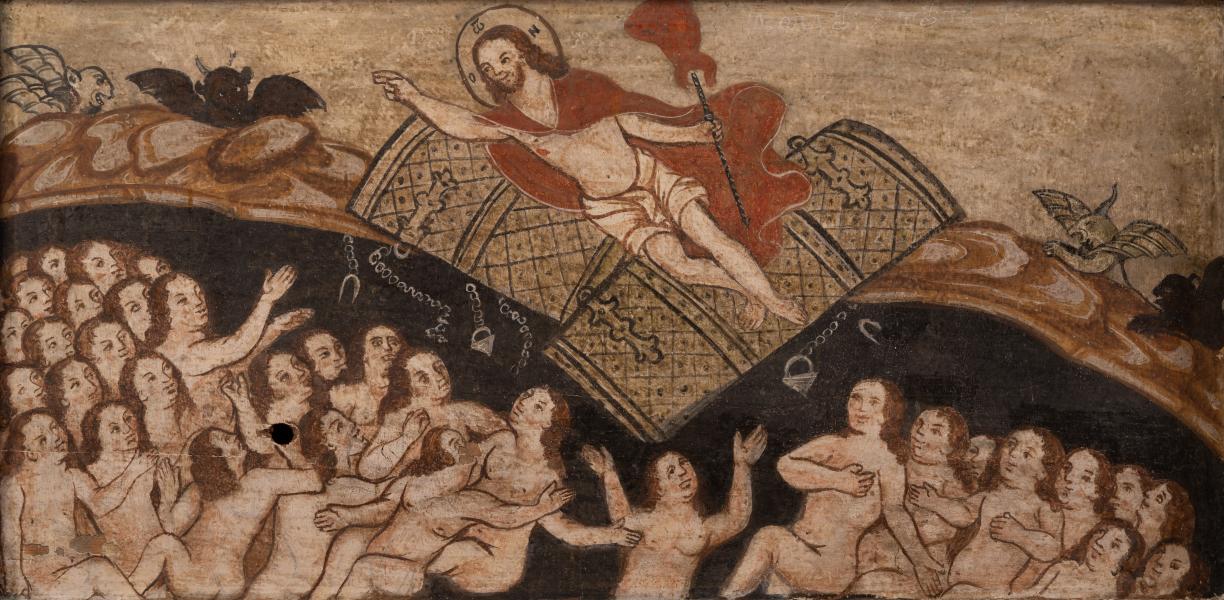
The "Descent into Hell" fragment shows Jesus in accordance with liturgical and apocryphal texts. The Saviour breaks the gates of hell and becomes the light of the world in the darkness of death: "When you went down to death, O immortal life, then you slew Hell with the lightning flash of your Godhead; but when from the depths below the earth you raised the dead, all the Powers in the heavens cried out: Giver of life, Christ our God, glory to you!" The iconic depiction concentrates on the figure of Christ in a red cloak, who not only descends into the abyss of hell but also breaks the gates of hell, breaking the locks and overcoming the resistance of the devil. The right hand of the Saviour is depicted in a gesture of blessing, and the left hand holds a banner. In the lower part of the work, the author shows the righteous waiting for the arrival of the Messiah – their bodies and faces are pale, reproduced using ochre glaze, with a slight blush on their cheeks. Such an interpretation of flat images is inherent in the iconography of the Rybotytska School. The graphic line plays an important role in reproducing the images, and the colour scheme combines olive, grey-blue, and red colours.
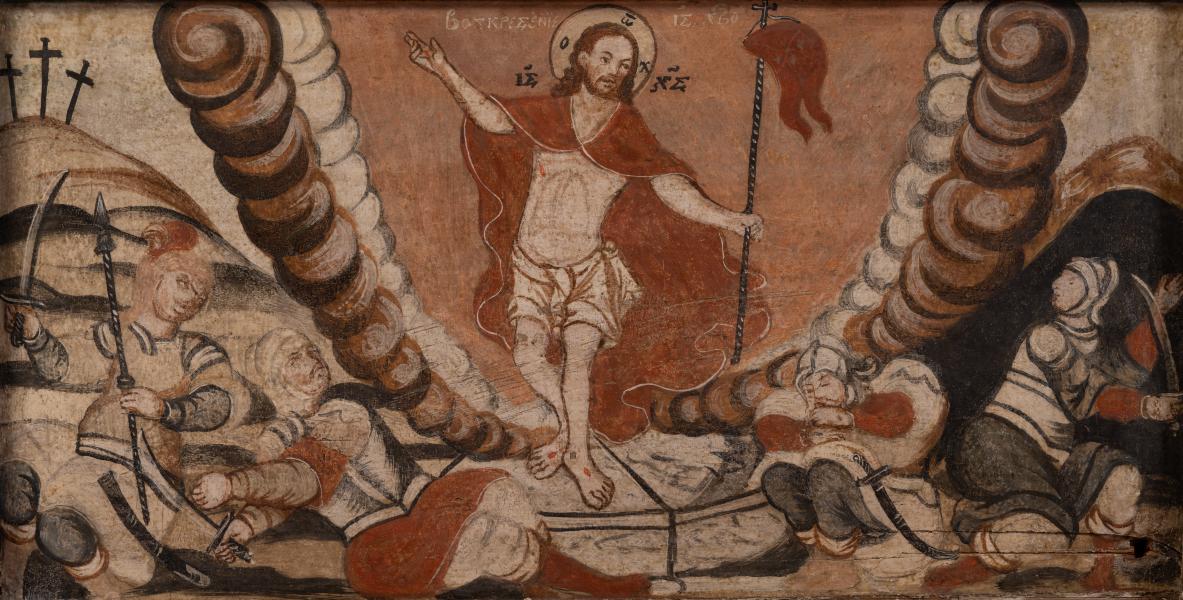
The "Resurrection" scene follows the Western iconographic tradition that was formed in the art of the late Middle Ages and later found its way into Ukrainian sacred painting. Christ, banner in hand, stands triumphantly on a stone tomb, with guards scattered around him. The Passion of Christ scenes from the village of Semenivka stand out among other works for their simplicity, immediacy, expressiveness, and attention to everyday details.
The depicted scenes – "The Way of the Cross", "Crucifixion", "Descent into Hell", and "Resurrection" – are located in the two lower rows. In the seventeenth century, the scenes of Veronica with a Handkerchief (the Way of the Cross) and the Crucifixion became popular in Ukrainian iconography. They are reproduced in the cycle from the village of Semenivka.
The "Way of the Cross" fragment depicts Jesus carrying the cross with Simon of Cyrene from the city to Mount Calvary. On the way, He meets Veronica, who is rubbing the face of the Saviour. The multi-figure scene is recreated against the background of an architectural staffage on a mountainous ground. In depicting the thorny path of Christ, the author does not deviate from the canonical Gospel narratives. The characters of the sacred plot, dressed in clothes typical for the artists' era, were notable for the Rybotytska School painters. A warm colour scheme with a smooth change of tone characterises the scene.
The "Crucifixion" fragment is another iconographic image where lively, dynamic figures divided into groups are depicted around the central composition. The image of the centurion Longinus on horseback is extraordinary – the artist placed him on several icons. The haughty, somewhat squat figure of the centurion in a red cloak with fur sits proudly on his horse. Warm colours predominate in the pictorial solution of the iconographic subject.
The "Descent into Hell" fragment shows Jesus in accordance with liturgical and apocryphal texts. The Saviour breaks the gates of hell and becomes the light of the world in the darkness of death: "When you went down to death, O immortal life, then you slew Hell with the lightning flash of your Godhead; but when from the depths below the earth you raised the dead, all the Powers in the heavens cried out: Giver of life, Christ our God, glory to you!" The iconic depiction concentrates on the figure of Christ in a red cloak, who not only descends into the abyss of hell but also breaks the gates of hell, breaking the locks and overcoming the resistance of the devil. The right hand of the Saviour is depicted in a gesture of blessing, and the left hand holds a banner. In the lower part of the work, the author shows the righteous waiting for the arrival of the Messiah – their bodies and faces are pale, reproduced using ochre glaze, with a slight blush on their cheeks. Such an interpretation of flat images is inherent in the iconography of the Rybotytska School. The graphic line plays an important role in reproducing the images, and the colour scheme combines olive, grey-blue, and red colours.
The "Resurrection" scene follows the Western iconographic tradition that was formed in the art of the late Middle Ages and later found its way into Ukrainian sacred painting. Christ, banner in hand, stands triumphantly on a stone tomb, with guards scattered around him. The Passion of Christ scenes from the village of Semenivka stand out among other works for their simplicity, immediacy, expressiveness, and attention to everyday details.
Legal regulation
Borys Voznytskyi Lviv National Art Gallery