Back

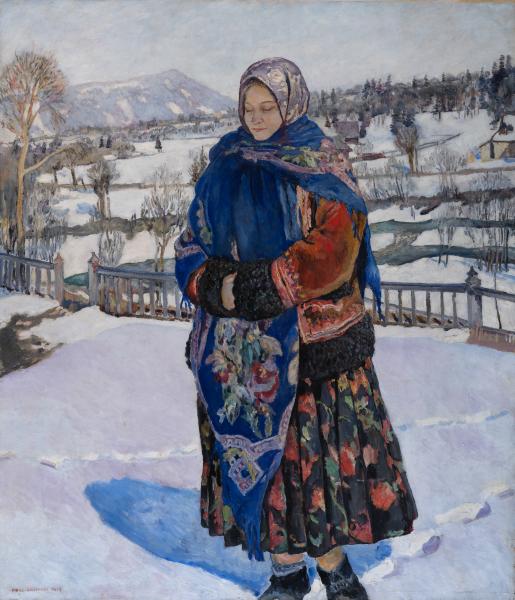
Winter Sun

Wladyslaw Jarocki

  • Winter Sun 2
  • Winter Sun 3
  • Winter Sun 4
Basic information
ID
Ж-4773
Author
Wladyslaw Jarocki
Name
Winter Sun
Date of creation
1929
Country
Poland
Technique
oil painting
Material
canvas oil
Dimensions (height x width, cm)
150 x 131
Information about author
Author
Wladyslaw Jarocki
Artist's lifetime
1879–1965
Country
Austro-Hungarian Empire, Poland
Biography
Wladyslaw Jarocki (June 6, 1879, Pidhaichyky, Austro-Hungarian Empire – February 7, 1965, Krakow, Poland) was a Polish painter, graphic artist, architect, educator, and public figure, as well as a member of the Society of Polish Artists "Sztuka" and the Vienna Secession. He was born on June 6, 1879, in the village of Pidhaichyky (now in the Ternopil region of Ukraine). After finishing high school and studying at the Faculty of Architecture at the Polytechnic in Lviv from 1902 to 1906, he continued his education at the Academy of Fine Arts in Krakow under Jozef Mehoffer and Leon Wyczolkowski. He continued his studies at the Academie Julian in Paris. From 1907 to 1911, he travelled through Italy, Ukraine, and the Caucasus. In 1915–1916, he served in the press headquarters of the Austro-Hungarian army. Until 1920, W. Jarocki lived in Lviv. He taught drawing courses at the Lviv Polytechnic and the State Industrial School and worked as a set designer for the City Theatre. From 1920, the artist lived in Krakow, where he served as a professor at the Academy of Fine Arts and an editor for the magazine "Sztuki piękne". He actively participated in art exhibitions in Krakow (1905), Kyiv (1908), Rome (1911), and Venice (1909, 1910, 1920, 1926, 1932). The artist held solo exhibitions in Lviv (1912), Warsaw (1914, 1938), Poznan (1923), The Hague (1938), Krakow (1939, 1949, 1952, 1957), and Zakopane (1956). Wladyslaw Jarocki is primarily known for his colourful landscapes of the Carpathians, portraits, and genre scenes depicting the lives of the inhabitants of the Hutsul and Pidhallia regions. Additionally, the artist was passionate about graphics (posters, caricatures for magazines) and set design. The artist was part of the "Hutsul Trio" (as critics referred to them at the time) – W. Jarocki, K. Sichulski, and F. Pautch – who were captivated by Hutsul themes and employed Impressionist methods and techniques in the genres of everyday life and portraiture. The artist's entire life was connected to the Tatras. In 1920, W. Jarocki married Anna, the eldest daughter of Polish poet and translator Jan Kasprowicz and Jadwiga Gasowska, and frequently visited the "Harenda" villa – the home of Jan Kasprowicz in Zakopane. Since 1964, a gallery of paintings by Wladyslaw Jarocki has been opened at the "Harenda" villa as part of the Jan Kasprowicz Memorial Museum.
Object description
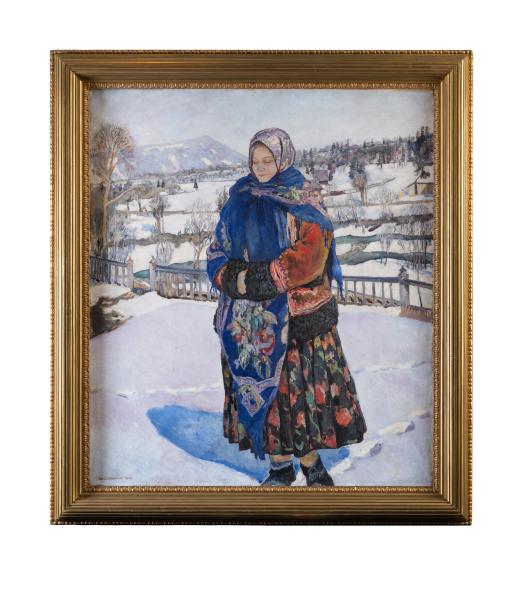
Against the backdrop of a sunlit, snow-covered mountain landscape with scattered houses, a young woman in colourful Hutsul attire is depicted. Her head is slightly lowered, and her eyes are squinting. The girl is dressed in the typical winter attire of the mountain dwellers – a long floral skirt and a red coat trimmed with black fur. Her hands are hidden in the sleeves. The main focus is a large, brightly blue headscarf with a floral pattern that covers her shoulders and hangs loosely in front, below her knees. A dark blue shadow falls from the woman's figure onto the white-pink snow to the left. In the distance, grey fencing strips, a stream, and hills create a striking horizontal rhythm. Everything around is filled with soft, diffused sunlight. The painting depicts Maria Kasprowiczowa (1887–1968), nee Bunina, the third wife of Polish poet, playwright, and translator Jan Kasprowicz (1860–1926), near their "Harenda" villa in Zakopane.
Inscriptions
In the lower left, the author's signature and date: "Wlad. Jarocki 1929".
Portrayed person
The name of the person portrayed
Maria Kasprowiczowa (1887–1968), daughter of General Victor Bunin of the russian Imperial Army and Maria Anderson was the third wife of the Polish poet, playwright, and translator Jan Kasprowicz (1860–1926). Maria Bunina and Jan Kasprowicz married in 1911 despite the significant age difference. After her husband's death, Maria published "The Diaries", a memoir about the distinguished poet, in 1932–1934. In 1950, at her initiative, the Jan Kasprowicz House Museum was established at the "Harenda" villa in Zakopane. In 1964, the Society of Friends of the Work of J. Kasprowicz was established at the museum, and a gallery of paintings by W. Jarocki was opened.
Lifetime of the person portrayed
1887–1968
Legal regulation
Borys Voznytskyi Lviv National Art Gallery