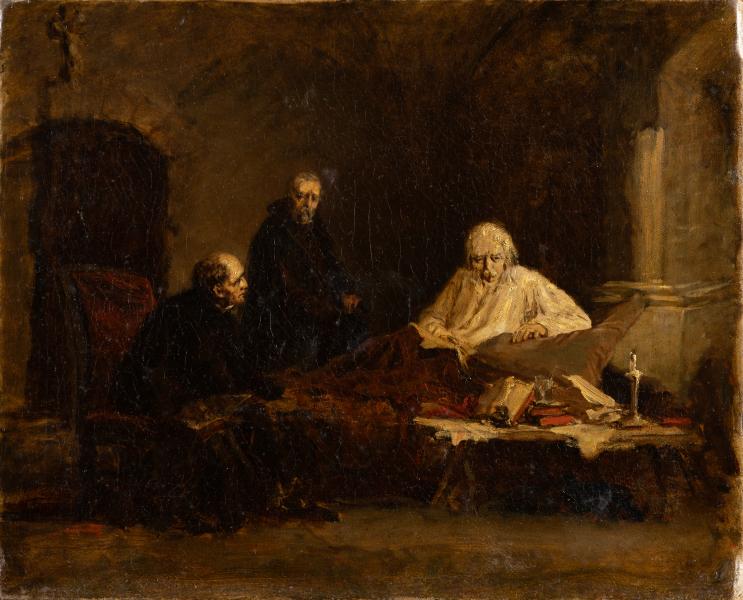
Death of Acernus. Sketch
Wilhelm Leopolski


Basic information
- ID
- Ж-114
- Author
- Wilhelm Leopolski
- Name
- Death of Acernus. Sketch
- Date of creation
- 1865–1867
- Country
- Austro-Hungarian Empire
- Technique
- oil painting
- Material
- canvas oil
- Dimensions (height x width, cm)
- 45 x 56
Additionally
- Type
- painting
- Genre
- history painting
- Plot
- The death of Acernus
- Provenance
- Collection of Lviv City Gallery
Information about author
Object description
The work is a sketch for the first version of W. Leopolski's painting "The Death of Acernus" (1867), one of the artist's most famous works. The canvas exists in two versions, created by the artist with a ten-year interval – 1867 and 1876. The first version of the painting, titled "The Last Moments of Klenowicz", was created shortly after the artist moved to Lviv. The painting brought him recognition and an award from the Austrian government. Until 1903, the sketch and the painting were part of the collection of Lviv musician Ludwik Marek. In 1903, the painting and sketch were purchased for the Gallery collection. Later, in 1946, the "Last Moments of Acernus" canvas was transferred to the National Museum in Wroclaw. In the Gallery's collection, in addition to the sketch for the first version, there is also the second version of the painting, created by W. Leopolski on commission from the collector J. Weigel. Acernus is the Latin surname of the Polish poet of the late Renaissance, Sebastian Klonowic (circa 1545–1602). Among his main works is the poem "Victoria deorum", in which the writer attempted to highlight societal issues, particularly criticising the clergy. In the context of Counter-Reformation, this led to accusations against Klonowic for promoting the reformist movement and resulted in official condemnation of his work. For the same reason, he was also accused of writing the anti-Jesuit pasquinade ''Equitis in Jesuitas actio prima" in 1590. Thus, the legend of Sebastian Klonowic as a fighter against the Catholic Church emerged. The theme of the Reformation captivated W. Leopolski in his time, and the conflict between S. Klonowic and the Jesuits was reflected in two of his works. The oil sketch by W. Leopolski, created without the use of models, depicts the final moments of Sebastian Klonowic (Acernus) in the Jesuit hospital of St. Lazarus in Lublin, where the dying poet contemplates the possibility of reconciliation with the Roman Catholic Church during a conversation with a Jesuit monk. In this dramatic confrontation between the main characters – the wise but stern Jesuit and the weary-from-life-and-illness Sebastian Klonowic – the court physician of King Stephen Bathory, Wojciech Oczko, is depicted observing in the background.
Legal regulation
Borys Voznytskyi Lviv National Art Gallery