Nymph of Svitiaz
Witold Pruszkowski


Basic information
- ID
- Ж-2121
- Author
- Witold Pruszkowski
- Name
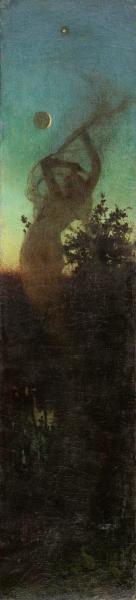
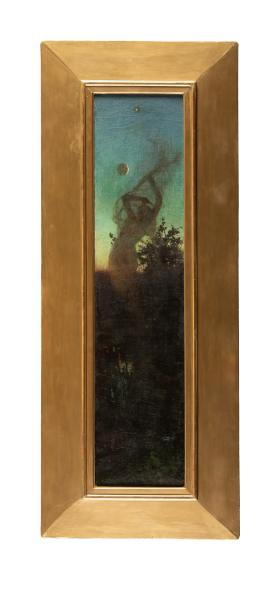
- Nymph of Svitiaz
- Technique
- oil painting
- Material
- canvas oil
- Dimensions (height x width, cm)
- 122.5 x 28.5
Additionally
- Type
- painting
- Genre
- symbolic art landscape
- Provenance
- Collection of Lviv City Gallery
Information about author
Object description
Witold Pruszkowski was a master of exquisite, melancholic landscapes. The nature depicted in his paintings is always otherworldly, fantastical, mysterious, and often semi-personified. The artist created the "Nymph of Svitiaz" painting under the influence of the eponymous romantic ballad by Adam Mickiewicz, which was first published in the collection "Ballads and Romances" (1822, Vilnius). The main character of the poetic work is the water nymph Svitiazianka, a mythical inhabitant of Lake Svitiaz, located near the town of Novohrudok in Belarus. In the rectangular vertical composition, the silhouette of a young, naked girl dominates the scene, with her arms raised upwards and her back turned to the viewer. Pruszkowski's Svitiazianka is an elusive night-time phantom that transforms into a delicate, diffused haze. The dark, reed-covered expanse of the lake at the bottom of the painting contrasts with the clear pre-dawn sky, featuring a thin crescent moon and a solitary star above it.
Inscriptions
At the bottom right, the author's signature: "W. Pruszkowski".
Legal regulation
Borys Voznytskyi Lviv National Art Gallery