Madonna with the Child, Saints and Donor
unknown (Venetian School)


Basic information
- ID
- Ж-2508
- Author
- unknown (Venetian School)
- Name
- Madonna with the Child, Saints and Donor
- Date of creation
- 2d half of the 16th c.
- Country
- Italy
- Technique
- oil painting
- Material
- copper oil
- Dimensions (height x width, cm)
- 25.5 x 36
Additionally
- Type
- painting
- Genre
- religious portraiture
- Plot
- Madonna. Mary with the Christ-child
- Provenance
- the Lubomirski collection
- Exposition
- Potocki Palace
Information about author
Object description
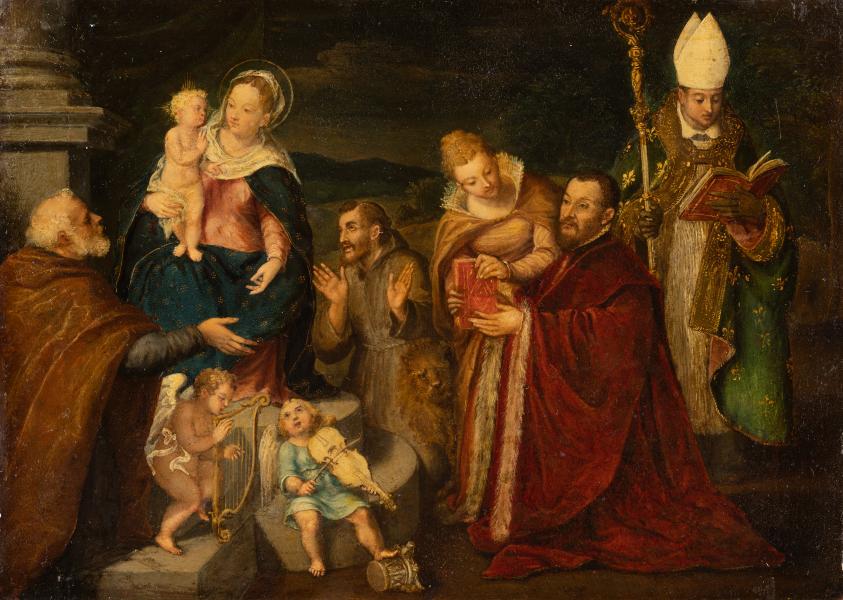
The Venetian School existed in Veneto, a region of Italy, for several centuries. The works of the masters who belonged to it were characterised by their colourfulness, and the use of bright, festive, harmoniously combined colours. The Venetian masters achieved great success in portraiture, as evidenced by the invitations they received to work in other countries. Essential features of Venetian art and culture were secularism and sensuality. In the left half of the painting, the Madonna sits on a pedestal, holding the infant Jesus in her lap and blessing the donor. Two saints kneel to worship the Virgin Mary and Christ: a grey-haired elder in a brown cloak on the left and a Franciscan monk on the right. Two angels play at the feet of the Virgin: one plays the harp, and the other the violin. At the notional centre of the composition is the figure of a lion, a symbol of Venice, looking directly at the viewer. The figure of the donor dominates the right half of the canvas. He is depicted on his knees, wearing a purple doge's robe with ermine trim. A young woman in a luxurious gold dress hands him a prayer book. To the donor's right is a saint in episcopal vestments and a mitre. He holds a staff in his right hand and an open prayer book in his left. The backdrop for the figures is a vast landscape. The saints do not have attributes that could be used to identify them. Still, the iconography of the figures suggests that they are Mark the Evangelist, Francis of Assisi, St. Barbara, and St. Theodore (from left to right).
Legal regulation
Borys Voznytskyi Lviv National Art Gallery