Back

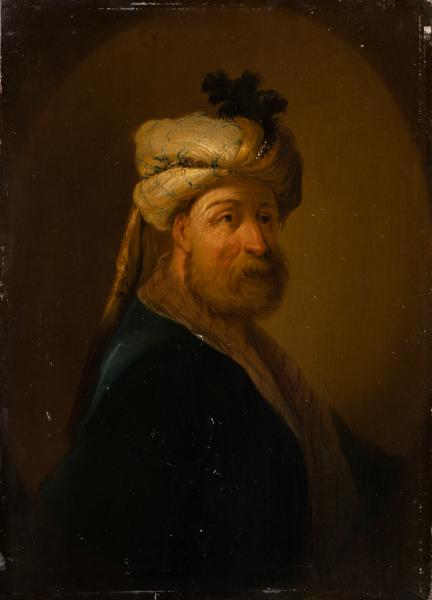
Study of a Man in a Turban

Christian Dietrich

  • Study of a Man in a Turban 2
  • Study of a Man in a Turban 3
Basic information
ID
Ж-2337
Author
Christian Dietrich
Name
Study of a Man in a Turban
Date of creation
18th c.
Technique
oil painting
Material
wood oil
Dimensions (height x width, cm)
29.3 x 21
Additionally
Type
painting
Genre
portraiture
Plot
Portrait
Provenance
the Lubomirski collection
Exposition
Potocki Palace
Information about author
Author
Christian Dietrich
Artist's lifetime
1712–1774
Country
Germany (?)
Biography
Christian Wilhelm Ernst Dietrich (1712–1774) was a German painter and engraver. He was born in Weimar, Thuringia, into the family of the court painter Johann Georg Dietrich. His mother was Johanna Dorothea Dietrich, the daughter of court painter Johann Ernst Rench. Dietrich's sister Maria Dorothea Wagner and his nephew Johann Georg Wagner were also artists. Christian Wilhelm Dietrich studied painting with his father, a miniaturist at the ducal court. To continue his training, Dietrich was sent to Dresden, the capital of Saxony, where he learned from the painter and engraver Johann Alexander Thiele. At the age of eighteen, Dietrich managed to paint a picture in two hours, which impressed Elector Augustus the Strong so much that he instructed his minister, Count Bruhl, to take care of Dietrich's further education. It is known that from 1734 Dietrich was in the Netherlands, and in 1741 he was appointed court painter to the Saxon Elector Augustus III. A subsequent trip to Italy in 1743, during which Dietrich signed his works "Dietericij", did not significantly impact his oeuvre. The following years were successful for the artist. Initially, he limited himself to imitating famous Italian and Dutch artists such as Raphael, Rembrandt, Salvator Rosa, Adriaen van Ostade, Cornelius van Poelenburgh, and Nicolaes Berchem. His paintings were so similar to the originals that they were sold, for instance, as genuine Rembrandts. In most of Dietrich's works, historical or biblical themes were depicted, including landscapes, still lifes, and, less frequently, genre scenes. However, the artist rarely painted portraits. According to his contemporaries, Dietrich lacked an independent, creative artistic spirit, and his talent was rather technical. But many highly praised his landscape etchings, and Johann Joachim Winckelmann even referred to Dietrich as the "Raphael of all times in landscapes". Fifty-four of Dietrich's paintings are in the Old Masters Gallery in Dresden. His graphic works reflect the growing interest in etching art in Germany at that time while showcasing the artist's ease and artistry. In 1810, a collection of Dietrich's drawings, studies, and sketches was published in Leipzig. Around one hundred and eighty printed graphic sheets have been preserved, characterised by the virtuosity of technique and a variety of motifs. Dietrich's graphic works include themes from the Old and New Testaments, mythological subjects, and allegories, as well as landscapes, rural scenes, pastorals, animal depictions, coats of arms, vignettes, book initials, and genre images. Dietrich focused on the landscape genre, drawing inspiration from his favourite Dutch masters of the seventeenth century. The works of Christian Wilhelm Dietrich were well-known in many European countries. He was elected an honorary member of the Augsburg, Bologna and Copenhagen academies. In 1764, he was appointed director of the painting school at the Meissen porcelain manufactory. In 1765, he became a professor at the Dresden Academy of Fine Arts. The artist was also an inspector of the Dresden Picture Gallery.
Object description
Though Christian Dietrich created a wide variety of paintings, he is primarily known for emulating the masters of the 17th century. This canvas features a portrait created by the author himself. On a light brown oval background, there is a half-length depiction of an older man, almost in profile, with his head turned three-quarters towards the viewer. On his head is a light turban adorned with black feathers and beads. The portrayed man is dressed in a dark blue Eastern robe and a light brown shawl, highlighting the shade of his beard. The man's eyes reflect wisdom, weariness, and a sense of detachment. The gaze itself avoids the viewer and is directed straight ahead. The overall colour palette consists of warm brown tones. Starting from the late 17th century, Europeans began to favour wearing Eastern garments in their private lives. Inspired by satirical fantasy tales, plays, exotic travels, and paintings by artists who travelled extensively, contemporary decor and fashion for private settings began to adopt Eastern influences.
Legal regulation
Borys Voznytskyi Lviv National Art Gallery