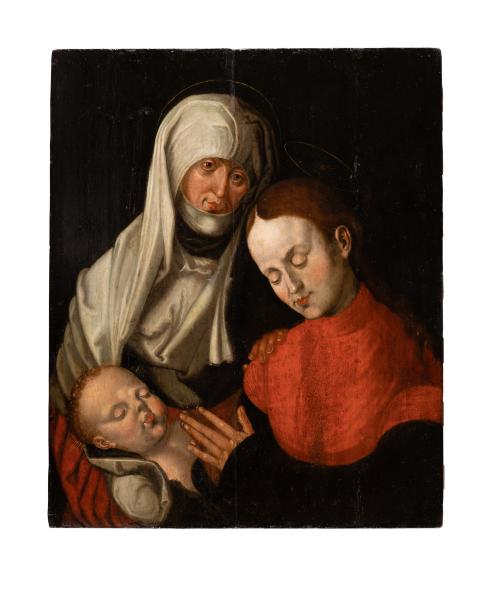
Madonna with Saint Anne
unknown (Copy after Albrecht Durer)


Basic information
- ID
- Ж-2023
- Author
- unknown (Copy after Albrecht Durer)
- Name
- Madonna with Saint Anne
- Technique
- oil painting
- Material
- wood oil
- Dimensions (height x width, cm)
- 68.5 x 56
Additionally
- Type
- painting
- Genre
- religious
- Plot
- Virgin Mary Saint Anne
- Provenance
- Collection of Lviv City Gallery
- Exposition
- Potocki Palace
Information about author
Object description
The painting is a copy after Albrecht Durer. It depicts the Virgin Mary with the Child and Saint Anne, the mother of the Virgin Mary, who was especially venerated in Germany. The hand of Saint Anne on her daughter's shoulder symbolises comfort, while her gaze evokes the foreboding of Christ's Passion. The composition is traditionally framed within a triangle. Under the influence of Venetian painting, Durer emphasised rich colours and paid meticulous attention to the depiction of details, as well as to the simplicity of the composition. In the apocryphal texts of the 6th–8th centuries, the righteous Joachim and Anna, the parents of the Virgin Mary, are mentioned as having long awaited the blessing of having children, as being childless was considered a curse. The true names of the Virgin Mary's parents are unknown. The Hebrew name "Anna" means "grace", while "Joachim" means "prepared for the Lord" – both are distinctly symbolic.
Legal regulation
Borys Voznytskyi Lviv National Art Gallery