Back

Sleeping Venus

unknown (School of Palma il Vecchio)

  • Sleeping Venus 2
  • Sleeping Venus 3
  • Sleeping Venus 4
  • Sleeping Venus 5
Basic information
ID
Ж-2124
Author
unknown (School of Palma il Vecchio)
Name
Sleeping Venus
Date of creation
1510–1515
Technique
oil painting
Material
wood oil
Dimensions (height x width, cm)
68 x 141
Additionally
Information about author
Author
unknown (School of Palma il Vecchio)
Biography
Jacopo Palma the Elder (Jacopo Nigretti) (1480–1528) was an Italian painter from the transition between the 15th and 16th centuries. The artist was born in the town of Serino. After completing his studies in Bergamo, he moved to Venice, a world-renowned economic and artistic centre. Evidence of the artist's presence in Venice is provided by a document from 1510. The addition of "Vecchio" (Elder) to the artist's surname was created by historians to distinguish his work from that of his nephew, Jacopo Palma the Younger, a painter of the Mannerist period. It is known that Palma the Elder had three daughters and continued working in Venice until his life's end. His work was influenced by artists who emerged from the workshop of Giovanni Bellini – Giorgione and Titian – who became creatively independent from their respective teachers. Jacopo Palma the Elder carefully mastered the fashionable innovations of his predecessors to earn a living successfully. His works resonate with those of other Venetian masters in terms of narrative, composition, and colour palette. He often painted works based on established recipe schemes, sometimes not even changing the format but rather removing or adding new characters according to the commission, altering only the details, etc. The extent to which he accurately imitated the artistic styles of others is illustrated by the confusion surrounding his early works and the paintings by other Venetians, who often did not sign their finished works. However, the poetic quality and richness of meaning in the works by Giorgione and the artists of his workshop are inferior to the provincial insignificance and the mundane, dull existence found in Palma the Elder's paintings. The bright clothing of the characters in his paintings misleads viewers and merely conceals the ordinariness of the figures. The artist's works attest to the highest level that a provincial and well-trained master could achieve in a significant artistic centre of that time. Palma the Elder's canvases are part of the collections of many art galleries; however, the only work signed by the artist is held in the Berlin Museum.
Object description
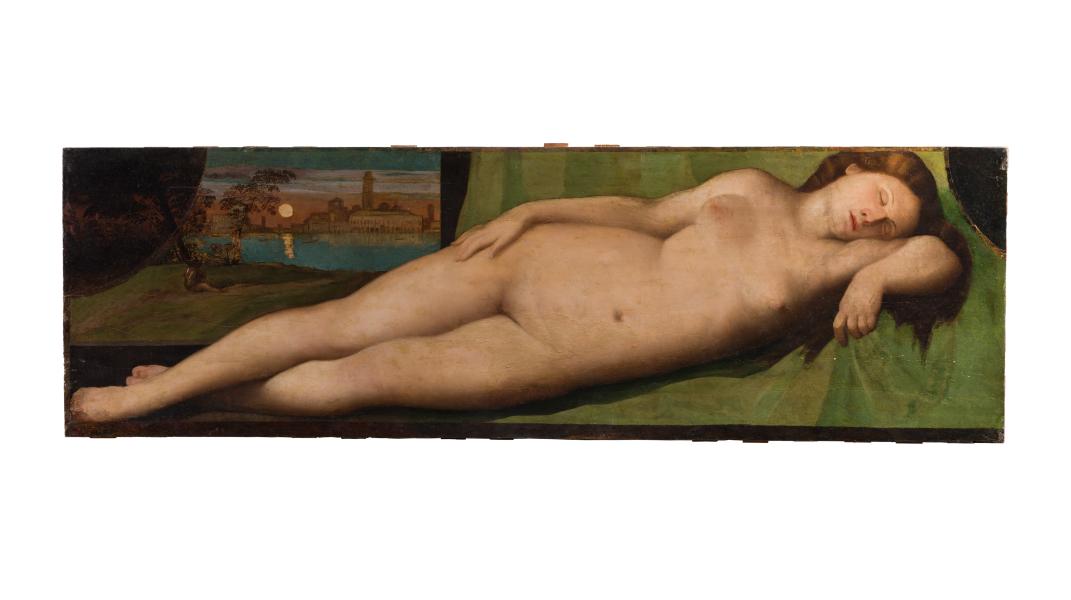
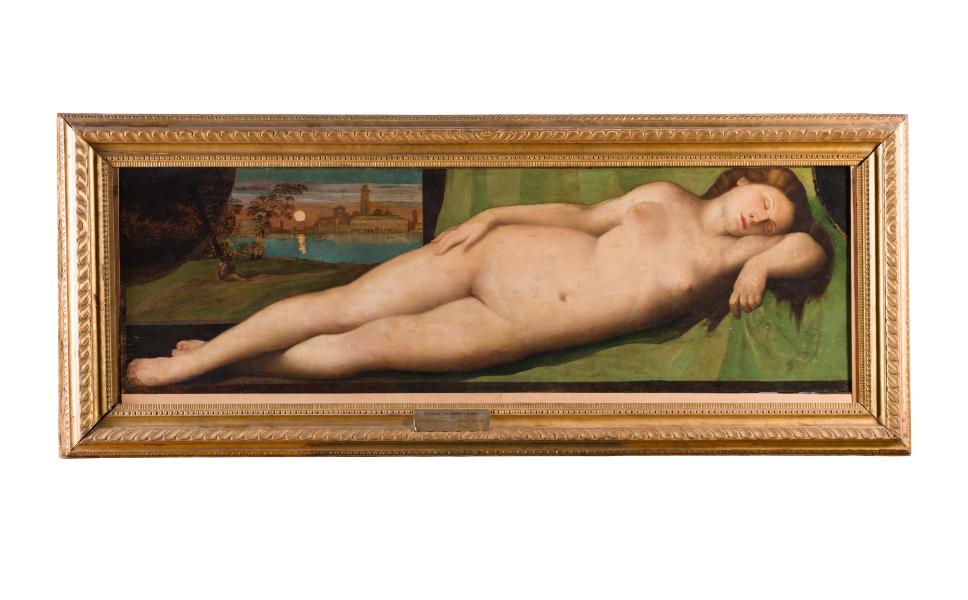
A sleeping nude woman is depicted on a bed covered with light green fabric in a warm shade. To the left, behind a pulled-back dark curtain, a landscape breathes with tranquil beauty. The sun sets behind the outlines of an ancient city, its long reflection touching the water's surface. The artwork exudes a particular charm. The refined fluidity of lines, soft outlines of the distant landscape, and the use of shadows to create volume – all of these are characteristic of the works of Renaissance artists. The reference to ancient mythology is a distinctive feature of the Early Renaissance period. Ancient culture became the foundation and arsenal of humanism, which celebrated humankind's spiritual and physical beauty. "Sleeping Venus" was one of the most popular themes of that period. Venus is the goddess of beauty, love, spring, desires, and rebirth.
Legal regulation
Borys Voznytskyi Lviv National Art Gallery