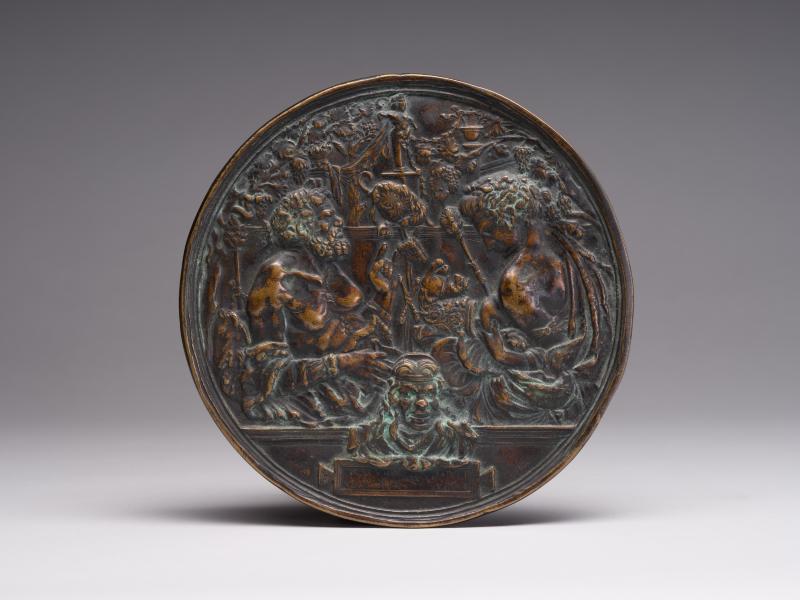
Satyr and Bacchante (Maenad)
Master of the Martelli Mirror



Basic information
- ID
- С-II-677
- Author
- Master of the Martelli Mirror
- Name
- Satyr and Bacchante (Maenad)
- Date of creation
- late 15th c.
- Technique
- casting
- Material
- bronze
- Dimensions (diameter, cm)
- 18.7
Additionally
Information about author
Object description
The original Martelli mirror was a round plaquette that supported a polished mirror (15th century). In the following centuries, casts of the plaquette itself became popular. The main characters of the composition are two waist-length figures sitting in profile, facing each other – an old Satyr (to the left) and a Bacchante, or Maenad (to the right), squeezing milk from her breast into a horn decorated with a half-figure of a dog. The characters are seated, surrounded by grapevines and other symbols of fertility. At the top of the axis is a figure of a putto on a podium. At the bottom centre is a full-length image of a long-haired man, possibly one of the members of the aristocratic Martelli family of Tuscany. Among its famous members are Federico, a Franciscan monk and astrologer (15th–16th centuries), and Camilla Martelli (1547–1590), the morganatic wife of Cosimo I de' Medici, the first Grand Duke of Tuscany. Under the portrait is a plaque with the inscription: "Natura iovet que necessatis urget" ("Nature rejoices, for it satisfies the thirsty"). The satyr's hand gesture is an ancient sign that was believed to ward off the evil eye. This message of protection indicates that the original mirror may have been a wedding gift. Variations of the plaquette are kept in museums in London and New York, as well as in museums in other European countries and the United States. There are variations of oval plaquettes with separate images of the Satyr and the Bacchante. Master’s of the Martelli Mirror work was created after a model by Cristoforo Foppa, known as Caradosso (1445–1527 (?)).
Inscriptions
At the bottom of the plaque is an inscription in Latin: "Natura iovet que necessatis urget" ("Nature rejoices, for it satisfies those who thirst"). On the reverse side are the inscriptions: "39. G.N.M.L."; "№ С-ІІ-677 Львів ОКГ"; "№ С-ІІ-677 / Львів ОКГ"; a stamp with the inscription: "Gal. Nar. m. Lwowa".
Legal regulation
Borys Voznytskyi Lviv National Art Gallery