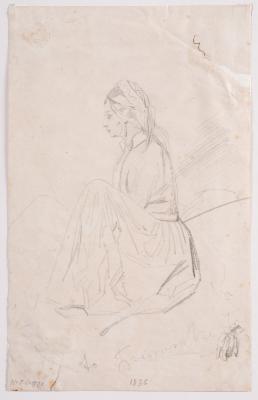
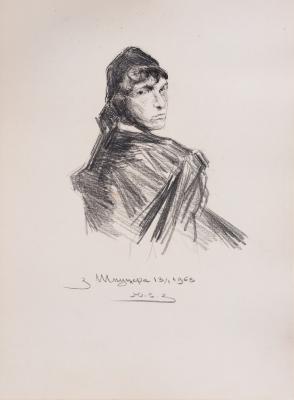
Drawing of a Man's Bust
Yulian Zaiats


Basic information
- ID
- Ф-З-Арх-ЛГМ-5/31
- Author
- Yulian Zaiats
- Name
- Drawing of a Man's Bust
- Date of creation
- 25.12.1909
- Country
- Austro-Hungarian Empire (?)
- Technique
- watercolour
- Material
- paper watercolour
- Dimensions (height x width, cm)
- 9.3 x 8.2
Additionally
- Type
- painting
- Genre
- portraiture
- Plot
- Portrait
- Provenance
- Received from Nina Zaiats
Information about author
Object description
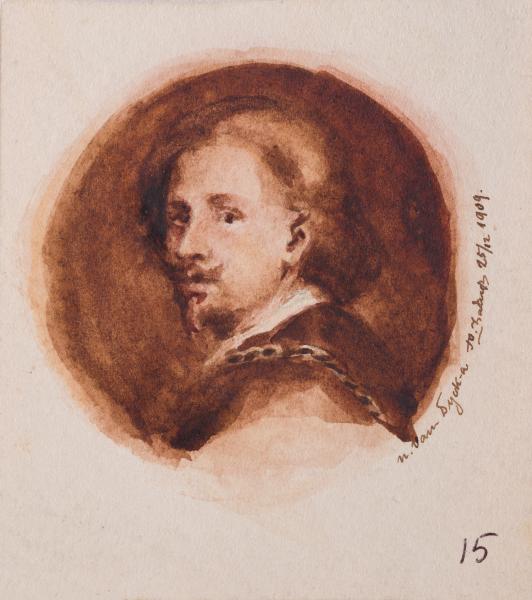
The letter features a watercolour copy (in warm monochrome sepia) reproducing Antonis van Dyck's self-portrait, dated 1623. The author of the copy chose a model that is complex in its composition and expressiveness, which in its original version is one of the most iconic early self-portraits of the artist, created during the formation of his artistic style. The composition reproduces a three-quarter bust portrait of the young artist, with his face turned towards the viewer. The raised head, somewhat distant gaze, and restrained facial expression give the portrait a sense of inner dignity, characteristic of the aristocratic self-portrait canon of the time. The technical execution of the copy demonstrates a high level of discipline in working with watercolour as a medium. The author uses transparent and semi-transparent layers of paint to model volume, which allows him to achieve depth in the rendering of form while preserving the texture of the paper. Particular attention is paid to the face, where the chiaroscuro drama enhances the expressiveness of the gaze and the relief of the features. In the background and costume areas, a complex play of gradations is evident, ranging from rich brown to light ochre halftones, which creates a rhythmic and harmonious construction of space. The copy is not a mere mechanical reproduction of the image: the author reveals his personal attitude to the model, preserves the characteristic rhythm of lines and the overall plastic structure, but somewhat softens the original expressiveness. Despite its monochromaticity, the sepia tone adds elegant integrity to the image and emphasises the nobility of the original. The use of this particular range is indicative of the teaching practice of the early 20th century: it allowed students to delve deeper into the analysis of light and shadow structure, texture, and plastic construction of form, without being distracted by colour diversity. The image of Van Dyck as a young artist is symbolic and methodically justified, demonstrating an early awareness of his own image as part of his creative and social self-positioning. In the context of academic training, such work was an exercise in simultaneously studying anatomy, composition, portrait psychology, and the peculiarities of graphic interpretation of the original painting. Thus, the watercolour copy of Van Dyck's self-portrait is a valuable example of academic methodology, which combined the copying of masterpieces with conscious artistic analysis and the gradual formation of one's own expressive language.
Inscriptions
Inscription "п. Van Dyck-a"; signature of Yulian Zaiats; "25/12 1909".
Portrayed person
- The name of the person portrayed
- Anthony van Dyck
- Lifetime of the person portrayed
- 22.03.1599–09.12.1641
Legal regulation
Borys Voznytskyi Lviv National Art Gallery