Drawings of Genre Scenes
Yulian Zaiats


Basic information
- ID
- Ф-З-Арх-ЛГМ-7/5
- Author
- Yulian Zaiats
- Name
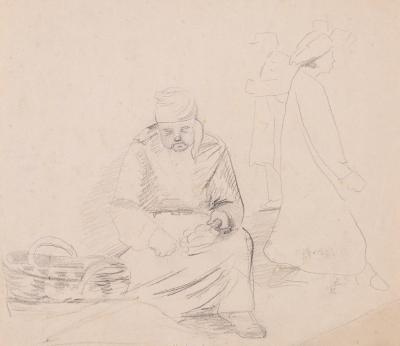
- Drawings of Genre Scenes
- Date of creation
- 21.04.1962
- Country
- the Ukrainian SSR
- Technique
- drawing
- Material
- paper pencil Indian ink
- Dimensions (height x width, cm)
- 20.4 x 28.5
Additionally
- Type
- graphic art
- Genre
- genre art
- Provenance
- Received from Nina Zaiats
Information about author
Object description
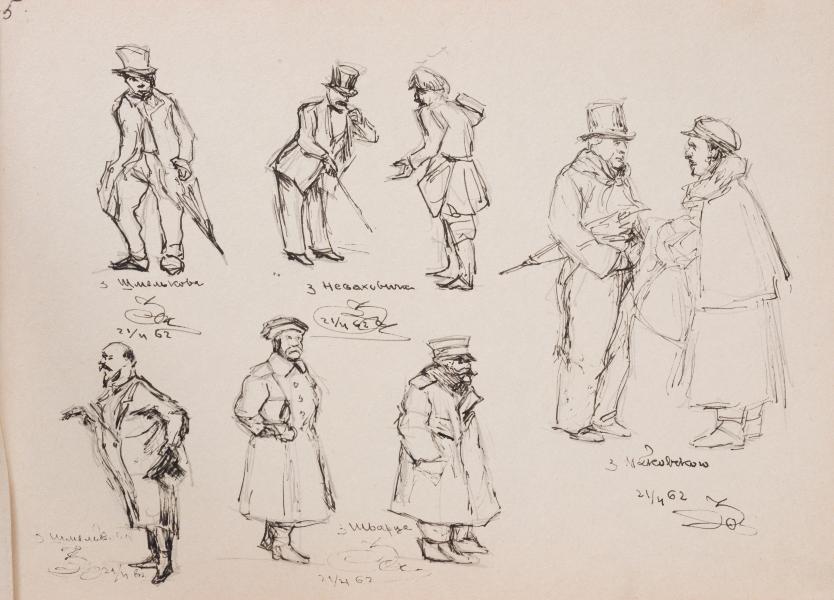
The sheet features a series of concise yet expressive graphic sketches that are stylistically consistent with previous studies but based on characters from satirical and everyday compositions by authors such as Pavlo Shmelkov, Mykhailo Nevakhovych, Kostiantyn Makovskyi, and Yosyp Schwartz. All the figures are grouped on a single sheet in a compositional structure reminiscent of a “gallery of characters”, where each face and each figure has individual features, grotesque exaggeration, or caricatured deformation characteristic of the sources of inspiration. Despite the humorous nature of the source material, the drawings are executed with high technical skill: the author has a confident command of line and knows how to convey emotional states through the deformation of proportions, gestures, and facial expressions. The satirical figures retain their recognizability while maintaining artistic restraint. The line is confident but flexible, with a slight vibration that gives the characters inner movement and energy. The character of the drawing is skilful, sketchy, with a focus on quickly capturing a form similar to a theatrical mask or satirical scene. The work was done by the same artist as the previous portraits, dated 1962, but reveals an intellectual play with form and cultural heritage rather than an educational focus. The characters show wit, keen observation, and a good knowledge of the traditions of visual humour, from the bourgeois scenes of K. Makovsky to the caricatures of P. Shmelkov or the cartoons of Y. Schwartz. The composition of the sheet is organised with a balance between empty space and filled areas, and each figure occupies its place in a conditional “frame” where it interacts with others. This creates a sense of ensemble, similar to a theater poster or a page from an illustrated magazine of the early 20th century. And although the drawings are perceived as light and ironic, behind them lies a clear understanding of the plastic structure of the face and the ability to transform natural observation into a symbolic image. Thus, this work is not just a graphic variation on the theme of satire, but a deeper reflection on the genre of characterisation as an artistic tool. The composition combines academic discipline and freedom of plastic thinking, demonstrating the author's ability to work with different visual languages, from restrained realistic interpretation to expressive deformation, where each character becomes part of an artistic statement about time, society, and humanity.
Inscriptions
In the centre, under the images, there are inscriptions: "From Shmelkov"; Yulian Zaiats' signature; "21/4 1962"; "From Nevakhovych"; Yulian Zaiats' signature; "21/4 1962"; "From Makovsky"; "21/4 1962"; Yulian Zaiats' signature; "From Shmelkov"; Yulian Zaiats' signature; "21/4 1962"; "From Schwartz"; Yulian Zaiats' signature; "21/4 1962".
Legal regulation
Borys Voznytskyi Lviv National Art Gallery