Drawings of Men's, Women's, and Children's Heads
Yulian Zaiats


Basic information
- ID
- Ф-З-Арх-ЛГМ-5/8
- Author
- Yulian Zaiats
- Name
- Drawings of Men's, Women's, and Children's Heads
- Date of creation
- 1911
- Country
- German Empire (?)
- Technique
- drawing
- Material
- paper pencil
- Dimensions (height x width, cm)
- 29.3 x 21.4
Additionally
- Type
- graphic art
- Genre
- portraiture mythological painting
- Provenance
- Received from Nina Zaiats
Information about author
Object description
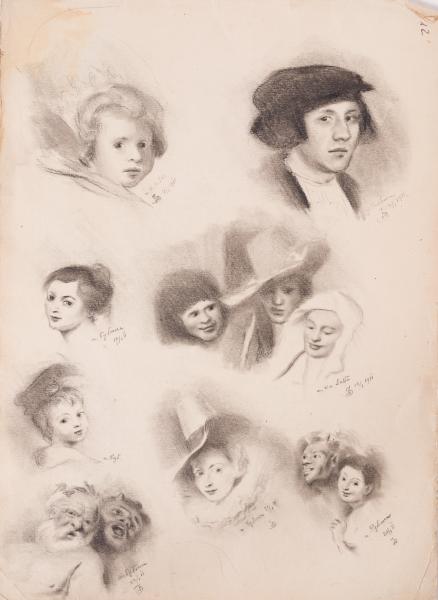
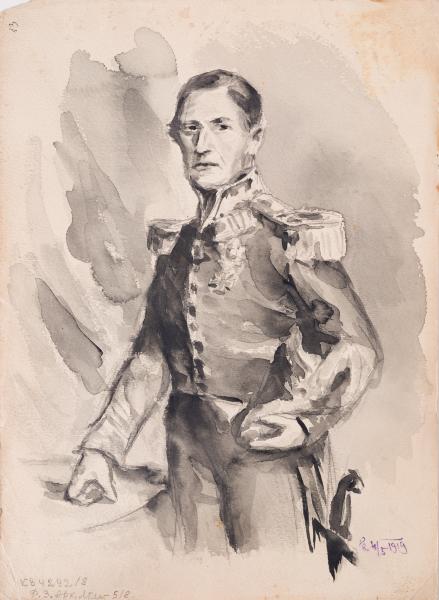
On this sheet, Yulian Zaiats created a series of graphic sketches based on paintings by European masters of the 16th–17th centuries. The sketches, likely created in the context of his studies, are copies of portraits by Hans Holbein the Younger, Peter Paul Rubens, and Jan Vermeer. The figures of satyrs and nymphs (possibly dryads) are derived from mythological scenes by Peter Paul Rubens. All images are executed in soft pencil, and the composition encompasses twelve faces presented in different angles and moods, ranging from childlike spontaneity and refined worldliness to Dionysian revelry. The upper part of the sheet features a portrait of a young boy and a young man wearing a black beret – the wealthy German Hanseatic merchant Georg Giese, who resided in London at the time the portrait was created. Their faces are subtly modeled with hatching, with attention to lighting and anatomy, which shows the artist's deep immersion in the stylistic manner of the originals. Next is a group of female portraits, among which both of Peter Rubens' wives (Isabella Brant and Helena Fourment) are recognisable, their faces rendered with Rubens' characteristic plasticity – voluminous forms, soft facial contours, and emotional gazes. In Yulian Zaiats' practice, these images clearly and consistently reproduce the spirit of the secular portrait of the Flemish era. Particular emphasis is placed on the grotesque pair of figures in the lower right corner – a satyr and a bacchante, probably borrowed from Rubens' mythological compositions. Here, the artist demonstrates his skill not only in portraiture but also in conveying emotional tension, where the brushwork becomes more expressive. These are contrasted by the image of a woman and men from Jan Vermeer's painting “The Procuress” (1656), particularly in the lighting, which models the faces with a gentle shadow. The work is clearly educational and research-oriented, representing the author's deep interest in the diversity of the painting tradition. The ability to vary technique depending on the image and source, along with attention to detail and working with the texture of clothing and hats, all testify to a high level of studio training. This combination of portraits from different artistic traditions creates a dialogue between cultures and styles, emphasising the universality of academic drawing as a method of mastering classical art. On the reverse side of this sheet is a graphic copy of an official portrait of King Leopold I of Belgium (1790–1865), executed in watercolour with graphic preparation. The image of the monarch is conveyed in a three-quarter turn, with a classic ceremonial pose: one hand rests on the table, the other holds a headdress pressed against the body, and the posture is restrained, measured, and dignified. The composition emphasises the grandeur of the person, status, and attributes of military and political power. The king is depicted in a uniform with epaulettes, orders, and clearly modelled folds of fabric. The face is rendered softly, with slight chiaroscuro modelling: the gaze is directed forward, exhibiting an element of detachment and concentration characteristic of the official iconography of monarchs in the mid-19th century. The background is rendered freely – broad patches of grey tones frame the figure without distracting from the central image. This technique creates depth and a spatial frame while maintaining focus on the face and torso, allowing for a clear and distinct portrayal. The composition is balanced: from the top edge to the bottom, the eye is guided by the calm line of the arms and the bend of the elbow, which refers to the classical canons of ceremonial portraiture.
Inscriptions
Under each of the eight images is an inscription indicating the author of the original image: "..." [illegible]; "P. Rubens"; "H. Holbein"; "Jan Vermeer van Delft". Under seven images is the monogram of Yulian Zaiats and dates (from top to bottom and from left to right): "17/1 11"; "16/1 1911"; "24/1 1911" (twice); "20/1 1911". Reverse: "⅘ 1919".
Portrayed person
- The name of the person portrayed
- Georg Giese (02.04.1497–03.02.1562), Helena Fourment (11.04.1614–15.07.1673), Isabella Brant (1591–15.07.1626). On the reverse side is a portrait of King Leopold I of Belgium (16.12.1790–10.12.1865).
Legal regulation
Borys Voznytskyi Lviv National Art Gallery