Drawings of Genre Scenes
Yulian Zaiats


Basic information
- ID
- Ф-З-Арх-ЛГМ-7/6
- Author
- Yulian Zaiats
- Name
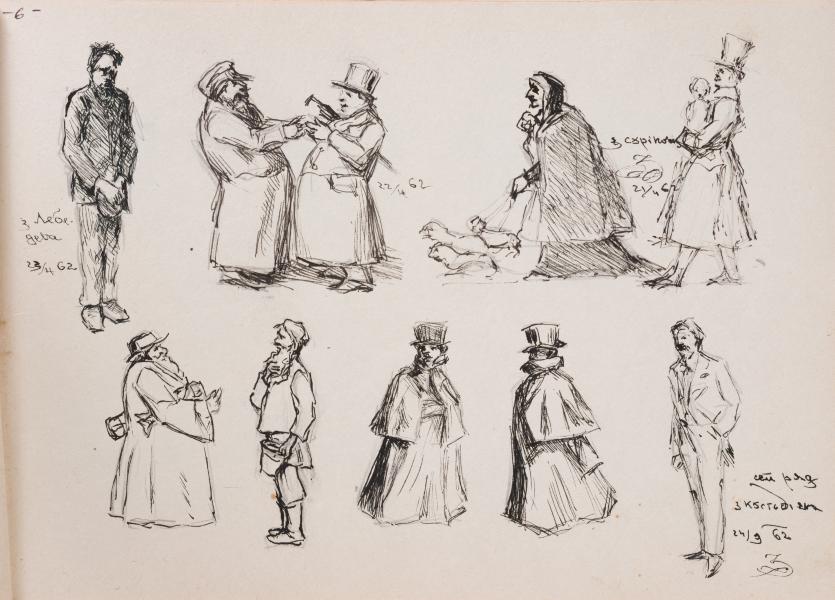
- Drawings of Genre Scenes
- Date of creation
- 24.03.1962–23.04.1962
- Country
- the Ukrainian SSR
- Technique
- drawing
- Material
- paper pencil Indian ink
- Dimensions (height x width, cm)
- 20.4 x 28.5
Additionally
- Type
- graphic art
- Genre
- genre art
- Provenance
- Received from Nina Zaiats
Information about author
Object description
The sheet contains a collection of graphic sketches executed in a restrained but characteristically expressive manner, tending toward academic precision of form with elements of stylisation. The source for the creation of the images was the paintings and graphic works of such masters as Volodymyr Lebedev, Vasyl Surikov, and Borys Kustodiev – artists who combined a deep knowledge of character types with keen observation and plastic generalisation in their work. The drawings are devoid of sharp grotesqueness. The characters are portrayed with respect for nature; these are primarily the faces of inhabitants of past eras. In each image, the author's attempt to immerse himself in the character of the model while remaining faithful to the original spirit is palpable. The drawings are executed with a confident, experienced hand. The lines are mostly contour lines, sometimes with minimal strokes to accentuate volume or chiaroscuro, but with a clearly defined structural form. In some parts, you can see traces of exploration, such as slight adjustments to proportions, corrections to the position of the eyes or the tilt of the head, which indicate that this is a living work process, not just mechanical copying. The author draws on the artistic tradition of the early 20th century, characterised by its respect for silhouette, expressive flatness, and concise form. Compositionally, the sheet is constructed as a free group of figures arranged with visual balance in mind. There is enough space between the figures for each image to “breathe”, but at the same time, they form a coherent thematic whole, namely a panorama of characters in which the influence of the three aforementioned authors can be seen, but at the same time, the artist's personal interpretive gesture. The signature and dates are consistent with the style of other works in the series, suggesting a common concept of research exercises on the history of character types in art. The sheet demonstrates not only the function of imitation, but also an analytical exercise that shows how the language of representation changes when moving from one artistic vision to another, from the sharpness of V. Surikov to the intimate intonation of B. Kustodiev, from the existentialism of V. Lebedev to laconic realism. This series is both a formal study and a thoughtful tribute to three distinct visions of characterisation, each of which influenced the development of the visual language of the 20th century.
Inscriptions
In the centre, under the images, there are inscriptions: “From Lebedev”; “23/4 62”; “22/4 62”; “From Surikov”; Yulian Zaiats' signature; “21/4 62”; “This row is from Kustodiev”; “24/3 62;” Yulian Zaiats' signature.
Legal regulation
Borys Voznytskyi Lviv National Art Gallery