Two Drawings
Yulian Zaiats


Basic information
- ID
- Ф-З-Арх-ЛГМ-8/8
- Author
- Yulian Zaiats
- Name
- Two Drawings
- Date of creation
- 06.12.1962–10.12.1962
- Country
- the Ukrainian SSR
- Technique
- drawing
- Material
- paper pencil
- Dimensions (height x width, cm)
- 20.3 x 28.6
Additionally
- Type
- graphic art
- Genre
- portraiture
- Plot
- Portrait
- Provenance
- Received from Nina Zaiats
Information about author
Object description
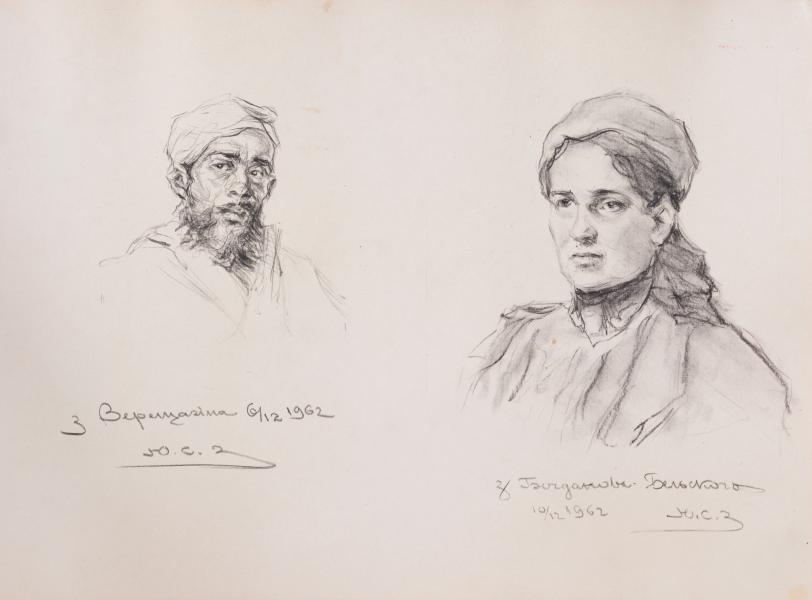
Two drawings by Yulian Zaiats, based on portraits of prominent artists of the late 19th and early 20th centuries, combine academic precision with a subtle sense of the model's individual character. Both images are three-quarter profile portraits, but with fundamentally different visual accents. The choice of source material, namely Vasyl Vereshchahin's "Muslim. Portrait of a Man" and "Portrait of a Woman in a Beret" by Mykola Bohdanov-Belskyi, testifies to Y. Zaiats' interest in the multifaceted nature of the portrait tradition within the classical school of fine arts. The portrait of a man after V. Vereshchahin is presented with particular attention to ethnographic specifics. The depicted Muslim wears a light-coloured (in the original, saffron) turban that tightly covers his head, leaving only his face with prominent cheekbones and a thick beard exposed. His gaze is directed to the side (in the original, at the viewer), which gives the image a restrained concentration. In Y. Zaiats' interpretation, there is a noticeable desire to convey the model's stern dignity; he forms the image with soft but confident strokes. The contrast of light and shadow works here to enhance expressiveness, and the background is kept clean to avoid distracting attention from the main point – the strength of character of the person portrayed. The female portrait by M. Bohdanov-Belskyi has a completely different tone. A young woman in a light beret (?), with soft features and a calm expression, is depicted in a slight turn, looking to the side. Y. Zaiats subtly models the chiaroscuro, especially in the areas of the cheeks and chin, giving the face a lively volume. The hair, barely peeking out from under the beret, is drawn with delicate lines, and the clothing is rendered in a generalised manner, focusing attention on the face as the centre of the composition. Placed side by side, these two portraits form a contrasting pair: a stern and reserved male image embodying the cultural tradition of the East, and a calm and melancholic female image of a European intellectual of the early 20th century. In this dialogue, Yulian Zaiats acts not simply as a copyist but as an attentive interpreter, preserving the style and character of the originals, while at the same time revealing his own interpretation of plasticity, light, and psychological expressiveness.
Inscriptions
In the centre, beneath the images: "From Vereshchahin"; "6/12 1962"; Yulian Zaiats' signature; "From Bohdanov-Belskyi"; "10/12 1962"; Yulian Zaiats' signature.
Legal regulation
Borys Voznytskyi Lviv National Art Gallery