Crucifixion
unknown folk sculptor


Basic information
- ID
- С-I-1667
- Author
- unknown folk sculptor
- Name
- Crucifixion
- Date of creation
- 19th c.
- Country
- Ukraine
- Technique
- carving polychrome
- Material
- wood
- Dimensions (height x width x depth, cm)
- 12.8 x 9 x 5.5
Additionally
- Type
- sculpture
- Genre
- religious
- Plot
- Crucifixion
- Provenance
- Lukavets village, Zolochiv district, Lviv region
Information about author
Object description
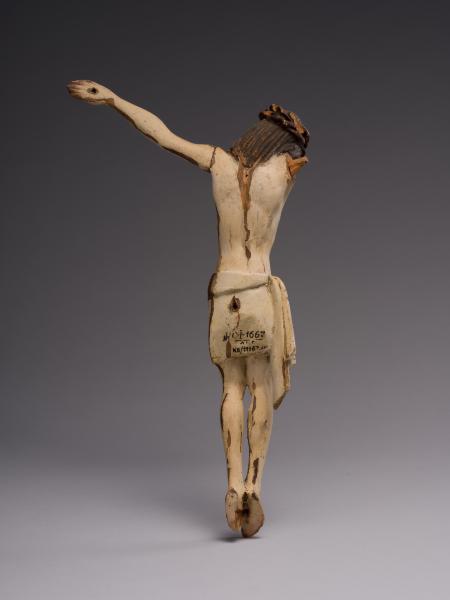
The polychrome work is executed in the classical canon of the Crucifixion image, which follows Western iconography. Christ's pose conveys suffering, but at the same time, calmness after accepting the sacrifice. The anatomically modelled frontal figure of the Saviour with his head tilted to the right is stretched vertically, his arms outstretched, his legs crossed and nailed with a single nail, which corresponds to traditional models of Catholic sculpture. The realism and drama of the image are emphasised by drops of blood contrasting with the pale complexion of the body. The naked figure of Christ is covered by a perizoma (loincloth) tied in a knot on the right side, modelled with soft folds. Emphasising sacrifice and mercy, the master paid special attention to the sorrowful yet calm expression of the face with closed eyes. The work leans towards the realistic tradition, but without excessive naturalism. The sculptural depiction of the Crucifixion strikes a balance between spiritual symbolism and physical realism.
Legal regulation
Borys Voznytskyi Lviv National Art Gallery