Back

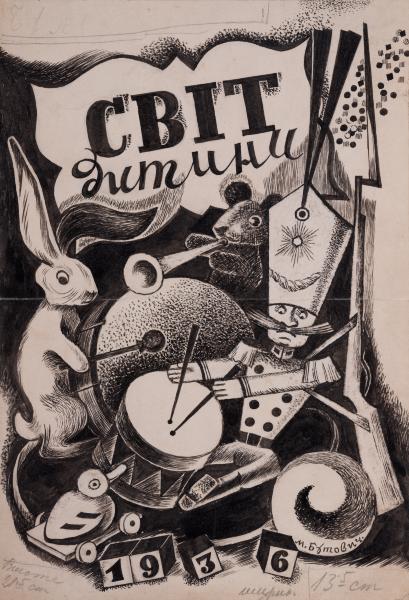
Project of the Cover for the Magazine "Svit Dytyny"

Mykola Butovych

  • Project of the Cover for the Magazine "Svit Dytyny" 2
  • Project of the Cover for the Magazine "Svit Dytyny" 3
Basic information
ID
Г-V-2157
Author
Mykola Butovych
Name
Project of the Cover for the Magazine "Svit Dytyny"
Technique
drawing
Material
paper pen Indian ink
Dimensions (height x width, cm)
25.8 x 18.8
Additionally
Information about author
Author
Mykola Butovych
Artist's lifetime
1895–1961
Country
Ukraine, the USA
Biography
Mykola Butovych (pseudonym – Butumbas; 1 December 1895, Petrivka village, Hadyachsky district, Poltava province – 21 December 1961, Hackensack, New Jersey, USA) – graphic artist, painter, master of decorative graphics, illustration, caricature, a memoirist, and author of epigrams. He was born into an old Cossack family. Member of the Circle of Ukrainian Artists in Lviv (1922–1926), Association of Independent Ukrainian Artists in Lviv (1931–1939), Ukrainian Artists' Association in the USA (1952). Studied at the Poltava Cadet Corps (1906–1913). Participant in the liberation struggle, adjutant to the headquarters of the 1st Cossack Division of the Army of the Ukrainian People's Republic. Interned in Poland, from where he fled to Prague. Studied at the Higher School of Arts and Crafts (Prague, 1920), the Charlottenburg School of Arts and Crafts (1920–1926), the Leipzig Academy of Graphic Arts (1923–1926), and was a scholarship holder at the Ukrainian Scientific Institute in Berlin (1926–1928; directed by V. Zalozetskyi). After graduating from the Leipzig Academy of Graphic Arts, he settled and worked in Lviv and other cities in western Ukraine. In 1928, he was invited to teach in Kyiv, but declined due to the political situation in Soviet Ukraine. In the 1920s and 1930s, he lived in Paris, Prague, Derwent, Split, and in the 1940s in Lviv. He wrote epigrams for Galician magazines. They were only published separately in 1995 in Kyiv under the title "Epigrams of Butumbas". In them, he created satirical and ironic images of many Ukrainian writers, actors, sculptors, and publishers (Vasyl Barka, Oksana Liaturynska, Oleksandr Oles, Yevhen Malaniuk, Olena Teliha, Oleh Olzhych, and others). In 1924, he released an album of woodcuts depicting characters from Ukrainian demonology. During the interwar period, he designed book publications devoted primarily to folklore and demonology themes. The origins of his artistic style are linked to the work of Ivan Kotliarevskyi and Mykola Hohol. From 1943, he taught at the Lviv Art and Industrial School in Nazi-occupied Lviv. After World War II, he found himself in West Germany, where he designed the covers for the books "Our Parnassus" and "Prague Artists: Words and Pellets". He later moved to Austria and, from 1947, lived in the United States (New Jersey), from where he relocated to Ridgefield Park near New York in 1948. He worked in the field of applied art and participated in art exhibitions in the United States. He maintained relationships with many figures of Ukrainian culture and literature. He exhibited in many cities around the world, including Berlin (1920, 1928), Lviv (1922, 1923), Regensburg (1947), and New York (1955, 1961). In particular, he designed the book "Rin" by Oleh Olzhych, "Volyn" by Ulas Samchuk, "Stories" by Panteleimon Kulish, "History of the Ukrainian Army" (ed. I. Tykot), "Chronicle of Red Kalyna", illustrated Ivan Kotliarevskyi's "Eneida", works by M. Hohol, V. Stefanyk, and folk tales; designed the magazines "Nova Khata”, "Dnipro", "Zhyttia i Znannia", "Zyz", "Nasha Kultura", and "Veselka". He published his autobiography (New York, 1956), his memoirs "The Cadet Corps" (Visnyk, 1959), "The Uprising Against the Hetman (The Grey Division)" (Visnyk, 1959), and others. Together with Robert Lisovskyi and Pavlo Kovzun, he raised the level of Ukrainian book graphics and became a follower of Heorhii Narbut. In easel graphics and painting, he demonstrated a deep understanding of Ukrainian mythology, folklore, and ethnography. He worked in the field of scenography, designing puppet shows and children's theatre, where he used the traditions of Ukrainian folk vertep. Mykola Butovych's work is a unique blend of constructivism and Ukrainian expressionism, marked by influences of national primitivism and comic culture. The artist's works successfully combine features of folk art and ancient Ukrainian engraving. His search for his own creative style led to neo-baroque innovations, incorporating features of European modernism, which resulted in the formation of Mykola Butovych's original style. He died on December 21, 1961, in the United States. He is buried in the Ukrainian Orthodox cemetery in South Bound Brook, New Jersey.
Object description
The rectangular composition of the magazine cover features a group of toys playing musical instruments in the centre. In the centre, on the right, a toy soldier plays the drum; on the left, behind him, a hare plays the tambourine, and on the top right, a mouse plays the trumpet. Above the group, in a decorative frame, is the caption: "Svit Dytyny" ["The World of a Child"]. In the foreground, scattered toys include cubes, balls, a toy duck, and more.
Inscriptions
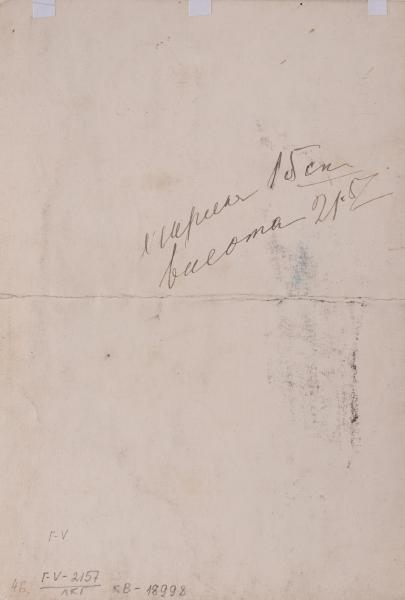
In the lower left corner, written in pencil: "Height 21.5"; in the lower right corner: "Width 13.5". On the right side of the drawing (on the ball), there is an inscription: "M. Butovych". On the reverse side, at the top of the sheet, there is a pencil inscription: "Width 15 cm/height 21.5".
Legal regulation
Borys Voznytskyi Lviv National Art Gallery