Back

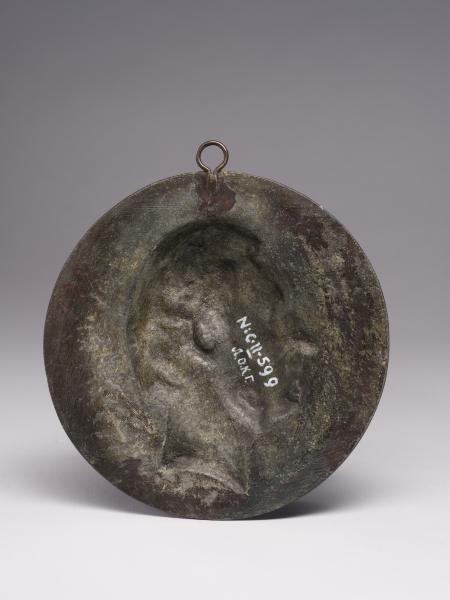
Medal “Stefan Witwicki”

Wladyslaw Oleszczynski

  • Medal “Stefan Witwicki” 2
  • Medal “Stefan Witwicki” 3
Basic information
ID
С-II-599
Author
Wladyslaw Oleszczynski
Name
Medal “Stefan Witwicki”
Date of creation
1841
Country
Duchy of Warsaw Kingdom of Poland
Culture
Modern times
Technique
casting
Material
iron
Dimensions (diameter, cm)
17.6
Additionally
Information about author
Author
Wladyslaw Oleszczynski
Artist's lifetime
1807–1866
Country
Duchy of Warsaw, Kingdom of Poland
Biography
Władysław Tomasz Kazimierz Oleszczyński (December 17, 1807 – April 11, 1866) was a Polish sculptor, medallist, and graphic artist. The future artist was born in Koniaków to the family of magistrate Kazimierz Oleszczyński and Salomea, née Kosinska. His godfather was Franciszek Zablocki (1752–1821), a Polish writer, poet, and publicist. W. Oleszyński's two older brothers, graphic artist Antoni (1794–1879) and lithographer and illustrator Seweryn (1801–1876), were also prominent artists. In 1824, W. Oleszczyński began studying at the Faculty of Fine Arts of the Royal University of Warsaw; a year later, he received a government scholarship, which enabled him to study in France. The artist's teachers were F. J. Heim (drawing) and A. L. Dantan (sculpture). In 1825–1830, W. Oleszczyński continued his studies in Paris, studying sculpture at the School of Fine Arts under Pierre-Jean David d'Angers and medal art at the Paris Mint under Nicolas-Pierre Tiolier. In May 1830, the master returned to Poland and worked for some time at the Warsaw Mint. Soon after, he took part in the November Uprising, and after its defeat, he emigrated. From 1832 to 1857, he lived in Paris. In 1857, he lived in Poznań, and later, from 1858 to 1863, in Warsaw, where he had a workshop in the Royal Castle and received numerous private commissions. In 1865, he was in Warsaw, from where he left for Rome. The artist died in Rome on August 11, 1866, and was buried in the Le Champs cemetery in Montmorency, Paris. W. Oleszczyński is considered the most outstanding representative of Romanticism in Polish sculpture. The master created numerous monuments and tombstones for representatives of the Polish émigré community, as well as portrait statuettes, bronze medallions, and medals. He conceived a medallion gallery of Polish writers, which included, in particular, images of J. Bartoszewicz, K. Wojcicki, and J. Kraszewski – some of the best in the artist's oeuvre. W. Oleszczyński created the first monument to A. Mickiewicz in Poland on the square in front of St. Martin's Church in Poznań, unveiled in 1859. The main materials used by the sculptor were marble, bronze, plaster, and clay. His main graphic techniques were lithography and copperplate engraving.
Object description
Stefan Witwicki (September 13, 1801 – April 15, 1847) was a Polish Romantic poet and publicist. He was born on September 13, 1801, in the village of Ivaniv in Podillia (now Vinnytsia Oblast). He graduated from the Volhynian Lyceum. From 1822, he lived in Warsaw, where he began his career in the Government Commission for Religion and Public Education. In 1824–1825, he made his debut in Warsaw with two collections of ballads and romances. In 1829, he published the drama Edmund, and in 1830, a paraphrase of Poems from the Bible and a volume of poems entitled Rural Songs, which gained popularity after being set to music by Frédéric Chopin and Stanisław Moniuszko. In 1832, he emigrated and became one of the co-founders of the Society of United Brothers in Paris. For some time, he was friends with A. Mickiewicz. In 1838, S. Witwicki's collection of poems, the Polish Altar, was published. Shortly before his death, he intended to become a priest and published two prayer books. S. Witwicki's moralistic publications "Evenings of a Pilgrim" (1837–1845) and "Letters from Abroad" (1842) were well received in intellectual circles. He died in Rome in 1847 and was buried in the Campo Verano cemetery.
Inscriptions
"Stefan Witwicki".
Portrayed person
The name of the person portrayed
Stefan Witwicki
Lifetime of the person portrayed
15.04.1847–11.04.1866
Legal regulation
Borys Voznytskyi Lviv National Art Gallery