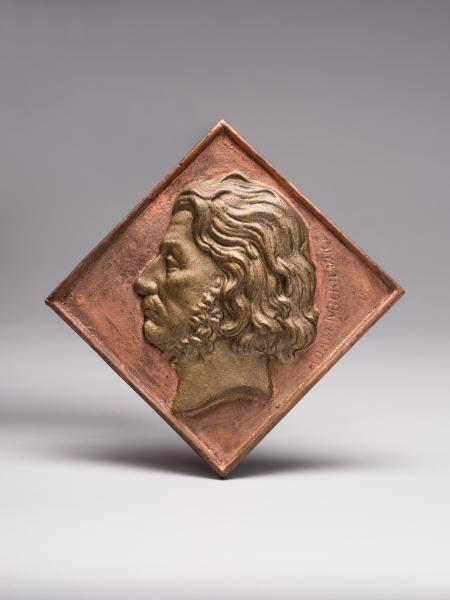
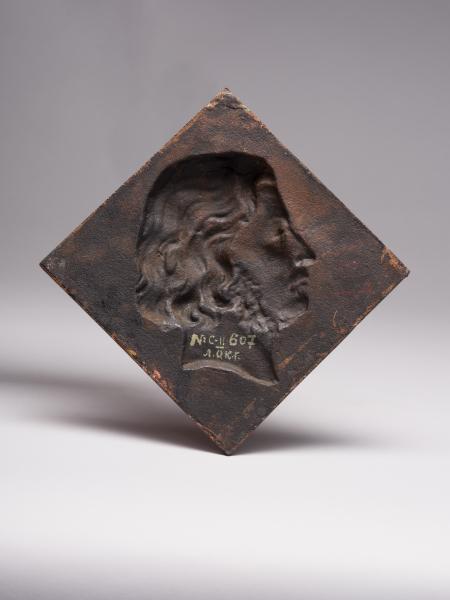
Plaque "Adam Mickiewicz"
unknown


Basic information
- ID
- С-II-607
- Author
- unknown
- Name
- Plaque "Adam Mickiewicz"
- Country
- Kingdom of Poland (?)
- Culture
- Modern times
- Technique
- moulding
- Material
- bronze gilt
- Dimensions (diameter, cm)
- 15
Additionally
- Type
- sculpture (relief)
- Genre
- portraiture
- Plot
- Portrait
- Provenance
- the Dzieduszycki collection
Information about author
Object description
Adam Bernard Mickiewicz (December 21, 1798 – November 26, 1855) was one of the most prominent Polish poets, writers, and figures in the Polish national liberation movement. He was the founder of Polish romantic drama and romanticism in Polish literature. National poet of Poland, Lithuania, and Belarus. An activist of the independence movement, organiser of Polish troops to fight against Russia, and a Bonapartist. Son of nobleman Mikołaj Mickiewicz (1765–1812), a lawyer in Navahrudak (now Belarus). From 1807 to 1815, he was educated at the Dominican school at the Church of St. Michael the Archangel in Navahrudak. In 1815, he enrolled in the Faculty of Physics and Mathematics at Vilnius University, but soon transferred to the Faculty of Arts. From 1817, he participated in the creation and activities of patriotic youth groups. In 1818, he published his first poem, "City Winter" ("Zima miejska"), in the Vilnius newspaper Tygodnik Wileński. In 1820, he wrote the poem "Ode to Youth". After graduating from university between 1819 and 1823, he worked as a teacher in Kovno (now Kaunas). In 1822–1823, with the help of close friends in Vilnius, he published his first volume of works, which included ballads and romances. The ideas and themes introduced in the ballads were developed in the major poems "Grażyna" and "Dziady" (Parts 2 and 4). In 1823, A. Mickiewicz was arrested and imprisoned in the Basilian monastery in Vilnius (from autumn 1823 to March 1824), and later sentenced to exile for participating in secret youth organisations. In 1826–1830, his ballads, "Sonnets", "Faris", "Konrad Wallenrod", and "Dziady" (Forefathers' Eve) were published in magazines and almanacs. On July 22, 1834, Adam Mickiewicz married Celina Szymanowska (July 16, 1812–March 5, 1855), with whom he had six children, two daughters and four sons. From May 1829, he lived in Germany, Switzerland, and Italy. In 1832, he settled in Paris, collaborated with Polish émigrés, and engaged in political journalism. In 1834, he published his greatest work, the Polish national epic poem "Pan Tadeusz", which he had been working on from 1832 to 1834. In 1839–1840, he taught Latin literature in Lausanne. In 1840, he became the first professor of Slavic literature at the Collège de France. In 1841, A. Mickiewicz came under the influence of Andrzej Towiański, a preacher of Polish messianism. For his ideas, the French government removed the poet from teaching in 1845 and placed him under police surveillance. In April 1855, he lost his wife. He spent the last years of his life in great hardship. From 1852 to 1855, he worked in the Arsenal library. He died on November 26, 1855, probably from cholera. In 1890, Mickiewicz's ashes were transferred from Paris to Krakow and placed in Wawel Cathedral.
Inscriptions
"Adam Mickiewicz".
Portrayed person
- The name of the person portrayed
- Adam Bernard Mickiewicz
- Lifetime of the person portrayed
- 21.12.1798–26.11.1855
Legal regulation
Borys Voznytskyi Lviv National Art Gallery