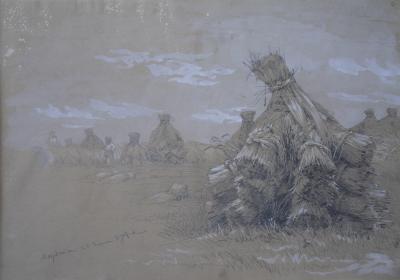
Collection of Ethnographic Drawings
Kajetan Kielisinski

Basic information
- ID
- Г-V-424_114
- Author
- Kajetan Kielisinski
- Name
- Collection of Ethnographic Drawings
- Country
- Kingdom of Poland
- Culture
- Modern times
- Technique
- drawing
- Material
- pencil
Additionally
- Type
- graphic art
- Genre
- genre art
- Provenance
- the Dzieduszycki collection
Information about author
Object description
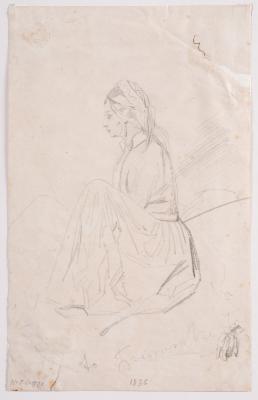
Kajetan Wincenty Kielisiński created numerous etchings and drawings devoted to folklore, life in Polish villages and towns, historical monuments, and landscapes. He was one of the first to develop bookplates in Poland. During his travels to various locations, he collected graphic materials for the publications "Polish Antiquities" and "Folk Costumes". In 1855, Poznań publisher Jan Konstanty Żupanski published "The Kielisiński's Album", which collected the artist's scattered works. Kielisiński's graphic works, drawings, sketchbooks, and correspondence were kept in the Kórnik Library of the Polish Academy of Sciences, as well as in national museums (Kraków, Poznań, Warsaw) and renowned libraries (Jagiellonian University, Ossolineum, Warsaw University). The picture shows a middle-aged woman in the traditional clothing of a wealthy peasant or townswoman. She wears a long scarf or ochipok tied at the back of her head, with long ends hanging down to her waist. The woman stands in profile against a background of vegetation. Her facial features are calm, without any pronounced emotions, and the overall impression can be described as restrainedly positive. The woman holds her left hand, which is lowered, in front of her in the fold of her clothing. Her head is turned to the left, so we see her face in profile, and her gaze, directed straight ahead and into the distance, gives the image a specific romantic meaning. The woman is dressed in a long dress that reaches her ankles. On top, she is wearing clothing similar to a coat or a long jacket with a fitted silhouette. The upper part of the outfit features a massive, possibly fur collar that falls on the shoulders. There are decorative ties at the front edges. Overall, the clothing looks warm, suitable for the cool season, multi-layered and practical, while also featuring decorative elements, in particular buttons and pleats. The figure is depicted against a natural background, with the outline of vegetation, including bushes and small trees. The image has a calm, harmonious character. The lines are clear, the detail is moderate, and we can see the clothing's folds and the facial features. The drawing's background is minimalist. The graphic drawing has undeniable historical and cultural value, as it is a precise and careful reproduction of folk clothing. Since the drawing accurately reflects and conveys the details and features of the folk clothing of a particular region, it has a pronounced ethnographic, historical, and cultural value. Its artistic significance lies in the accurate and detailed reproduction of folk costumes, making it a valuable source for research and study of traditional culture. From an aesthetic point of view, we are dealing with a realistic drawing, with a special emphasis on its documentary nature.
Legal regulation
Borys Voznytskyi Lviv National Art Gallery