Collection of Ethnographic Drawings
Kajetan Kielisinski

Basic information
- ID
- Г-V-424_143
- Author
- Kajetan Kielisinski
- Name
- Collection of Ethnographic Drawings
- Country
- Kingdom of Poland
- Culture
- Modern times
- Technique
- drawing
- Material
- pencil
Additionally
- Type
- graphic art
- Genre
- genre art
- Provenance
- the Dzieduszycki collection
Information about author
Object description
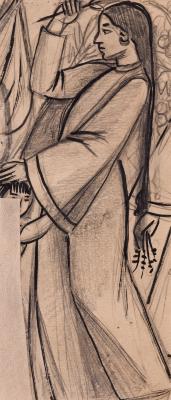
Kajetan Wincenty Kielisiński created numerous etchings and drawings devoted to folklore, life in Polish villages and towns, historical monuments, and landscapes. He was one of the first to develop bookplates in Poland. During his travels to various locations, he collected graphic materials for the publications "Polish Antiquities" and "Folk Costumes". In 1855, Poznań publisher Jan Konstanty Żupanski published "Kielisiński's Album", which collected the artist's scattered works. Kielisiński's graphic works, drawings, sketchbooks, and correspondence were kept in the Kórnik Library of the Polish Academy of Sciences, as well as in national museums (Kraków, Poznań, Warsaw) and renowned libraries (Jagiellonian University, Ossolineum, Warsaw University). Judging by their clothing and styling, these are women from the noble or wealthy strata of society from the late Middle Ages or early Renaissance – approximately the late 14th to early 15th centuries. All three women have long, loose, or partially gathered hair, which at that time could indicate their young age or that they were unmarried (depending on the region). They are standing against a stone wall, probably near a building or fortress. All are wearing long robes or dresses with lavish folds that fall to the ground. This style was characteristic of noble ladies of the Middle Ages. The woman on the left is wearing a long dress with a belt at the waist. Over the dress is a long cloak or cape that falls from her shoulders. Her hair falls freely, possibly with braiding or decorative elements. The woman in the centre is wearing similar clothing – a long dress with a neckline covered by a lower layer of fabric. On her head is a narrow headband or bandage that supports her hair, which falls freely on her shoulders. Her posture indicates a certain liveliness – she may be talking or explaining something. The woman on the right is most distinguished by her headdress: she wears something like a veil or a majestic gauze covering her head and shoulders – it could be a hennin with a veil or another form of headdress worn by a married or older woman. She is dressed in a long robe with wide sleeves, which is a sign of status or respectable age. Her clothing looks more restrained and heavy than that of the other two. Their refined appearance, exquisite fabrics, long robes, and headdresses testify to their high social status. The background of the image is outlined – a stone wall of some building, with a plaque or coat of arms attached, and stone paving. At the bottom of the drawing, there is an inscription "1409", which may indicate the year or historical context. The artistic value of the drawing lies in its documentary and ethnographic accuracy in depicting the historical costume: the author sought to capture the details of the clothing and social image, rather than the individual features of the person.
Inscriptions
"1409".
Legal regulation
Borys Voznytskyi Lviv National Art Gallery