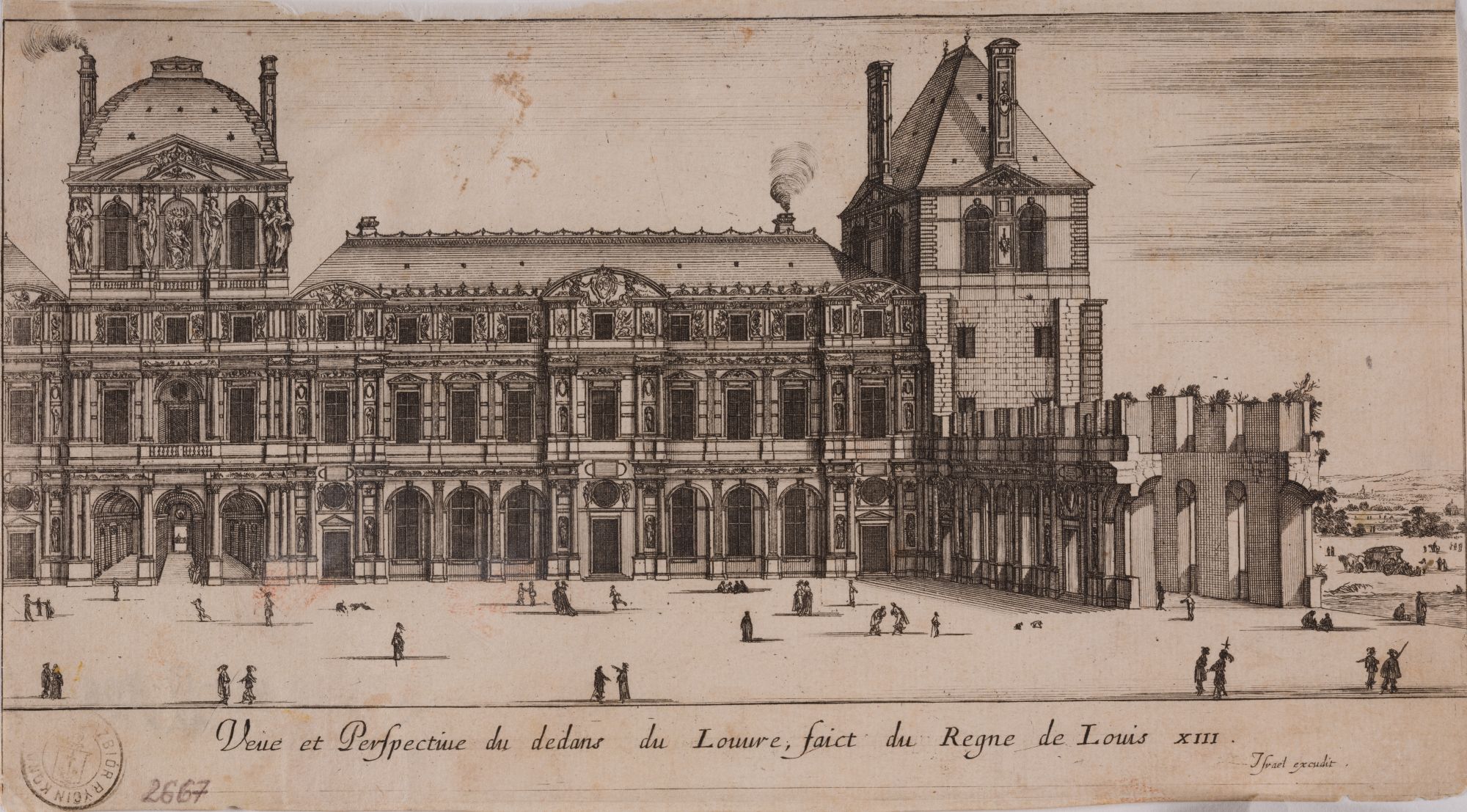
View of the Louvre from the Courtyard
Israel Silvestre
Basic information
- ID
- Г-IV-1006
- Author
- Israel Silvestre
- Name
- View of the Louvre from the Courtyard
- Date of creation
- c.1650
- Country
- France
- Technique
- etching
- Material
- paper
- Dimensions
- 13 x 24 cm (height x width)
Additionally
- Type
- graphic art
- Genre
- cityscape
- Plot
- City landscape
- Provenance
- Lviv Historical Museum
Information about author
Object description
Although the "Vues de Paris" ("Views of Paris") series of engravings was formally attributed to Israel Silvestre, it was the result of a collaboration between several talented 17th-century printmakers, including Jean Marot, Stefano della Bella and Israel Silvestre himself. Collaboration between graphic artists was a common practice when a group of masters worked on a single series or even an individual piece.
Israel Silvestre created the preparatory drawings and executed only a few etchings. The series was published on 12 sheets by Israel Henriet's publishing house. The engravings depict prominent Parisian buildings. This sheet was created by two graphic artists: Jean Marot, who recreated the structure, and Stefano della Bella, who executed the figures and the landscape.
On the engraving based on a drawing by Israel Silvestre, Jean Marot depicted the facade of the Clock Pavilion of the Royal Palace of the Louvre. At the time the sheet was created, the construction was still unfinished – we see the incomplete right wing designed by the architect Jacques Lemercier, which has already become overgrown with shrubs. Jean Marot meticulously executed all the ornamental decorations of the facade, whilst also introducing his own additions, replacing the window on the top floor of the pavilion passage with allegorical sculptures. Israel Silvestre, who skilfully captured the court life of the Louvre, created the small figures of people going about their daily activities in front of the building.Soldiers, elegant couples, playing children, men gambling in a circle, dogs chasing each other, and cats ready to fight – all are depicted here. The combination of these elements adds an exceptional vibrancy to the work, drawing the viewer's attention. Behind the unfinished wing, a panoramic view of the Parisian suburbs unfolds.
Inscriptions
At the bottom left, there is a stamp with the inscription: "ZBIORY RYCIN KONOPKOW". At the bottom right is the inscription "Israel excudit".
Legal regulation
Borys Voznytskyi Lviv National Art Gallery