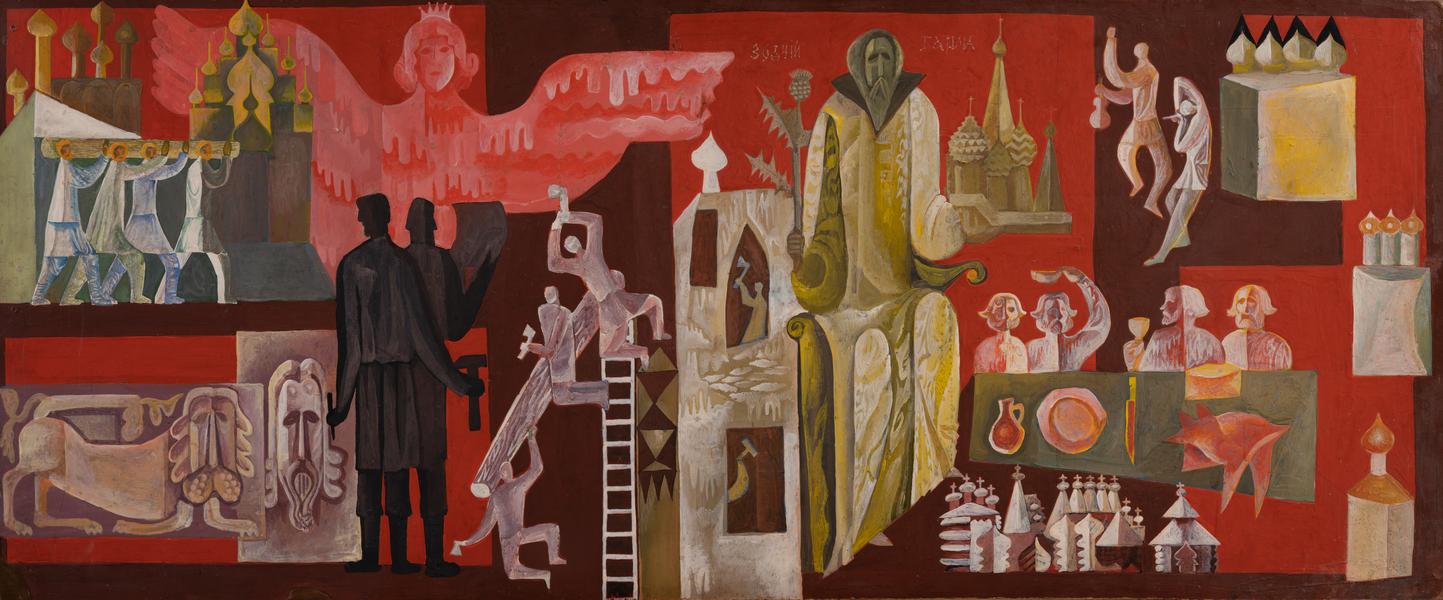
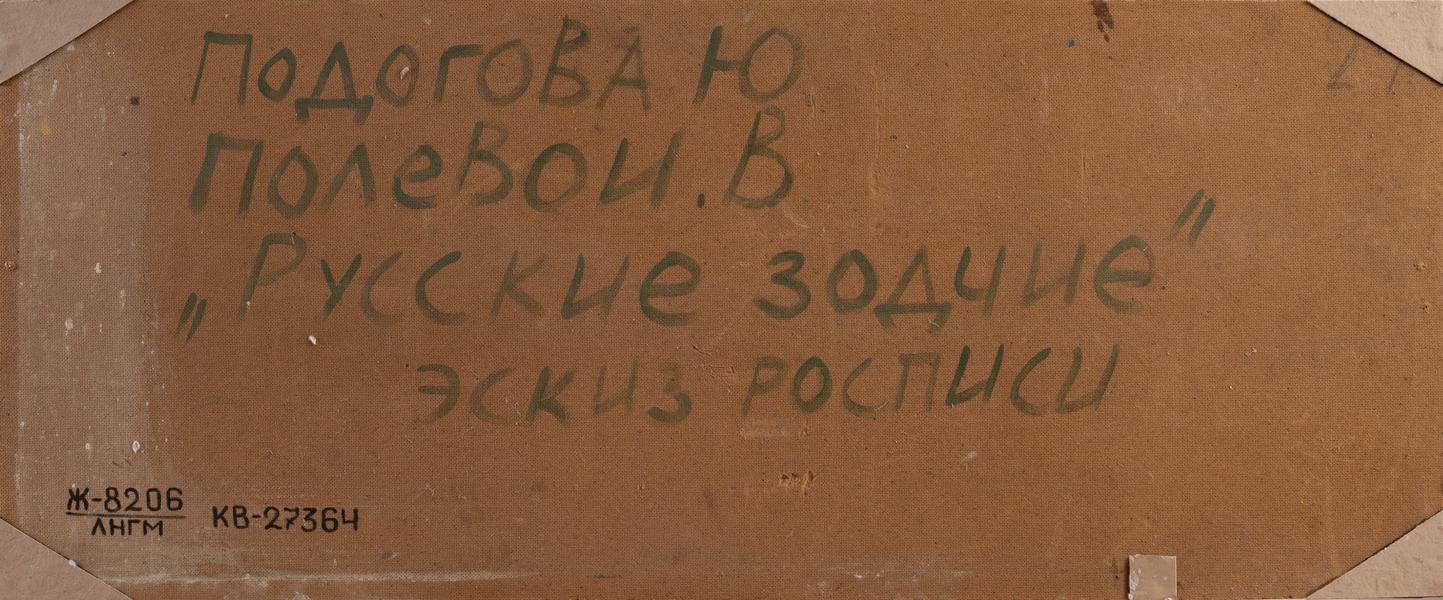
Sketch for the "Ruthenian Architects" Mural for the Main Foyer at Central Architectural and Planning Department in Moscow

Vasyl Poliovyi, Yuliia Podohova

  • Sketch for the "Ruthenian Architects" Mural for the Main Foyer at Central Architectural and Planning Department in Moscow 2
  • Sketch for the "Ruthenian Architects" Mural for the Main Foyer at Central Architectural and Planning Department in Moscow 3
Basic information
ID
Ж-8206
Author
Vasyl Poliovyi Yuliia Podohova
Name
Sketch for the "Ruthenian Architects" Mural for the Main Foyer at Central Architectural and Planning Department in Moscow
Date of creation
1972–1973 (?)
Culture
Ukrainian art of the Soviet period
Technique
original technique
Material
fibreboard mixed media
Dimensions (height x width, cm)
55 x 122
Information about author
Author
Vasyl Poliovyi
Artist's lifetime
b.1936
Country
the USSR, the USA
Biography
Vasyl Poliovyi is a Ukrainian painter and graphic artist, one of the leading authors of Soviet Nonconformist art. He was born on April 22, 1936, in Kryvyi Rih city. The artist's father, Petro Poliovyi, worked as an engineer, and his mother, Oleksandra, was a mathematics teacher. With the start of hostilities on the territory of the USSR on June 22, 1941, the family was evacuated to the Sverdlovsk region (RSFSR). There Vasyl Poliovyi studied in school, and after completing his education in 1954, he entered an art school in Yelets. However, the artist later transferred to the Tavricheskaya Art School (Leningrad, RSFSR) and then to the Higher School of Industrial Art named after Vera Mukhina. After completing his studies, he moved to Moscow, where he worked at an art collective with his wife, artist Yuliia Podohova. He focused mainly on the monumental and decorative design of the interiors and the exteriors of public buildings and governmental institutions. At the same time, he was involved in the circle of nonconformist artists in Moscow and Leningrad, including Dmytro Krasnopevtsev, Anatolii Zverev, Mykhailo Shemiakin, Oleh Tselkov, Eduard Steinberg, Volodymyr Sterlihov, and the Lianozovo Group, as well as writers like Serhii Dovlatov, Yurii Mamleev, and Vladlen Gavrilchik. He participated in unofficial exhibitions, including those in the Federal Republic of Germany, France, Italy, and Czechoslovakia. In 1965, while visiting his brother, the researcher and inventor Renat Poliovyi, the artist created a large cycle of thematic works about Ukraine. Some of them were exhibited in Moscow. Later he joined the Artists' Union of the USSR. In 1972, Vasyl Poliovyi moved to Lviv, where he worked on monumental and easel paintings. During this period, he interacted with the local art community, including Valerii Shalenko, Mykhailo Steinberg, Yurii Sokolov, Okhrim Kravchenko, Margit and Roman Selsky, Anatolii Semahin, art critics Hryhorii Ostrovskyi and Dmytro Shelest, and writer Ihor Klekh. In 1976, Vasyl Poliovyi was expelled from the Artists' Union, which made his professional activity practically impossible. As a result, the artist decided to emigrate from the Soviet Union to the United States, where he still lives and works in Greenville, South Carolina.
Information about author
Author
Yuliia Podohova
Artist's lifetime
1927–2021
Biography
Yuliia Podohova (1927–2021) was a monumentalist and a member of the Artists' Union of the USSR. She studied at the Stroganov Higher School in Moscow and was a student of the People's Artist of the USSR, Yekaterina Belashova. Her diploma work, stained-glass windows for an international exhibition in Brussels, was accepted as "excellent with honours". Yuliia Podohova worked on monumental murals, stained-glass windows, and mosaics. In addition, her works include easel paintings. The monumental and easel works of the artist are now kept in public spaces, museum collections, and private collections in the countries of the former USSR, including Moldova, Ukraine, and the Russian Federation. Yuliia Podohova met and later married Vasyl Poliovyi during the "Moscow period" of his work. Later, the couple moved to Lviv, where the artist created monumental works famous for her co-authored sketches for murals and mosaics (1970s). No easel works of the Lviv period have been found so far. In 1990, together with Vasyl Poliovyi, the artist moved to the United States for permanent residence, where she died in 2021 after a long illness.
Object description
As with the other sketches in this series, a multi-exposure is used here, revealing the core idea of this monumental work: time is a combination of past and present, which is best reflected in the heredity of traditions. The artist depicts the period from Kyivan Rus to the 17th century when artistic imagery was developed based on the synthesis of Byzantine and Oriental cultures. From the thoughtful, focused, but completely anthropomorphic lions on the facades of the Northern Rus' cathedrals to the scenes of a short break from work, the world to some extent echoes the visual imagery of Andrii Tarkovskyi's film "Andrii Rublev" (1966). This approach helps overcome the psychological temporal distance between the past and the present since, in most aspects, human nature remains unchanged. Attention to historical details in the characters' costumes and everyday moments is combined with the creation of a space where real characters find themselves amidst legendary and symbolic images. In the left part of the artwork, one of the dominant motifs is the mythical bird Alkonost (indicated by the presence of a crown and the absence of a halo), whose wings seem to embrace the space where the composition unfolds. It is no less real than the images of the architects at work or rest. The composition is exceptionally dynamic yet harmonious, just like its colour and tonal resolution.
Legal regulation
Borys Voznytskyi Lviv National Art Gallery