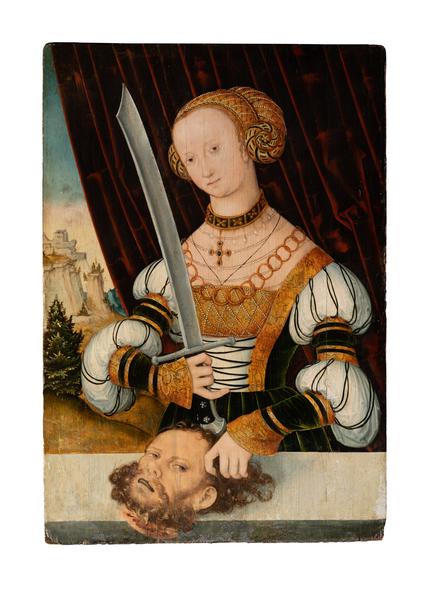
Judith with the Head of Holofernes
Lucas Cranach the Elder (the workshop)



Basic information
- ID
- Ж-758
- Author
- Lucas Cranach the Elder (the workshop)
- Name
- Judith with the Head of Holofernes
- Date of creation
- c.1530s
- Technique
- oil painting
- Material
- wood oil
- Dimensions (height x width, cm)
- 54.5 x 37.5
Additionally
- Type
- painting
- Genre
- religious
- Plot
- Judith with the head of Holofernes
- Provenance
- the Lubomirski collection
- Exposition
- Potocki Palace
Information about author
Object description
The iconography of this biblical story is extremely rich in European art due to its intense drama, psychological controversy, and content. The so-called Cranach style can be read in the Gallery's painting – in the composition, colour, and particularly in the completeness of the image of Judith. Her long arms, rounded shoulders, small bust, red-golden hair, and ruthless cold gaze create an impression of a slight eroticism. By killing the commander-in-chief of the Babylonian army, Holofernes, and saving the fortress city of Bethulia, Judith became a symbol of patriotism, the victory of the Virgin over the devil, purity and faith over lust and pride in the Judeo-Christian tradition. Like other righteous women of the Old Testament times, such as Esther, Judith is regarded as a typological prototype of the Virgin Mary. She is the New Eve who defeats Satan and the temptation that led humanity to the fall. The statement "weakness is stronger than human strength" is confirmed by the actions of Judith, the female counterpart of David, who defeated Goliath.
Legal regulation
Borys Voznytskyi Lviv National Art Gallery