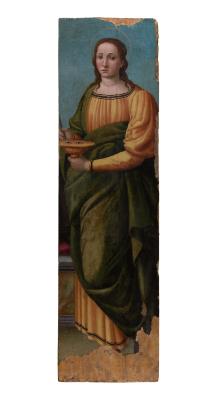
John the Baptist
unknown folk sculptor


Basic information
- ID
- С-I-1183
- Author
- unknown folk sculptor
- Name
- John the Baptist
- Date of creation
- 19th c.
- Country
- Ukraine
- Technique
- carving polychromy
- Material
- wood
- Dimensions (height x width x depth, cm)
- 91 x 58 x 22
Additionally
- Type
- sculpture
- Genre
- religious
- Plot
- John the Baptist
- Provenance
- Harasymiv village, Tlumach district, Ivano-Frankivsk region
Information about author
Object description
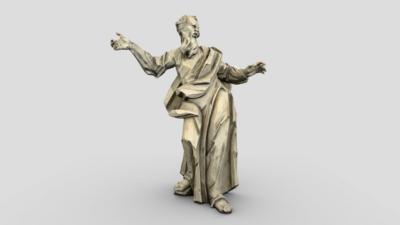
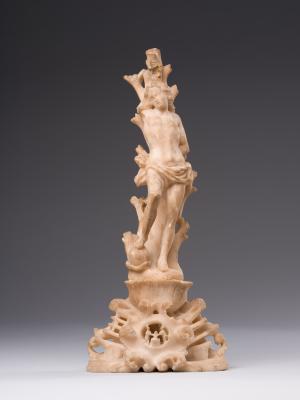
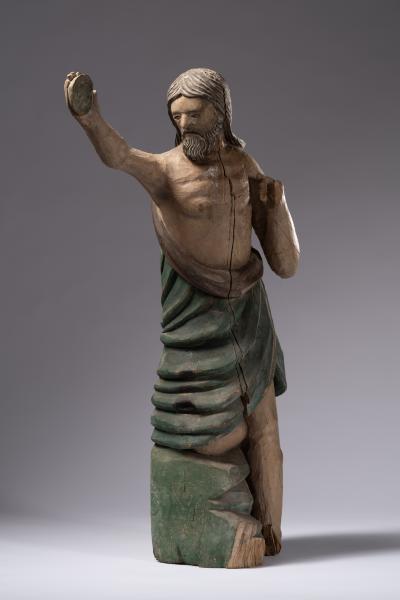
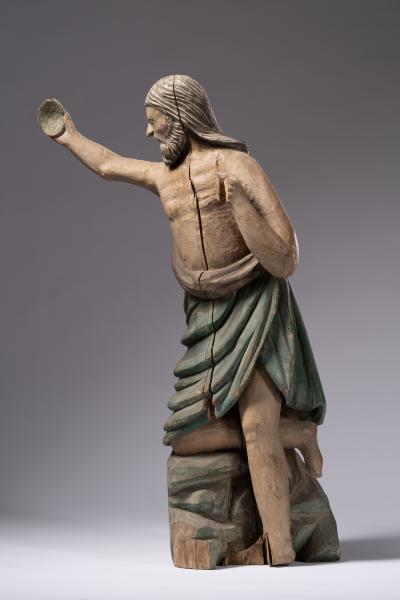
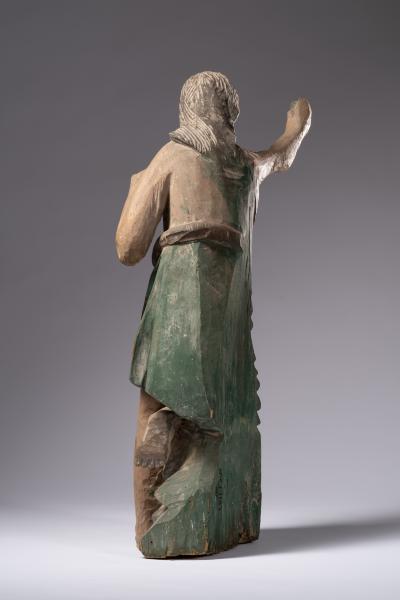
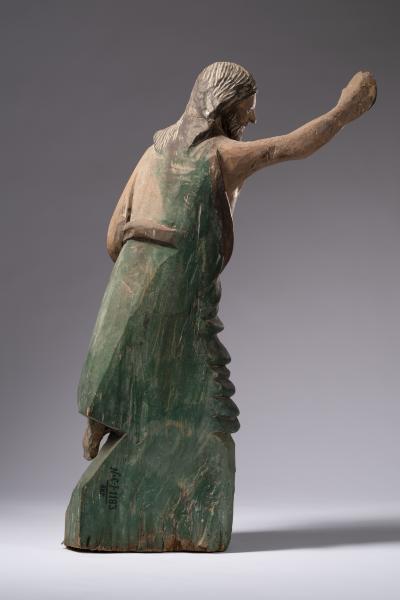
John the Baptist is a prophet, the son of the priest Zechariah and the virtuous Elizabeth, the predecessor of Christ. He was chosen to prepare people to recognize the Savior as the Messiah. In the Orthodox tradition, the saint played a more prominent role than in the Catholic one. Orthodoxy also reveres John the Baptist as an ascetic, a hermit, and an ideal monk representing the "angelic order". The full-length figure of John the Baptist leans on a stone with the right leg knee. The saint's right hand is raised up, and he holds a vessel for baptism. The Baptist's hips are covered with drapery, the folds arranged in smooth oval lines parallel across the surface, without repeating the anatomy of the saint's movement. The author skillfully reproduced the construction of the human body – obviously, he was familiar with the works of professional sculptors. In a manner typical of folk artists, he conveyed the figure of John the Baptist without polishing the body's surface, where rough traces of the chisel, placed next to each other, can be seen. The main focus of the work is on the face of John the Baptist, who, half-covering his eyelids, directed his gaze downwards. The figure of the saintly man, his posture and his raised hand holding a small vessel indicate that the sculpture was a part of the iconographic composition of the baptism of Jesus Christ.
Legal regulation
Borys Voznytskyi Lviv National Art Gallery