Saint Anthony
unknown folk sculptor


Basic information
- ID
- С-I-1294
- Author
- unknown folk sculptor
- Name
- Saint Anthony
- Date of creation
- 19th c.
- Country
- Ukraine
- Technique
- carving polychromy
- Material
- wood
- Dimensions (height x width x depth, cm)
- 104 x 34 x 27
Additionally
- Type
- sculpture
- Genre
- religious
- Plot
- Saint Anthony
- Provenance
- Expedition to the Ivano-Frankivsk region
Information about author
Object description
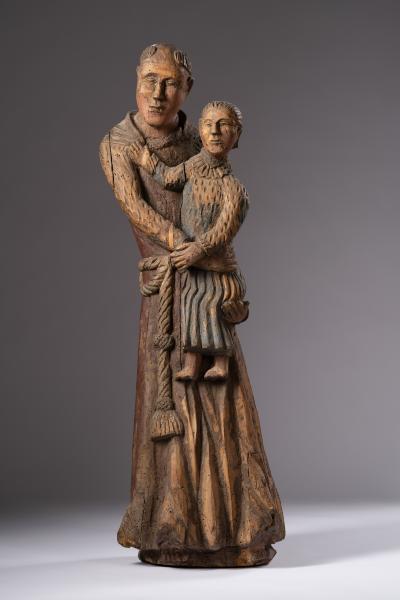
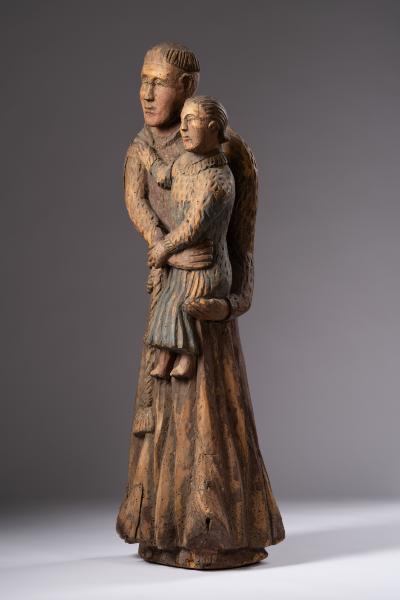
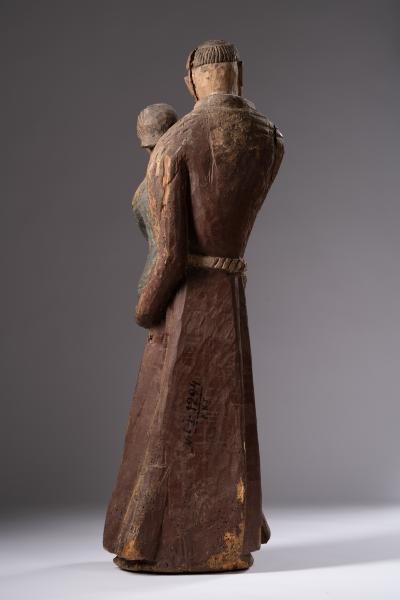
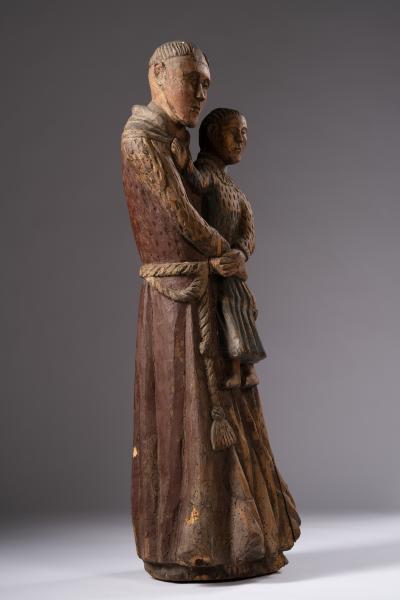
In churches, mainly Roman Catholic ones, sculptures of saints are located in altar compositions, side chapels or at the entrance. Sculptural images of some saints can be found in almost every temple – for example, the figures of Anthony of Padua. The saint was born in 1195 in Lisbon (Portugal). He was a Catholic priest, a monk of the Franciscan order, and a preacher. He healed the sick, helped discover lost things, and was considered the patron saint of travellers. In the thirteenth century, Anthony was canonised by Pope Gregory IX, who, during canonisation, read out a description of 53 miracles performed by the saint. Anthony the Great was depicted in the Franciscan habit with the child Jesus in his arms; also, he was often depicted with a lily. The Little Christ symbolises St. Antony's vision in Camposampiero and reflects his love for the human image of Jesus and his close relationship with God. The sculptural representation conveys the image of a monk wrapped with a rope with large knots, typical of the Franciscans, and in a long coarse cloth soutane with a hood. The saint holds a little Jesus dressed in a long blue tunic, decorated at the bottom with parallel lines imitating folds and reproducing a child's movement. The elongated face ovals of Anthony the Great and Christ are roughly carved. Arched eyebrow lines smoothly turning into a protruding wedge-shaped nose, wide cheekbones, and a straight mouth with plump lips characterise the figures' faces. The reproduction of the saint's tonsure is unique (shaving the head as a sign of belonging to the church), as there is no hair above the forehead, which was not characteristic of the image of Anthony the Great. Christ's hair is carved with incised straight lines that start from the forehead and fall to the back of the head. The sculptural composition is depicted in a naive manner typical of folk masters; it conveys familiar images sincerely and without pathos.
Legal regulation
Borys Voznytskyi Lviv National Art Gallery