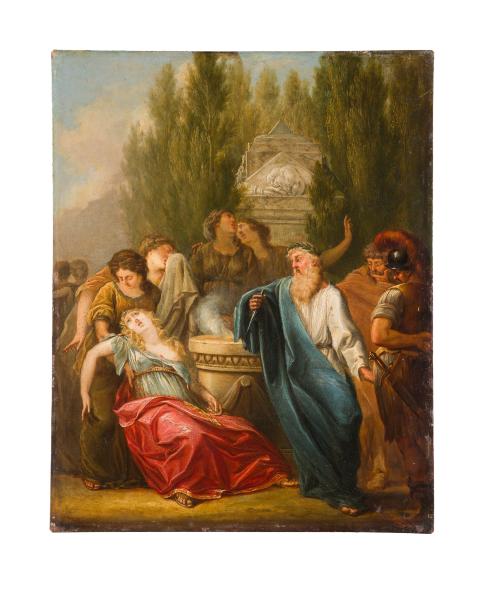
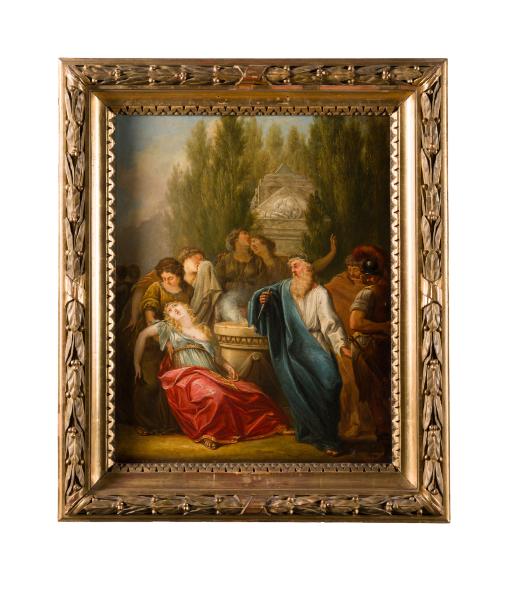
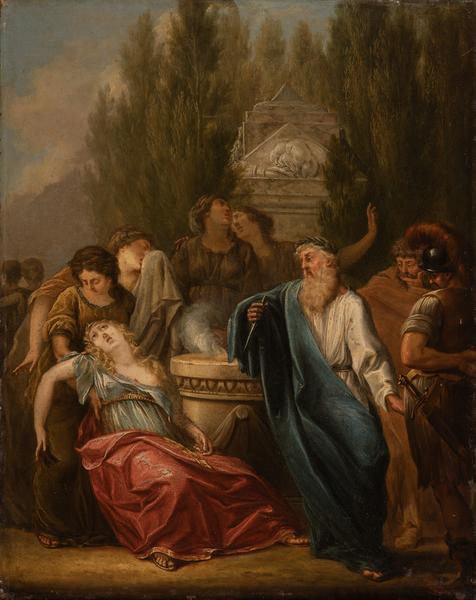
Death of Polyxena
Johann Georg Schutz


Basic information
- ID
- Ж-2607
- Author
- Johann Georg Schutz
- Name
- Death of Polyxena
- Technique
- oil painting
- Material
- copper oil
- Dimensions (height x width, cm)
- 48 x 38
Additionally
- Type
- painting
- Genre
- mythological painting
- Plot
- Myth of Polyxena
- Provenance
- Collection of Ivan Yakovych
- Exposition
- Potocki Palace
Information about author
Object description
In Greek mythology, Polyxena was the daughter of Priam and Hecuba. Achilles accidentally saw the girl and fell in love with her. He decided to marry her and head to Troy but was treacherously killed by Paris just as he arrived, unarmed, to marry Polyxena. According to another version, Achilles sent Automedon to request her hand in marriage from Hector. Hector declared that Polyxena would marry Achilles on the day he betrayed his countrymen. Since Achilles could not betray his people, he couldn't marry Polyxena, which caused him immense suffering. When Hermes convinced Achilles to accept a ransom for Hector's body, there was not enough gold left in Priam's treasury. Polyxena, watching from the wall, threw her bracelets down to make up for the missing weight. This act once again captivated Achilles, who offered Priam to keep the gold for himself but give Polyxena to him in return. The King of Troy responded that he would give his daughter to Achilles if he convinced the Greeks to lift the siege and sail home. Thus, Achilles became a victim of a plot. Polyxena learned that Achilles's heel was his weak spot. He came to the temple of Apollo unarmed and barefoot at her request. Deiphobus pressed Achilles against his chest, and Paris struck him in the heel with a poisoned arrow. When the Achaeans were about to return home after the fall of Troy, Achilles's shadow appeared above his cenotaph and demanded that Polyxena be sacrificed to him. Otherwise, the sails of the Greek ships would never be filled with wind. Neoptolemus, the son of Achilles, offered Polyxena as a sacrifice. She proudly presented herself for the sword strike and died with dignity. The tale of Polyxena, documented in the Cyclic epic, lyrics, and Athenian tragedy, refers to the ancient custom of burying the hero's wife, concubines, favourite servants, and horse with him. In a later version, her demise was romantically explained: the enamoured Achilles was killed when he came unarmed to negotiate their wedding, and after his death, he took his betrothed with him. Schutz's painting depicts a group of people around an altar against the backdrop of a green grove with a tomb. To the right of the altar is Polyxena. In the background to the right is the tomb of Achilles, with the image of a helmet crowned with a laurel wreath. Neoptolemus is in the foreground to the right of the altar, accompanied by Achaean warriors.
Legal regulation
Borys Voznytskyi Lviv National Art Gallery