Drawing of a Man's Head
Yulian Zaiats


Basic information
- ID
- Ф-З-Арх-ЛГМ-5/26
- Author
- Yulian Zaiats
- Name
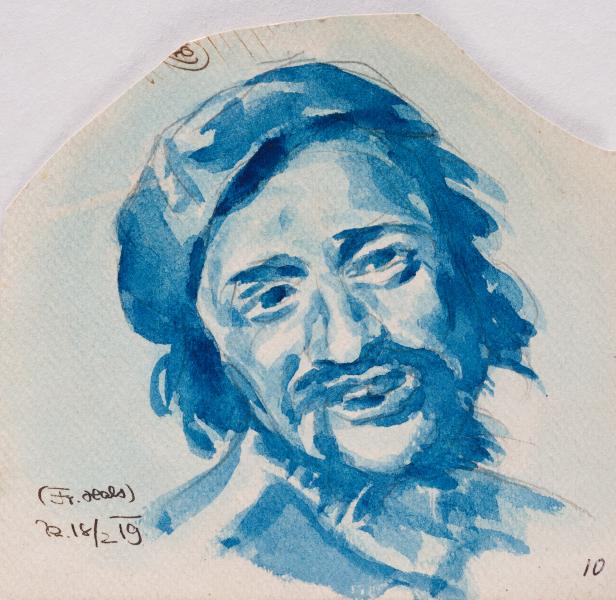
- Drawing of a Man's Head
- Date of creation
- 18.02.1919
- Country
- the Second Polish Republic
- Technique
- watercolour
- Material
- paper watercolour
- Dimensions (height x width, cm)
- 10.9 x 11.8
Additionally
- Type
- painting
- Genre
- portraiture
- Plot
- Portrait
- Provenance
- Received from Nina Zaiats
Information about author
Object description
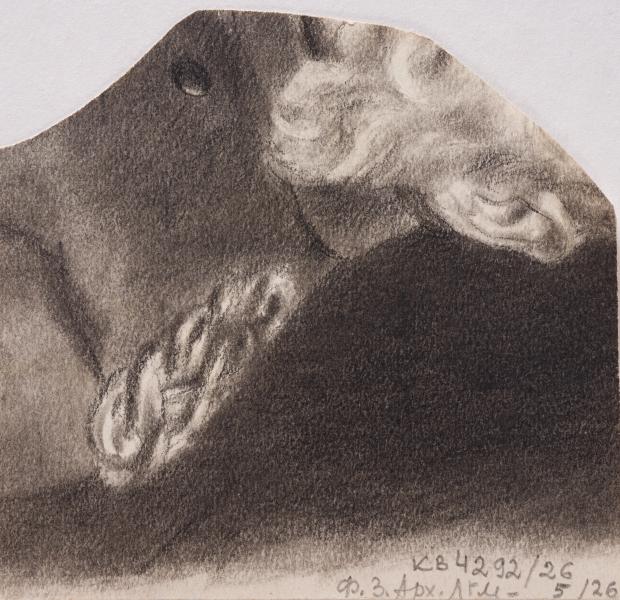
We are examining a study copy created through a complex technique of monochrome watercolour, almost in the style of grisaille, where the image is modelled exclusively with shades of one colour. The cold, saturated blue range was chosen, allowing the author to focus on the tonal construction of the form, volumes, and chiaroscuro effects. This technique was used in the art academies of the early 20th century. The original painting, known under the conventional title “Mulatto” (ca. 1628), is attributed to the brush of Frans Hals, one of the leading masters of the Dutch Baroque, whose portraits are distinguished by their ease, lively expression, and instantaneous capture of character. The watercolour copy preserves all the main features of the image: three-quarters of the head turned, high-raised eyebrows, half-opened lips, and a look directed at the viewer that combines surprise and a smile. The author of the copy achieves a tangible depth with the help of a free, sometimes blurred watercolour spot that contrasts with sharp line accents. This allows us to convey the dynamics of Hals' writing without directly imitating his oil texture. Limiting the colour palette was an important didactic tool: through such exercises, students of the academies learned to separate tone from colour, analyse the light and shadow structure, composition, and character of the brushstroke. The choice of this particular image indicates an interest in the study of non-canonical portraits in Baroque art, where the ethnic, social, or psychological difference of the character allowed the artist to deviate from the conventional style. On the reverse side is a portrait of a military man in uniform with braided shoulder straps, created by the same hand, which has been preserved only in fragments. The portrait depicts part of the chest and shoulder, dressed in a uniform tunic with a high collar, a typical attire for European armies of the late nineteenth and early twentieth centuries. The braided shoulder straps suggest that the model belonged to the senior officer corps. The appearance of the reverse side indicates the educational nature of the sheet, as was customary in artistic practice; one sheet was often used on both sides for studio exercises. In general, the work exemplifies an academic copying process that combines an in-depth study of the skills of old masters, in this case Frans Hals, with the practical mastery of complex techniques, such as grisaille. These studios not only developed technical skill but also fostered an aesthetic understanding of the artistic image, which was the foundation of academic education in the first third of the twentieth century.
Inscriptions
On the obverse: “(F. Hals)”; signature of Yulian Zaiats; “12/2 19”.
Legal regulation
Borys Voznytskyi Lviv National Art Gallery