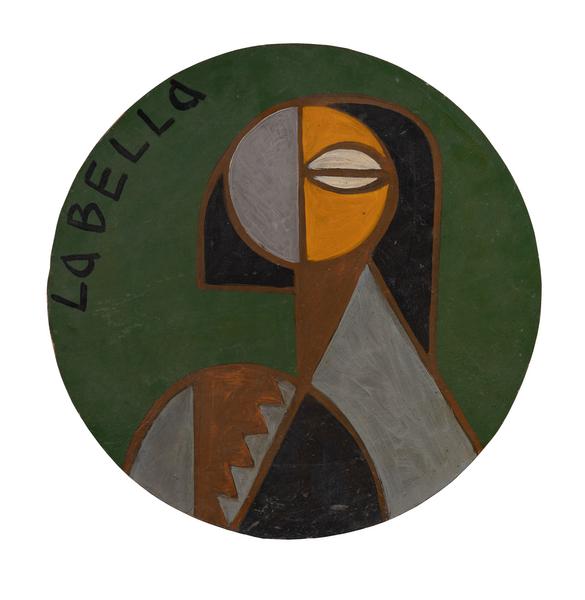
La Bella
Arnold Sharhorodskyi


Basic information
- ID
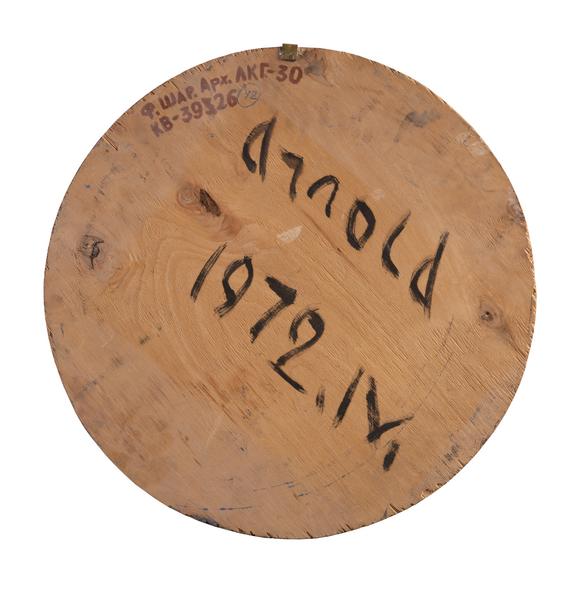
- Ф.Шар.Арх.ЛКГ-30
- Author
- Arnold Sharhorodskyi
- Name
- La Bella
- Date of creation
- 1972
- Country
- the USSR
- Culture
- Art of the Soviet period
- Technique
- oil painting
- Material
- plywood oil
- Dimensions (diameter, cm)
- 47.5
Additionally
- Type
- painting
- Genre
- symbolic art
- Plot
- Allegory
- Provenance
- Handed over to the museum from Arnold Sharhorodskyi
Information about author
Object description
A stylised modernist portrait of a woman with the inscription "LA BELLA" is set in a classical tondo similar to the Italian coppe amatorie. In the manner of the 16th-century masters of Castel Durante (Urbino), who placed the figure in a light perspective on a plain background, Arnold Sharhorodskyi presents an image of "new beauty" on a homogeneous green background. At the time of the creation of this work, this Renaissance practice was well-known among ceramists, graduates of the Lviv State Institute of Applied and Decorative Arts, and employees of the Lviv Ceramic and Sculpture Factory. In particular, the young students of the Artistic Ceramics Department of the Lviv State Institute of Applied and Decorative Arts were creating author's portrait plates of this type. The list of required reading included Alfred Kube's book "History of Faience" (RSFSR, State Publishing House, Berlin, 1923), which contains a separate section on "Italian Maiolica". Moreover, since the 1970s, the ceramics of the above-mentioned centre have been represented in the collection of the State Museum of Ethnography and Arts and Crafts of the Academy of Sciences of the USSR (e.g. in the 1976 catalogue). Therefore, the artist, who interacted with various representatives of the Lviv community, had the opportunity to become acquainted with this experience and rethink it in practice. The work's title and the figure's angle could be a reference to Titian Vecellio's work of the same name, dated 1536. The formal stylistic approach proposed by the artist is the result of his familiarity with the theoretical and visual developments of Pablo Picasso and local avant-garde artists (similar decorative solutions are found in the works of Borys Kosarev, who, in addition to Kharkiv, for a short period (1947–1948) taught at the London School of Art and Design). The composition is holistic and balanced, with tonal and colour accents. The parts of the body and the contours, reduced to geometric shapes, are recognisable and reproduce a delicate harmony.
Inscriptions
The inscription in Italian reads "LA BELLA" (in English "The Beauty")
Legal regulation
Borys Voznytskyi Lviv National Art Gallery