Saint Agatha
unknown (Italian School)


Basic information
- ID
- Ж-155
- Author
- unknown (Italian School)
- Name
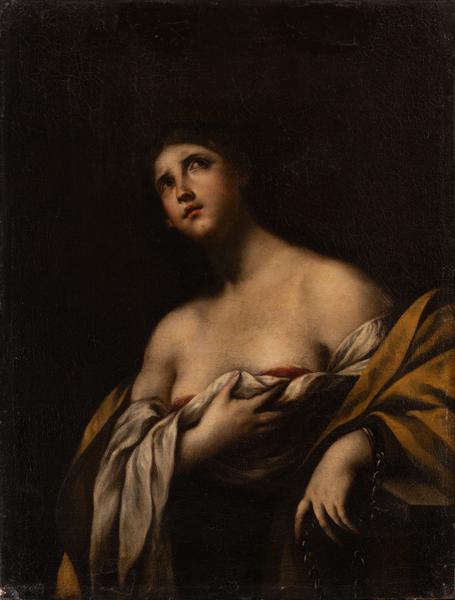
- Saint Agatha
- Date of creation
- 16th–18th c.
- Technique
- oil painting
- Material
- canvas oil
- Dimensions (height x width, cm)
- 94.5 x 72
Additionally
- Type
- painting
- Genre
- religious
- Plot
- Saint Agatha
- Provenance
- the Dzieduszycki collection
- Exposition
- Potocki Palace
Information about author
Object description
The painting depicts Saint Agatha against a dark background. Her body is exposed to her chest, which she covers with a white cloth held by her right hand. Her head is tilted in a three-quarter view to the left, and her gaze is directed upward. She wears a yellow robe that falls from her shoulders. Her left hand with shackles rests on a wooden stand. In iconography, Saint Agatha is often depicted in a long dress, symbolising purity. Her attributes include tongs used to tear off her breasts or her severed breasts on a plate, a crown or a palm branch in her hand. Little is known about the life of Saint Agatha, but more is said about her death. She came from a wealthy Sicilian family. She devoted herself to Christ as a maiden when she became a Christian. The governor of Sicily, Quintianus, desired to marry her, but Agatha refused. During this time, Emperor Decius initiated a wave of persecution against Christians, and Agatha became a target. Despite being confined to a public house, her dignity remained intact, and her resolve unshaken. As a result, the governor ordered her to be tortured. During this time, Etna erupted, and the frightened Quintianus ordered the tortures to stop. Agatha either died due to the torture or, according to another version, was killed by being thrown onto burning coals. There are many stories of the martyrdom of Christian virgins who rejected marriage to pagans. Saint Agatha is venerated as a protector against fires. When Etna erupted again the year after her death, townsfolk asked Agatha for help, and the lava spared the city of Catania.
Legal regulation
Borys Voznytskyi Lviv National Art Gallery