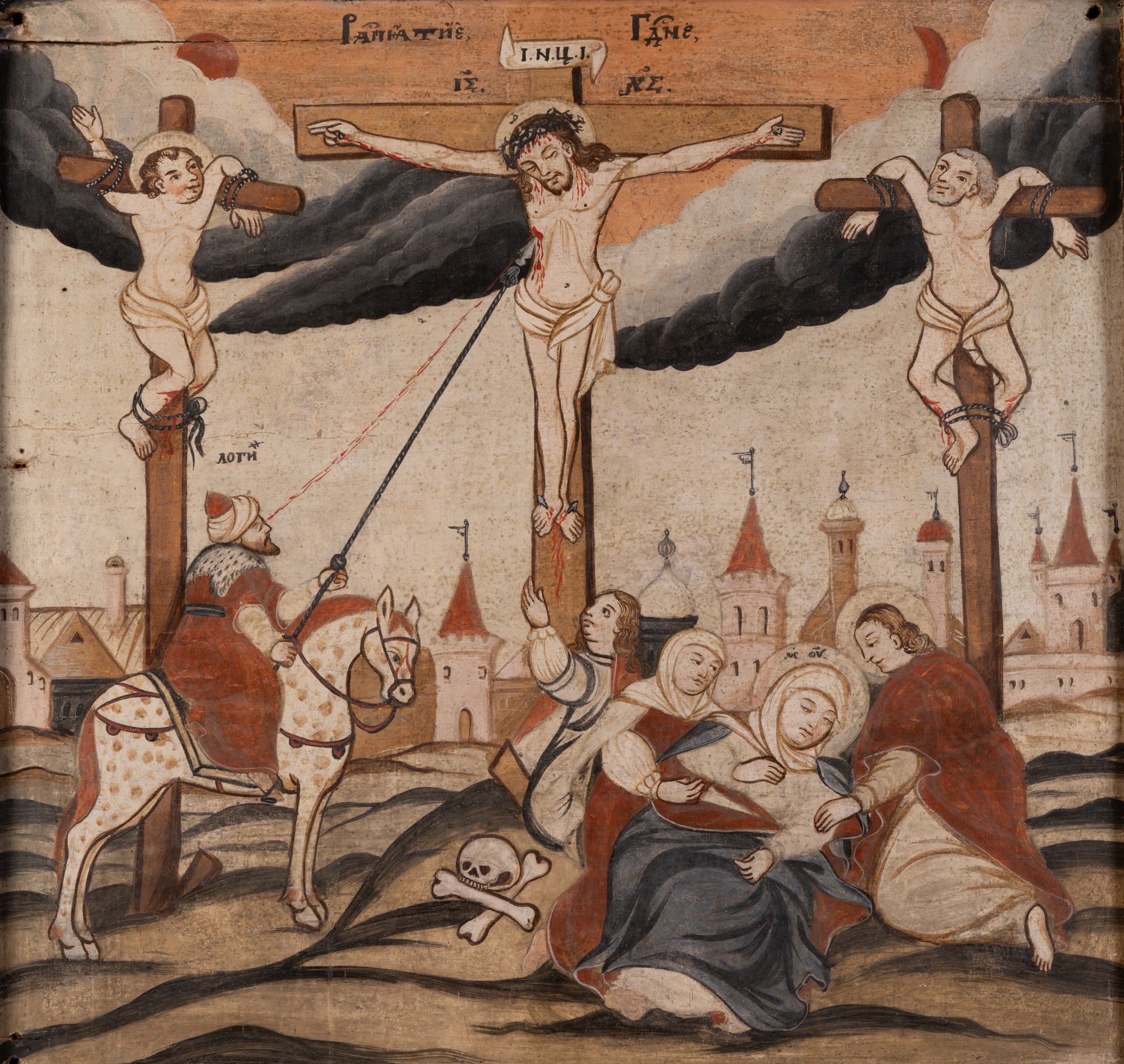
"The Passion of Christ" Iconostasis: Crucifixion
unknown
Basic information
- ID
- Ж-4128
- Author
- unknown
- Name
- "The Passion of Christ" Iconostasis: Crucifixion
- Date of creation
- early 18th c.
- Country
- Ukraine
- Culture
- Rybotytska School
- Technique
- tempera painting
- Material
- wood tempera
- Dimensions
- 116 x 120 cm (height x width)
Additionally
- Type
- icon
- Genre
- religious
- Plot
- The Passion of Christ Crucifixion
- Provenance
- Semenivka village, Lviv region
Information about author
Object description
"The Passion of Christ" is an iconostasis of the 17th – early 18th century consisting of a series of monumental multi-plot icons that should be viewed from top to bottom, in rows from left to right. The work's composition is distinguished by a large number of iconographic images with multi-figure scenes: 25 horizontally elongated Gospel scenes that tell us about the last days of Christ's earthly life. The background of the work is a detailed architectural staffage and a landscape with a wavy mountain ground. The works by the masters of the Rybotytska School were characterised by the conventional architecture of Jerusalem – white-walled buildings with red roofs (cupolas). According to the iconography that developed based on the Gospel texts, the Saviour was crucified on Mount Calvary, where Adam is said to be buried. Therefore, at the foot of the cross, the painter depicted Adam's skull, on which blood flowed from Christ's wounds. Next to Jesus are the figures of two crucified thieves, which the artist depicted in unnatural poses. The Virgin Mary and Mary Magdalene, John the Theologian, and the Roman soldier (centurion) Longinus on horseback are shown on either side of the Crucifix. According to legend, it was Longinus who supervised the execution and pierced Christ's side with a lance, and after his death, he recognised him as the Son of God. The exquisite individual style of the author is reflected in the somewhat disproportionate figures, typical characters, and harmonious combination of colours. Using cinnabar in depicting clothes and roofs of buildings adds an expressive accent to the delicate range of transparently applied colours. The touching immediacy of the icon execution is full of deep and restrained lyricism.
Legal regulation
Borys Voznytskyi Lviv National Art Gallery