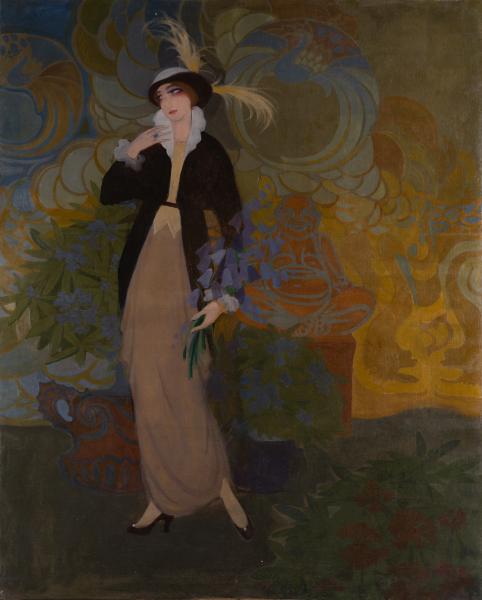
Parisian
Kajetan Stefanowicz


Basic information
- ID
- Ж-2290
- Author
- Kajetan Stefanowicz
- Name
- Parisian
- Date of creation
- 1912–1913
- Country
- Poland
- Technique
- oil painting
- Material
- canvas oil
- Dimensions (height x width, cm)
- 162 x 130.5
Additionally
- Type
- painting
- Genre
- decorative symbolic art portraiture
- Plot
- Portrait
- Provenance
- Received from the collection of Sabina Stefanowicz in 1940
Information about author
Object description
The Vienna Secession, particularly the work of Gustav Klimt, had a significant influence on Kajetan Stefanowicz – this explains his fascination with ornamental surfaces. A key artistic technique in the artist's works is the elastic, winding line, which creates rhythm and dynamism. The artist's attraction to Eastern motifs is evident in the use of vibrant oriental ornamentation, symbolism, and a focus on Eastern themes. This is precisely seen in the work "Parisian", where Eastern and Western cultures are contrasted yet harmoniously intertwined. The elegant figure of a tall young woman in a feathered hat resembles the stem of a flower. Her sleek attire, rendered in neutral black and light tones, contrasts with the vibrant ornamental background, which features a colour palette of blues, purples, greenish-yellows, and ochres. Amid the flowers and intricate dynamic lines, the outlines of dragons and peacocks can be recognised. In the background, behind the woman, is a statue of a smiling Budai on a pedestal, whose warm smile contrasts with the girl's melancholic expression. In Japanese mythology, Budai is the god of happiness, wealth, communication, joy, and prosperity. He is sometimes referred to as the Laughing Buddha.
Legal regulation
Borys Voznytskyi Lviv National Art Gallery