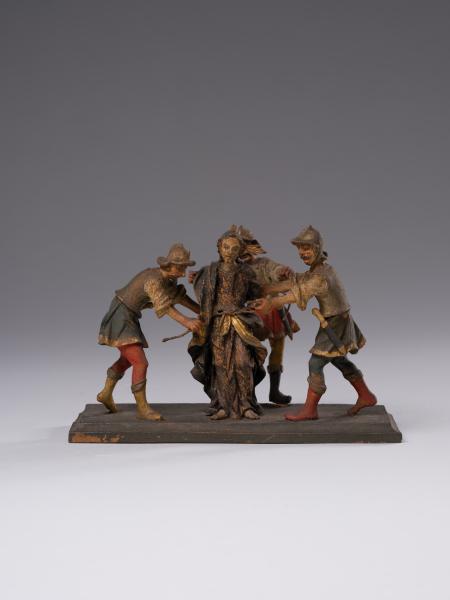
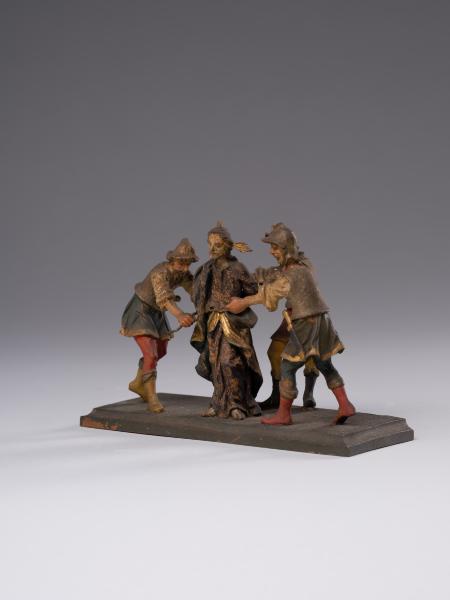
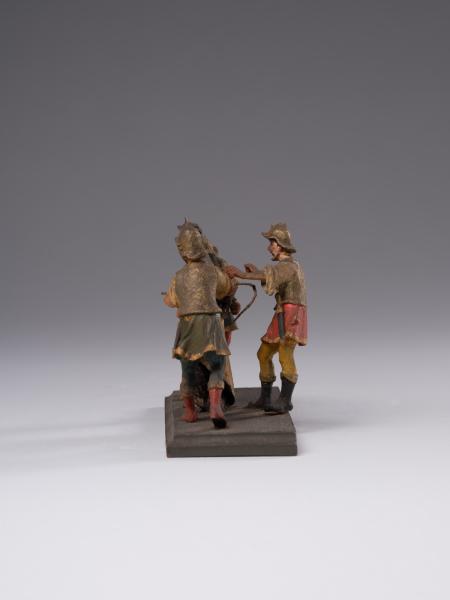
Jesus Before Pilate
unknown (Austrian School)


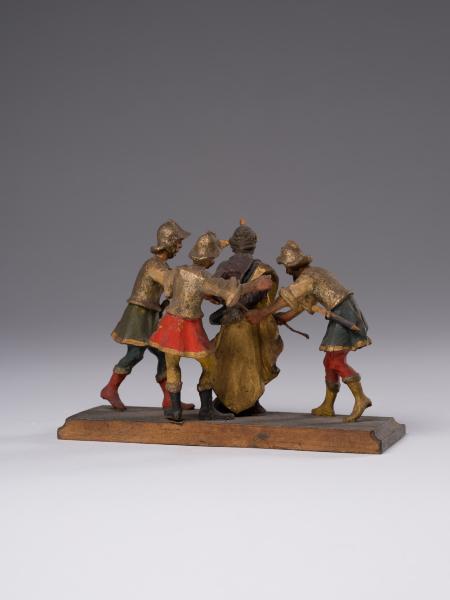
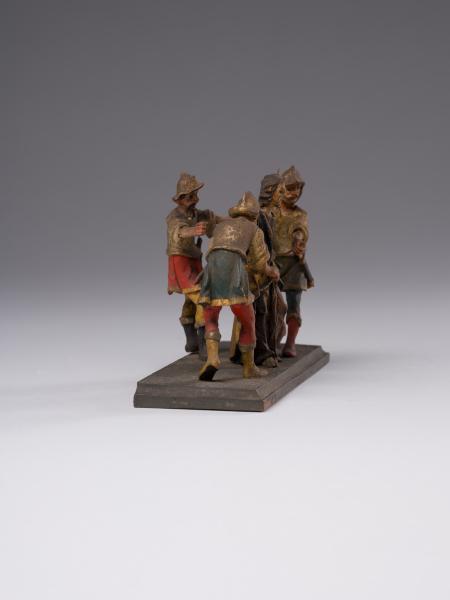
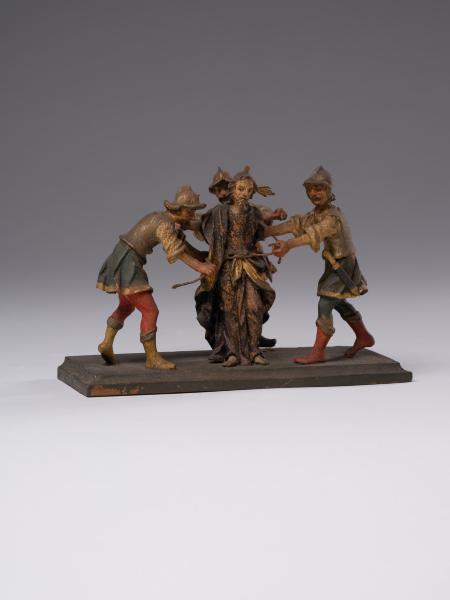
Basic information
- ID
- С-I-255
- Author
- unknown (Austrian School)
- Name
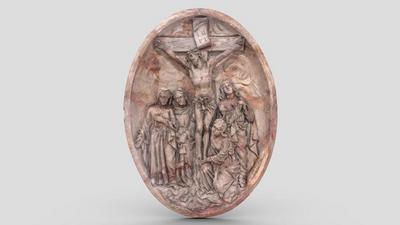
- Jesus Before Pilate
- Date of creation
- 18th c.
- Country
- Austria
- Culture
- Modern times
- Technique
- carving
- Material
- wood
- Dimensions (height x width x depth, cm)
- 15.5 x 5.5 x 10
Additionally
- Type
- sculpture
- Genre
- religious
- Plot
- Christ before Pilate
- Provenance
- Collection of Leon Pininski
Information about author
Object description
Pilate's Court is the trial of Jesus Christ by the Roman procurator of Judaea, Pontius Pilate, described in the Gospels. Pilate's trial is part of the Passion of Christ. According to the Gospel story, because the chief priests had sentenced Jesus to death and could not execute their sentence themselves, they brought him to the governor of the country (hegemon or praetor) in Judaea. At that time, the Roman governor was Pontius Pilate. Pilate came out to them and, seeing the members of the Sanhedrin, asked them: "What are you accusing this man of?" They answered: "If he were not a criminal, we would not have handed him over to you". Pilate told them, "Take him, and judge him according to your law". But they said to him, "We are not allowed to put anyone to death". And they began to accuse the Saviour, saying, "He corrupts the people and forbids them to pay taxes to Caesar, calling himself Christ the King". Pilate asked Jesus Christ: "Are you the King of the Jews?" Jesus Christ answered: "You say so". Then Pilate entered the Praetorium and called Jesus and asked Him again: "Are you not the King of the Jews?" Jesus Christ said to him, "Do you say this on your own, or have others told you about Me?" "Am I a Jew?" replied Pilate, "Your people and the chief priests have handed You over to me; what have You done?" Jesus said, "My kingdom is not of this world: if my kingdom were of this world, my servants (subjects) would fight for me, so that I might not be handed over to the Jews; but now my kingdom is not of this world." "So you are the King?" asked Pilate. Jesus answered, "You say that I am the King. I was born and came into the world to testify to the truth; everyone who is of the truth obeys my voice." From these words, Pilate saw that he was looking at a preacher of the truth, not a rebel who was opposing the Roman rule. Pilate said to Him: "What is the truth?" And without waiting for an answer, he went out to the Jews in the Gabbatha (stone courtyard) and declared: "I find no fault in Him". The chief priests and elders persisted, saying He was stirring up the people by teaching throughout Judaea, beginning in Galilee. Pilate heard about Galilee and asked, "Is He a Galilean?" When he found out that Jesus was from Galilee, he ordered Him to be brought before King Herod of Galilee, who was also in Jerusalem on the occasion of the Passover. Pilate knew that Jesus was innocent and was being falsely accused, so he was glad to get away from this unpleasant trial. When they brought the Lord Jesus Christ back to Pilate, many people, rulers and elders were gathered outside the Praetorium. Pilate called together the chief priests, the rulers, and the people and said to them, "You have brought this man to me who is alleged to be corrupting the people, and I have examined him before you and found him guilty of none of the things you accuse him of. I sent him to Herod, but he also found nothing in him worthy of death. So I should punish him and release him." Pilate said this because it was the custom of the Jews to release a prisoner chosen by the people at the Passover. He took this opportunity to say to the people: "You have a custom that I release a prisoner to you at the Passover; do you want me to release the King of the Jews?" Pilate was sure the people would ask for Jesus because he knew the rulers had handed Him over out of jealousy. But the chief priests and elders persuaded the people to ask for the release of Barabbas, the thief. Pilate asked them: "What do you want me to do with Jesus, the named Christ?" They shouted: "Crucify Him, crucify Him!" Then Pilate, trying to make the people feel sorry for Christ, ordered the soldiers to beat Him. The soldiers took Jesus Christ to the courtyard, stripped Him naked, and beat Him severely. Then they put on a scarlet robe (a short, sleeveless red garment that fastened on the right shoulder) and, having made a crown of thorns, put it on His head and gave Him a walking stick in His right hand instead of the king's staff. And they mocked him. They knelt down, worshipped Him, and said, "Hail, King of the Jews!" They spat on Him, took a cane and beat Him on the head and face. Then Pilate came out to the Jews and said: "Behold, I am bringing him out to you, that you may know that I find no fault in him". Then Jesus came out, wearing a crown of thorns and a crimson robe. Pilate said to them, '"Behold the Man!'" With these words, Pilate seemed to be saying, "Look how he is exhausted and disgraced", thinking that the Jews would pity him. When the chief priests and servants saw Jesus, they shouted again: "Crucify, crucify Him". Pilate decided to hand over an innocent Man to death rather than fall into disgrace with the emperor himself. He took water, washed his hands in front of the people and said, "I am not guilty of the blood of this righteous man; behold", and released the thief Barabbas and handed Jesus Christ over to be crucified. The story is depicted in numerous works of fine art and literature in various philosophical and imaginative interpretations. The work of an unknown eighteenth-century master is interpreted as a genre scene with the figures of the guards and Christ reproduced in detail.
Legal regulation
Borys Voznytskyi Lviv National Art Gallery