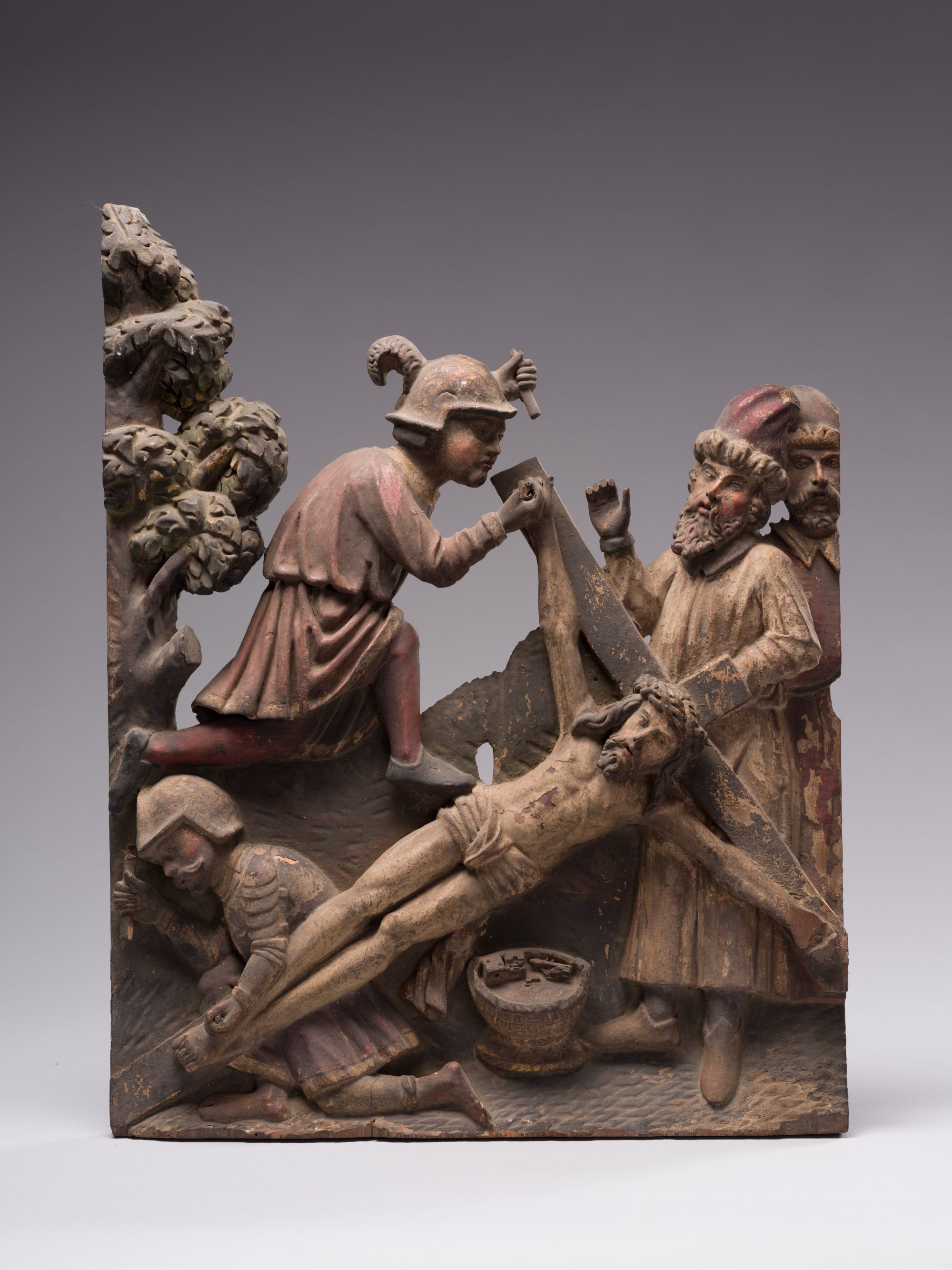
Nailing of Christ to the Cross (Crucifixion)
unknown (South German School)
Basic information
- ID
- С-I-238
- Author
- unknown (South German School)
- Name
- Nailing of Christ to the Cross (Crucifixion)
- Previous attributions
- Crucifixion. German School
- Date of creation
- early 16th c.
- Country
- Germany
- Culture
- Late Renaissance
- Technique
- carving polychromy
- Material
- wood
- Dimensions
- 45 x 35 cm (height x width)
Additionally
- Type
- sculpture sculpture (relief)
- Genre
- religious
- Plot
- Crucifixion The Passion of Christ
- Provenance
- Collection of Leon Pininski
Information about author
Object description
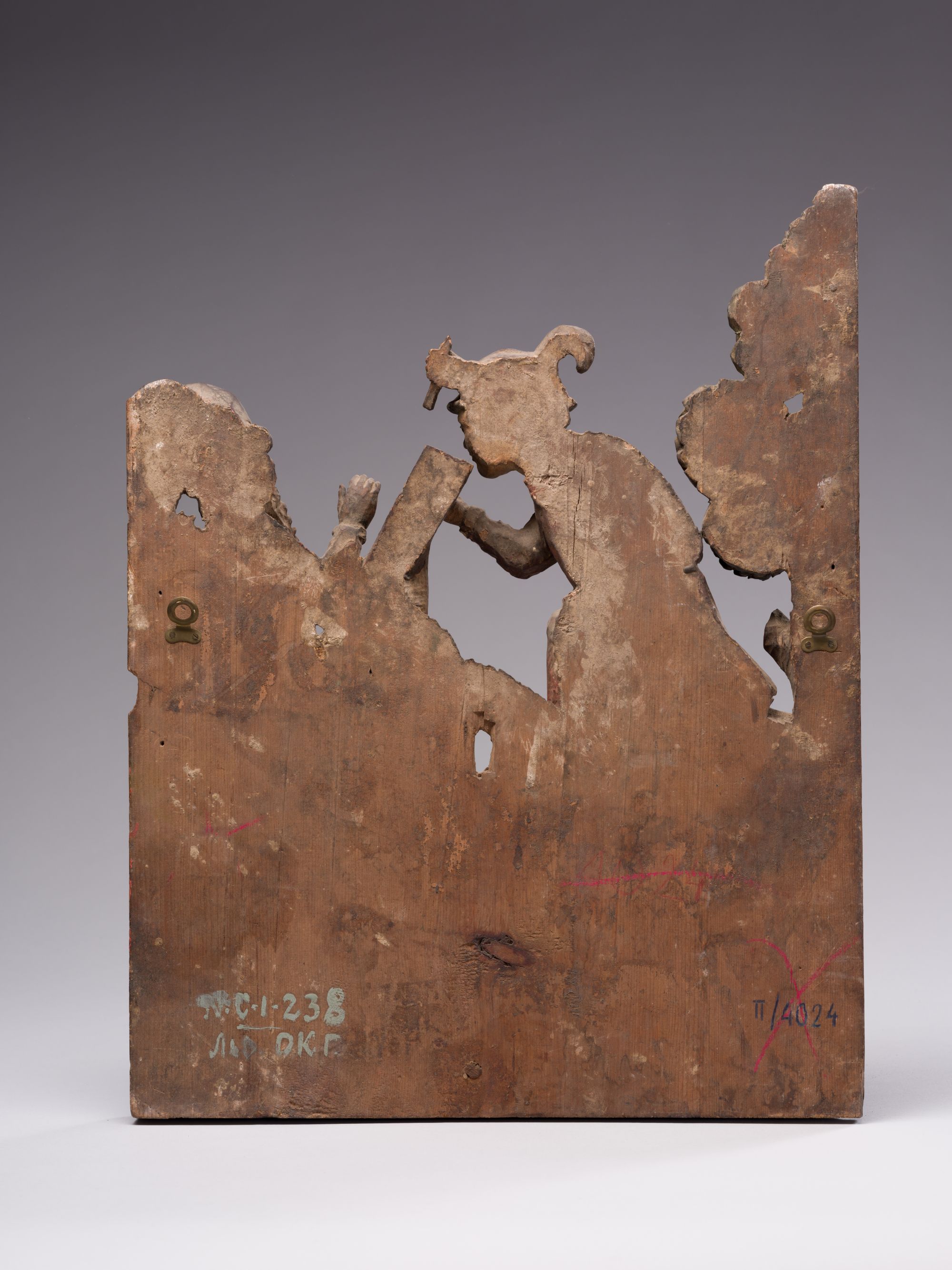
This piece belongs to a Gospel cycle that once adorned the interior of a provincial church in the South German region (Swabia – Bavaria – Tyrol). The series was executed by at least two carvers and a polychromist (Faßmaler). They were all members of the same workshop, which initially focused on church construction before shifting to interior decoration. Among the carvers was a more experienced master, who primarily crafted compositions featuring saints. The second hand was an artisan-carver whose work was less refined. This particular relief was executed by both masters.
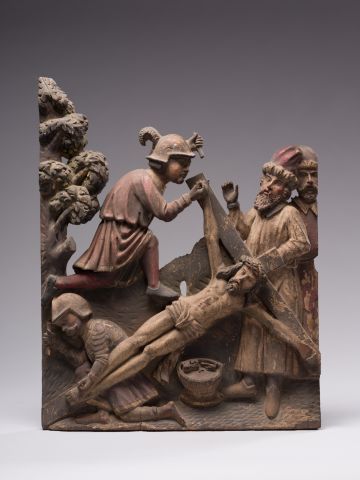
The high-relief carving presented in the collection belongs to a Passion of Christ cycle and depicts the Nailing to the Cross. The master carver projects the sacred history onto his contemporary medieval milieu. In the centre of the composition is the figure of Jesus, being crucified on the cross by soldiers. The image of the Saviour is rendered on a smaller scale than the other figures. He hangs powerlessly on the cross, no longer perceived as a living person. The crown of thorns, hair, and face of Christ are carved in intricate detail. The plastic modelling of the body, arms, and legs is distinguished by correct anatomical proportions.
The surrounding figures are filled with dynamics. The man on the right, wearing a red hat with a brim and a long tunic-cotte, personifies Pontius Pilate, repeating his iconographic type from the Ecce Homo scene. He stands over the cross, turned a quarter-turn to the left, directing the actions of the executioner-soldiers with his raised right hand. On his headdress, the original polychromy is best preserved – a red colour, which was characteristic of the attire worn by the elite. The prototype for this character was a wealthy burgher of a German town, presumably a member of the magistrate. Behind his back to the right, the figure of a man in a hat is visible en face, looking detachedly at the viewer.
In the upper part of the composition, the figure of a young executioner-soldier holding a hammer (now lost) is emphasised. On his head, he wears a sallet-type helmet (Schaller) – a characteristic German helmet of the 15th–16th centuries with a "tail" at the back, which replaced the traditional protective extension that previously covered the neck. In the image of this character, one can recognise a young townsperson. He is dressed in everyday attire, without knightly armour. Having placed a military helmet upon his head, the youth zealously participates in the execution of Christ. The second soldier is an older, moustachioed man wearing a helmet and a scale armour – lorica. Kneeling on one knee, he forcefully drives a nail into the crossed feet of the condemned Jesus.
At the top left, the composition is completed by a fragment of a tree with leaf-covered branches – typical of Central Europe. The work is executed in the traditions of late Gothic folk sculpture, showing the distinct influence of the latest Renaissance tendencies in plastic modelling.
Legal regulation
Borys Voznytskyi Lviv National Art Gallery