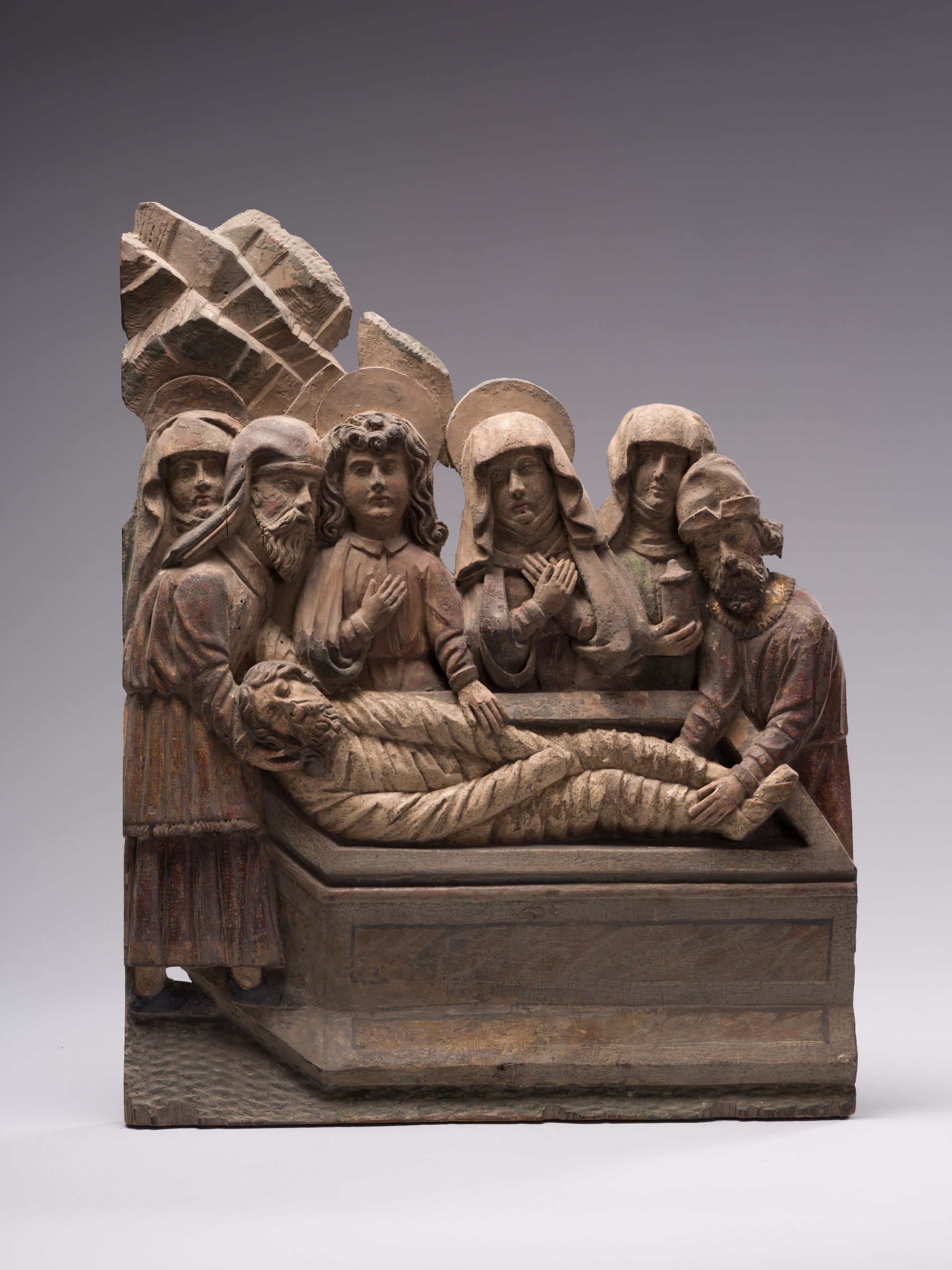
Entombment of Christ (The Burial of Christ)
unknown (South German School)
Basic information
- ID
- С-I-237
- Author
- unknown (South German School)
- Name
- Entombment of Christ (The Burial of Christ)
- Name in the original language
- Grablegung Christi
- Previous attributions
- Entombment of Christ. South Austrian School
- Date of creation
- early 16th c.
- Country
- Germany
- Culture
- Late Renaissance
- Technique
- carving polychromy
- Material
- wood
- Dimensions
- 44 x 35 cm (height x width)
Additionally
- Type
- sculpture sculpture (relief)
- Genre
- religious
- Plot
- Entombment of Christ The Passion of Christ
- Provenance
- Collection of Leon Pininski
Information about author
Object description
This piece belongs to a Gospel cycle that once adorned the interior of a provincial church in the South German region (Swabia – Bavaria – Tyrol). The series was executed by at least two carvers and a polychromist (Faßmaler). They were all members of the same workshop, which initially focused on church construction before shifting to interior decoration. Among the carvers was a more experienced master, who primarily crafted compositions featuring saints. The second hand was an artisan-carver whose work was less refined; he was tasked with depicting executioners, Pharisees, and other antagonists. This particular relief was executed by the more accomplished master.
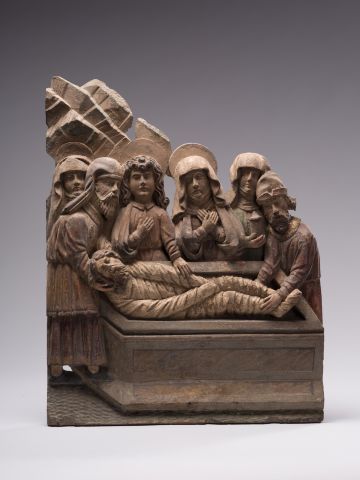
The high-relief carving presented in the collection belongs to a Passion of Christ cycle. The basis of its compositional structure consists of the figures standing over the body of Jesus. They are placing Him, completely wrapped in a white winding-sheet – the Shroud, into the tomb after the Deposition from the Cross. The half-length figures of John the Evangelist and the Mother of God are emphasised. The Apostle is depicted as a youth with long, wavy hair; he presses his right hand to his heart and touches Christ's hand with his left. To the right of John stands the Virgin Mary, her face partially covered by the hood of her maphorion. Mary's hands are crossed over her chest, and a circular halo is clearly distinguished above her head. Beside the Mother of God stands her sister, Mary of Clopas, holding a vessel with myrrh in her hand. Her head is also covered with a maphorion. The contrasts of light and shadow lend volume and fullness to the female images.
The tomb with powerful facets is depicted in the lower part of the relief. Christ's body is held by the head by Joseph of Arimathea, and by the legs by a secret disciple of Jesus, the Pharisee Nicodemus. Joseph – a Jewish elder who did not support the sentence against Jesus – is dressed in the traditional medieval attire of wealthy burghers. On his head, he wears a chaperon – a hood with a capelet. The fashion for this headdress lasted in German towns until the beginning of the 16th century. Nicodemus is dressed more modestly, wearing the attire of a middle-class citizen. A similar character can be seen in other reliefs of the cycle.
To the left of Joseph, another female face with a maphorion on her head is visible. This is one of the Myrrh-bearing Women. Possibly, her image personifies Mary Magdalene, who was also present at the burial of the Saviour. The composition is enriched by a schematically depicted rock mass at the top left, with relief-highlighted forms. The work is executed in the Late Gothic style, showing the distinct influence of Early Renaissance sculpture from the Franco-Burgundian and Italian schools.
Legal regulation
Borys Voznytskyi Lviv National Art Gallery